Race Across the World Board Game Review 2027: Is It Worth Buying?
Explore our Race Across the World Board Game review for 2027, covering gameplay, rules, four-route edition updates, player ratings, strategy, replayability and whether it's worth buying.


Contents
Few television programmes translate into a board game quite as naturally as Race Across the World. The BBC series is already built around competition, limited money, unpredictable journeys and difficult decisions.
Contestants must reach distant destinations without taking flights or relying on smartphones. Every journey presents the same dilemma: spend more money to travel quickly or conserve your budget and risk falling behind.
The Race Across the World Board Game attempts to recreate that experience around the dining table.
Players choose routes, manage their money, travel through different locations, complete jobs and deal with unexpected events. Winning requires reaching the final destination before everybody else.
The important development for buyers heading into 2027 is the 2026 edition, which UK retailers identify as having four routes across two double-sided gameboards, compared with the original version’s two routes.
But does the game offer enough strategic depth to remain interesting after several sessions? Or is its appeal mainly the familiar television branding?
We analysed the manufacturer’s information, the original published rules, specialist tabletop reviews and genuine customer feedback to evaluate its gameplay, strategy, replayability and value.
Our assessment is that Race Across the World works particularly well as an accessible family racing game, although experienced strategy gamers may find its reliance on dice and chance cards limiting.
Race Across the World Board Game Review: Quick Verdict
Our overall rating: 84% — 8.4/10
Race Across the World is an entertaining family adventure game built around one particularly effective mechanic: every decision has a cost.
Travelling quickly can consume your money. Working earns more cash but slows your progress. Taking a cheaper route can preserve your resources, although it might allow another player to reach the next checkpoint first.
These trade-offs make the game more interesting than a straightforward race determined entirely by dice.
Its strongest features are the recognisable television format, approachable rules, budgeting decisions and opportunities to change your strategy during the game.
The biggest weakness is that randomness sometimes has more influence than careful planning. An unexpected card or inconvenient dice roll can undermine a sensible decision.
The newer four-route edition improves the variety available to returning players.
Our Ratings at a Glance
| Review Category | Our Rating | Assessment |
| Gameplay and Decision-Making | 82% | Enjoyable route selection and budget management |
| Replayability | 81% | Four maps improve variety, although mechanics repeat |
| Accessibility | 91% | Easy to approach for families and casual gamers |
| Player-Group Suitability | 84% | Flexible for two to six players |
| Components and Value | 82% | Good amount of content for a family game |
| Theme and TV Adaptation | 92% | Strong recreation of the programme’s central challenges |
| Strategic Depth | 75% | Meaningful decisions, but significant randomness |
| Overall Rating | 84% | A well-designed, accessible family racing experience |
Our overall score is a rounded weighted editorial assessment: gameplay accounts for 30%, replayability 25%, accessibility 20%, player-group suitability 15%, and components and value 10%.
The theme and strategy scores are supplementary assessments rather than additional factors in the overall calculation.
These are our editorial evaluations of documented mechanics and published feedback, not results from an original playtest or a statistical customer survey.
Best for: Fans of the BBC series, families, casual strategy players and groups wanting a competitive game with simple rules.
Think twice if: You dislike luck-based movement, prefer highly complex strategy or expect a realistic travel simulation.
What Is the Race Across the World Board Game?
Race Across the World is a competitive tabletop adventure game based on the popular BBC travel competition.
Published under the IDEAL games brand by John Adams, it challenges players to travel across international routes while managing limited financial resources.
Every player races towards the same final destination.
However, not everybody will take the same route.
Some players may pay for quicker transportation. Others might choose cheaper journeys, stop to earn additional money or attempt to preserve enough cash for a final sprint.
The objective is straightforward: reach the finish line first.
Unlike the original Ticket to Ride board game, where players build railway networks and score points through completed routes, Race Across the World focuses on moving along travel routes while balancing speed, money and uncertainty.
Its challenge is not about collecting the most resources. It is about using limited resources efficiently enough to finish ahead of your opponents.
Game Details
| Feature | Information |
| Game | Race Across the World |
| Publisher | John Adams / IDEAL |
| Inspiration | BBC Race Across the World |
| Reviewed Version | 2026 four-route edition, assessed using available specifications |
| Original Version | Two-route game with one double-sided board |
| Players | 2–6 |
| Recommended Age | 8+ |
| Estimated Playing Time | Approximately 45–90 minutes, depending on route and group |
| Game Type | Family adventure and racing |
| Main Mechanics | Route selection, dice movement, budgeting, event cards |
| Travel Options | Boat, train, bus and walking |
| Main Objective | Reach the final destination first |
| Our Rating | 84% |
Playing time is an approximate planning range, not a guaranteed duration for every map.
What Changed in the Race Across the World Board Game in 2026?
One of the most important buying considerations for 2027 is that the original and 2026 versions should not be treated as identical.
Earlier reviews commonly describe a game containing a single double-sided board and two routes.
However, Argos explicitly labels its newer listing as the 2026 edition, containing two double-sided boards and four routes.
This is a meaningful improvement.
The original game already offered two different journeys, but experienced players had limited opportunities to change the geographic challenge.
The newer version introduces additional destinations and difficulty choices.
Original vs 2026 Edition
| Feature | Original Version | 2026 Edition |
| Gameboards | 1 double-sided board | 2 double-sided boards |
| Routes | 2 | 4 |
| Player Count | 2–6 | 2–6 |
| Age Recommendation | 8+ | 8+ |
| Chance Cards | 62 | 62 |
| Job Cards | 18 | 18 |
| Accommodation Cards | 20 | 20 |
| Travel Companion Cards | 9 | 9 |
| Playing Pawns | 6 | 6 |
| Main Objective | Reach the destination first | Reach the destination first |
The additional maps provide greater variety rather than evidence of a completely redesigned gameplay system.
We have not identified a separately announced 2027 rule revision as of November 2026. Therefore, our 2027 buying assessment uses the latest explicitly identified 2026 edition rather than assuming another version will be released.

Race Across the World 2026 edition showing the two double-sided boards and four available routes.
Which Routes Are Available in the Race Across the World Board Game?
The routes are one of the game’s defining features because they determine the journey that players must complete.
In the original edition, players could select either London to Singapore or Mexico City to Ushuaia.
The 2026 edition instead advertises four journeys associated with more recent series, including celebrity editions.
The Four Routes in the 2026 Edition
| Route | TV Series | Listed Difficulty |
| Beijing to Kanyakumari | Series 5 | Medium |
| Isla Mujeres to Cabo de la Vela | Celebrity Series 3 | Easy |
| Belém to Frutillar | Celebrity Series 2 | Medium |
| Sapporo to Lombok | Series 4 | Hard |
The four-map structure gives players a useful way to vary the experience.
A family learning the game may prefer beginning with the easy celebrity route before experimenting with one of the medium or hard journeys.
More experienced groups can choose a harder map to increase the challenge.
However, difficulty is not simply about geographic distance.
The shape of the route, available transportation, checkpoint positions and financial decisions can influence how demanding a journey becomes.
Our assessment is that the different maps provide the most significant practical improvement in the 2026 edition.
They also make the game more appealing to families who expect to play repeatedly.
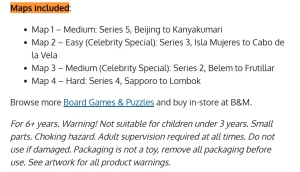
Four Race Across the World routes included in the 2026 board game, covering the standard and celebrity series.
Does the Board Game Include the 2026 Television Route?
The sixth television series, broadcast in 2026, took contestants from Palermo in Sicily to Hatgal in Mongolia.
That is different from the four routes identified in the 2026 board-game retail listings.
Buyers should not assume that a board game marketed as the 2026 edition automatically includes the route from the television series broadcast that year.
This distinction matters because retailers may continue carrying different printings.
Before purchasing, check the number of boards and the actual destinations listed on the packaging.
How Do You Play Race Across the World?
The rules are relatively approachable compared with many modern strategy board games.
Players travel along mapped routes, spend money on transportation and deal with the consequences of cards and checkpoints.
The following breakdown explains the core mechanics using the published original-edition rules. Owners of the four-route 2026 edition should follow the instructions supplied with their box if any values or procedures differ.
Step 1: Choose Your Map and Prepare the Game
Place the chosen board in the centre of the table.
Each participant selects a coloured playing pawn.
In the original edition, every player receives £900 in game money.
That starting amount is divided into:
- Five £100 notes
- Five £50 notes
- Five £20 notes
- Five £10 notes
Players then select a travel companion card at random.
The Chance, Job and Accommodation decks are placed in their designated positions.
One player can manage the bank, distributing money when somebody earns cash and receiving payments for transport or other expenses.
The original rules select the player whose birthday is next to begin.
Step 2: Choose a Travel Route
Players decide how they want to travel.
The principal options are boat, train, bus or walking.
Each transport type has advantages and disadvantages.
Faster options usually require greater expenditure, while cheaper journeys may require more movement turns.
Step 3: Pay for Transportation
The original published rules use the following standard fares unless the board specifies otherwise.
| Transport | Route Colour | Standard Fare |
| Boat | Blue | £150 |
| Train | Yellow | £100 |
| Bus | Green | £50 |
| Walking | Black | Free |
The appropriate coloured die determines movement.
Importantly, the fare is paid when embarking on a route, not after every dice roll along that same route.
This distinction makes careful route selection essential.
It also prevents the game from becoming a simple calculation in which players always choose the cheapest option.
Step 4: Roll the Dice and Move
After selecting and paying for a route, players roll the corresponding transport die.
Movement depends on the result.
Each transportation option creates a different balance between speed and cost.
However, an apparently efficient route can still become troublesome when unexpected events occur.
Players may encounter a Chance space, Accommodation stop, Job stop or major checkpoint.
Those locations can affect both their position and finances.
Step 5: Complete Jobs to Earn Money
Running low on money is one of the game’s most important challenges.
Players can visit Job stops to earn additional funds.
However, working involves sacrificing progress towards the final destination.
Under the original rules, players who cannot afford to continue must return to the nearest Job stop.
A player who manages their budget badly may therefore lose considerably more time than someone who plans ahead.
Step 6: Reach Checkpoints and Finish First
Players must visit the major checkpoints along their journey.
In the original rulebook, arrival order provides financial bonuses:
| Checkpoint Position | Bonus |
| First | £30 |
| Second | £20 |
| Third | £10 |
These rewards provide an incentive to travel efficiently, even when that requires some expenditure.
The game ends when a player reaches the final destination and wins the race.

Race Across the World board-game components showing the transportation routes, travel money, dice and event cards.
Is Race Across the World More About Strategy or Luck?
This is arguably the most important question for experienced board-game players.
Our strategic-depth rating is 75%.
Race Across the World contains genuine choices, but it is not a deep strategy game where the strongest player can reliably control every outcome.
We identify three main decision-making elements.
1. Managing Money
A successful player must continually assess how much cash they can afford to spend.
Paying for faster transport may provide an immediate advantage, but it can also create financial difficulties later.
Imagine two players beginning with £900.
Player A uses a £150 boat journey and two £100 train journeys, spending £350 on transport.
Player B uses three £50 bus journeys, spending £150.
| Example | Player A | Player B |
| Starting Budget | £900 | £900 |
| Transport Spending | £350 | £150 |
| Money Remaining | £550 | £750 |
Player A has spent £200 more.
Whether that expenditure is worthwhile depends on how much additional progress the faster journey creates.
This is an illustrative comparison using original-edition fares. It excludes cards, accommodation, bonuses and job income.
The important strategic principle is that speed must justify its cost.
2. Knowing When to Work
A Job stop is not automatically a disadvantage.
A player who deliberately earns money before a costly journey may be better positioned than somebody who travels quickly but subsequently becomes stranded.
However, working unnecessarily can be equally damaging.
Every turn spent earning money is a turn during which opponents may move closer to the destination.
The ideal approach is to earn enough to continue without accumulating excessive funds that will never be used.
3. Responding to Uncertainty
Chance and Accommodation cards can introduce unexpected costs, movement changes or other consequences.
These events force players to adapt rather than follow a fixed plan.
For casual gamers, this uncertainty is entertaining.
For serious strategy enthusiasts, it can be frustrating.
A clever route selection does not necessarily guarantee success when random events intervene.
This balance between dice, luck and tactical choices resembles the decision-making found in backgammon, although Race Across the World is substantially lighter in strategic complexity.
What Is the Biggest Weakness in the Gameplay?
Our main criticism is the limited control players have over unexpected events.
The game’s budgeting system initially suggests that careful planning will be decisive.
However, players cannot choose which Chance or Accommodation cards they receive.
That means two people making similarly sensible decisions can experience very different outcomes.
This creates three potential problems.
First, a player may lose their advantage through unfortunate card draws rather than poor strategy.
Second, a trailing player may find it difficult to recover if another financial setback occurs.
Third, repeated games may eventually reveal that many decisions have less strategic depth than they first appear to possess.
Specialist retailer Zatu’s published review awarded the original game 71%, identifying accessibility as a strength while highlighting its limited complexity and significant randomness.
Our assessment broadly agrees with that distinction.
Race Across the World is best judged as a family adventure game with strategic elements, not a sophisticated resource-management simulation.
Its unpredictable events may frustrate dedicated competitive players, but they also help create memorable moments for casual groups.
How Important Are the Travel Companion Cards?
Travel companions are one of the more distinctive parts of Race Across the World.
Instead of every participant beginning with identical advantages, players receive a companion with particular strengths and weaknesses.
These characteristics can affect the decisions available during the journey.
The game includes nine companion cards.
A useful companion might improve the value of a particular approach, while another could make certain decisions more costly.
This encourages players to consider their individual circumstances rather than automatically copying the strategy of their opponents.
It also creates some replay value.
Playing the same map with a different companion can change which decisions seem attractive.
Our assessment is that this mechanic makes the game feel more connected to the television programme, where the relationship between travelling partners often influences the outcome.
However, there is an important limitation.
Randomly assigned advantages and disadvantages do not necessarily create perfectly balanced competition.
An experienced player may be able to exploit a favourable companion more effectively, while another participant may struggle with a particularly inconvenient combination.
The companion system therefore adds variety rather than eliminating luck.
How Many Players Make Race Across the World Most Enjoyable?
The game supports two to six players.
However, the experience can change depending on the size of the group.
We would not recommend every player count equally.
| Players | Our Suitability Rating | Assessment |
| 2 | 77% | Direct competition but less group excitement |
| 3 | 89% | Good balance of interaction and pace |
| 4 | 92% | Our preferred balance for family gaming |
| 5 | 87% | More competition but potentially longer rounds |
| 6 | 82% | Lively group experience with greater downtime |
These are editorial suitability estimates based on the game’s structure, not measured playtest results.
Is It Good With Two Players?
Yes.
Two people can compete against each other without needing additional participants.
The simple race format remains functional, making it suitable for couples or siblings.
However, there is less opportunity for shifting rivalries or comparing different strategies.
A two-player game may also feel less dramatic if one participant establishes a substantial lead.
For couples seeking a deeper head-to-head strategy experience, other tabletop games may offer more meaningful tactical interaction.
Is Four Players the Best Number?
We consider four players the most promising group size.
It allows several competing journeys to develop without creating excessive waiting between turns.
A player who appears to be winning might suddenly encounter financial difficulties, while someone further behind could take advantage of a cheaper route.
These changing positions create much of the game’s entertainment.
With five or six participants, the race can become more socially engaging, but there are also more turns to wait through.
For families with several children, that extra downtime is worth considering.
Is Race Across the World Board Game Good for Families?
Our family accessibility rating: 91%.
This is one of the game’s strongest areas.
The recommended minimum age is eight, and the central concept is immediately understandable.
Players do not need extensive experience with modern board games.
The most important skills involve basic arithmetic, route selection, planning ahead and responding to unexpected outcomes.
Children can also develop an understanding of budgeting through play.
They quickly discover that money spent early cannot be used later unless additional funds are earned.
However, younger players may need occasional assistance understanding particular companion effects or deciding which transport options offer the best value.
Adults should also expect a degree of randomness.
This is not a game where every sensible decision leads to a predictable result.
For families exploring the wider tabletop market, our selection of the best board games includes alternatives that place greater emphasis on puzzles, strategy, cooperation or quick-play entertainment.
Race Across the World is most suitable for households that enjoy competition without needing complicated rules.
Does Race Across the World Have Good Replay Value?
Our replayability rating: 81%.
The 2026 edition makes a stronger case for repeated play than the original two-route version.
Four different maps provide more opportunities to vary the journey.
Different companion cards also influence the starting conditions.
Combined with random card effects and dice rolls, this means players should not expect identical outcomes every time.
Nevertheless, repeated sessions may expose limitations in the underlying mechanics.
Once players understand that the game mainly revolves around paying for routes, collecting cards, working and reaching checkpoints, the basic structure becomes familiar.
Unlike some hobby strategy games, it does not introduce extensive new systems as participants become more experienced.
For comparison, My Lil’ Everdell offers family-friendly resource management with a more developed emphasis on building combinations and planning efficient actions.
Race Across the World is generally easier to approach but has less room for sophisticated long-term optimisation.
Our recommendation is to vary the map and companions rather than repeatedly choosing the same journey.
The four-route edition is therefore the more attractive choice for somebody purchasing the game in 2027.
What Do Real Players and Reviewers Think?
Published opinions are generally positive about the game’s family appeal, although specialist reviewers differ over its strategic depth.
David Savage, reviewing the earlier version in January 2023, rated the game 5/5.
He described it as:
A fun and entertaining tv show based board game, especially if you like strategy.
His review particularly praised the combination of route selection, spending decisions and companion abilities.
That perspective is understandable.
For a household accustomed to traditional family games, Race Across the World offers a recognisable theme combined with several different types of decisions.
There is also positive customer feedback from more recent purchases.
Ollie Killinger, in a verified January 2026 product review, wrote:
Had all the family engaged. Great take on the tv show with lots of twists and laughs
That comment highlights one of the game’s strongest qualities: it can create enjoyment even when participants are not concentrating on advanced strategy.
However, specialist coverage is less uniformly enthusiastic.
Zatu’s 71% assessment of the original game offers a more cautious perspective, particularly around the amount of chance involved and its limited complexity.
The original version also received a 5/5 rating from What’s Good to Play in February 2024.
These different assessments suggest that enjoyment depends substantially on the expectations of the players.
Families looking for an accessible competitive adventure are likely to appreciate it more than enthusiasts seeking intricate strategic mechanics.
Importantly, the older professional reviews primarily concern the original two-route version. They should not be presented as independent playtests of the 2026 four-route edition.
How Does Race Across the World Compare With Other Board Games?
Race Across the World is not the only tabletop game built around competition, planning and uncertainty.
However, its balance of travel, budgeting and television-inspired entertainment gives it a distinctive position.
| Game | Main Gameplay | Strategic Complexity | Best Audience |
| Race Across the World | Travel, budgeting and racing | Light–medium | Families and travel-show fans |
| Ticket to Ride | Railway network building | Medium | Route-planning enthusiasts |
| Cluedo | Mystery and deduction | Light–medium | Families who enjoy solving puzzles |
| The Traitors | Bluffing and social deduction | Light–medium | Lively groups of older players |
| My Lil’ Everdell | Resource collection and building | Light–medium | Families wanting structured strategy |
Race Across the World vs Ticket to Ride
Both games involve geography and route selection.
However, their objectives are different.
Ticket to Ride requires players to build connections and complete destination objectives, while Race Across the World asks players to complete a journey before their opponents.
Ticket to Ride offers stronger competition over route ownership and network development.
Race Across the World focuses more directly on budgeting, travel costs and unexpected events.
We would choose Ticket to Ride for players seeking greater strategic consistency.
Race Across the World is more suitable for people attracted to the television concept.
Race Across the World vs The Traitors
These games adapt two very different BBC competition formats.
Race Across the World relies on movement, spending decisions and managing uncertainty.
The Traitors Board Game is centred on deception, secret identities and accusations.
The Traitors generally works better for a group that enjoys discussion, persuasion and bluffing.
Race Across the World is preferable for families wanting more structured progression around a physical board.
It also supports smaller groups.
Race Across the World vs Cluedo
The Cluedo board game rewards information gathering and logical deduction.
Players must work out the solution to a mystery rather than complete a physical journey.
Cluedo generally offers greater control over intellectual decision-making, although dice movement can still influence the pace.
Race Across the World provides a more direct sense of progress and a stronger travel-adventure theme.
The better choice depends on whether the group prefers investigation or racing.
How Much Does Race Across the World Cost in the UK?
Price is an important consideration because the game competes with many other family titles.
When we examined UK listings in November 2026, prices varied by retailer and available edition.
| Retailer | Listed Price | Important Detail |
| John Adams | £24.99 | Publisher listing describing the original two-route contents |
| Argos | £22.00 | Explicitly lists the 2026 edition |
| B&M | £19.99 | Lists the four-route game |
| Menkind | £25.00 | Check the edition before purchasing |
These are November 2026 price observations, not confirmed 2027 prices. Promotions, stock and delivery charges can change.
We would recommend examining the product contents rather than choosing solely on price.
A discounted original edition may be perfectly suitable for someone who only expects to play occasionally.
However, a small price difference could justify choosing the newer edition with four maps.
Is It Good Value for Money?
Consider a household buying the board game for £22.
If four people play it eight times, the cost can be spread across 32 individual player sessions.
| Financial Measure | Example |
| Purchase Price | £22 |
| Games Played | 8 |
| Players Per Game | 4 |
| Total Individual Player Sessions | 32 |
| Cost Per Group Game | £2.75 |
| Cost Per Player Per Game | £0.69 |
These figures are illustrative and exclude incidental costs.
The calculation demonstrates how a reusable physical game can provide relatively inexpensive entertainment when played regularly.
However, value depends on genuine repeated use.
A household that enjoys the game twice and then leaves it unused will not achieve the same value as one that regularly organises game nights.
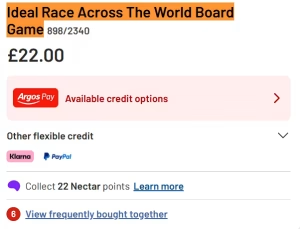
Race Across the World 2026 board-game price and edition details from an official UK retailer listing.
What Are the Best Strategies for Winning Race Across the World?
Although luck plays a role, thoughtful decision-making can improve a player’s opportunities.
Our recommendations focus on managing financial risk and avoiding unnecessary delays.
- Avoid spending heavily at the beginning: Expensive transport can help establish a lead, but spending too much early may force additional job stops later.
- Compare the cost of alternative routes: A more expensive journey should provide a worthwhile improvement in progress.
- Consider your companion’s abilities: The same route may be more attractive for one companion than another.
- Do not wait until you have no money: Planning a useful Job stop can be better than being forced backwards because you cannot afford to continue.
- Treat checkpoints as strategic milestones: Arriving ahead of opponents can provide benefits beyond simply gaining ground.
- Preserve enough cash for unexpected events: Chance and Accommodation cards may introduce additional financial pressure.
- Change your approach near the finish: Money has less value if the game ends with it unused, so aggressive transport spending may become more attractive in the final stages.
- Avoid copying the current leader automatically. Different financial positions and companions may justify different routes.
- Understand the correct edition rules: The older and newer maps differ, and any changes in the supplied instructions should take priority over advice based on the original version.
- Accept that not every defeat reflects a strategic mistake: Random events are part of the game design, and even carefully planned journeys can go wrong.
The strongest approach is usually a flexible strategy rather than a rigid commitment to always travelling quickly or always spending as little as possible.
What Are the Main Pros and Cons?
What We Like?
- Recognisable theme: The game’s central decisions closely reflect the BBC programme.
- Easy to learn: Players can understand the basic objective without an extensive rules explanation.
- Meaningful budgeting: Money management introduces decisions beyond simply rolling dice.
- Multiple transport options: Different routes encourage tactical thinking.
- Family accessibility: The recommended age of eight makes it suitable for a broad audience.
- Companion cards: Different strengths and disadvantages provide variation.
- Four-route edition: The 2026 update improves the selection of available journeys.
- Flexible player count: Two to six people can participate.
What Could Be Better?
- Significant randomness: Chance cards and dice can undermine careful planning.
- Limited strategic depth: The main decisions may become predictable after repeated sessions.
- Potential downtime: Games involving five or six players can take longer.
- Edition confusion: Retailers may still show older product details.
- Basic playing pieces: The physical components are functional rather than particularly luxurious.
- Possible runaway leads: Some combinations of early advantages and unfortunate setbacks can make recovery difficult.
These limitations do not prevent the game from being entertaining.
They simply make it better suited to casual family competition than serious tournament-style strategy.
Who Should Buy Race Across the World in 2027?
We would recommend Race Across the World to families who enjoy the television programme and want an approachable board game built around the same decisions.
The game is particularly suitable for households with children aged eight or older, groups of three or four participants and people who enjoy travel-themed entertainment.
It is also a sensible gift for somebody who watches the BBC series but does not regularly play modern board games.
The theme helps newcomers understand what they are trying to achieve.
We would be more cautious about recommending it to gamers who dislike unpredictable outcomes or expect extensive control over their decisions.
It may also disappoint people looking for a detailed simulation involving realistic transport schedules, geographic accuracy or complex financial planning.
Race Across the World deliberately simplifies those experiences.
Its purpose is to create an entertaining race, not simulate every challenge of international travel.
For buyers choosing between editions, the four-route 2026 version is the more attractive option when prices are reasonably close.
Race Across the World Board Game Final Verdict
Race Across the World succeeds because it converts the central dilemma of its television inspiration into an approachable tabletop experience.
Every player wants to move quickly, but speed costs money.
Every opportunity to earn additional funds comes with a potential delay.
Every checkpoint creates another reason to reconsider the journey ahead.
That tension gives the game its personality.
Its strategy is not especially complicated, and there is more luck involved than serious tabletop enthusiasts may prefer.
However, the simpler mechanics make the experience accessible to families who might find a heavier strategy game intimidating.
The addition of four routes in the 2026 edition strengthens its long-term appeal, particularly for owners who want to explore different journeys rather than repeat the same map.
Our assessment is that the game’s strengths are best appreciated when playing socially, rather than analysing every decision as a mathematical problem.
For families and fans of the programme, the combination of route selection, spending decisions and unpredictable events makes it an enjoyable choice.
For experienced strategy players, the limited complexity may make it more suitable as an occasional lighter game.
Our Final Rating: 8.4/10 — 84%
Best for: Families, BBC travel-show fans and groups of three or four.
Think twice if: You dislike randomness or want a highly complex strategy game.
Verdict: An enjoyable travel-themed family game with meaningful budgeting decisions, accessible rules and improved route variety in its 2026 edition. Worth considering for 2027, especially if you can purchase the four-route version at a competitive price.
Frequently Asked Questions
Is Race Across the World a Good Board Game?
Yes. It is an enjoyable family racing game combining route selection, limited money and unpredictable events. Our editorial rating is 84%, reflecting its accessibility, recognisable theme and straightforward gameplay.
How Many Players Can Play Race Across the World?
The game supports two to six players. We consider three or four players the strongest potential balance between competition, interaction and waiting time.
What Age Is Race Across the World Board Game Suitable For?
The recommended age is eight years and above. Younger participants may need occasional assistance with financial calculations or companion-card effects.
How Long Does Race Across the World Take to Play?
Allow approximately 45–90 minutes as a practical estimate. The selected route, number of participants and familiarity with the rules can influence the duration.
What Is Different About the 2026 Edition?
The 2026 edition is advertised with four routes across two double-sided boards. The original version contained two routes on one double-sided board.
Can You Play Race Across the World With Two People?
Yes. The game supports two-player competition. However, a larger group may create a livelier experience with more competing journeys.
Is Race Across the World Better Than Ticket to Ride?
That depends on player preferences. Race Across the World provides a lighter travel-adventure experience with budgeting and random events. Ticket to Ride generally offers deeper route-planning strategy and more competition over the board’s network.
Is the Race Across the World Board Game Worth Buying in 2027?
For fans of the programme and families looking for an accessible competitive game, yes. The 2026 four-route edition is especially worth considering because it provides more journey choices than the original. Check that the box contains the version you expect before purchasing.
Score
An accessible, entertaining travel race with strong family appeal and enough budgeting strategy to keep decisions interesting.