The Traitors Board Game Review: Is It Worth Playing in 2026?

Contents
Few television formats seem better suited to a tabletop adaptation than The Traitors. Secret identities, accusations, bluffing, alliances and last-minute betrayals already sound like the ingredients of a social deduction game.
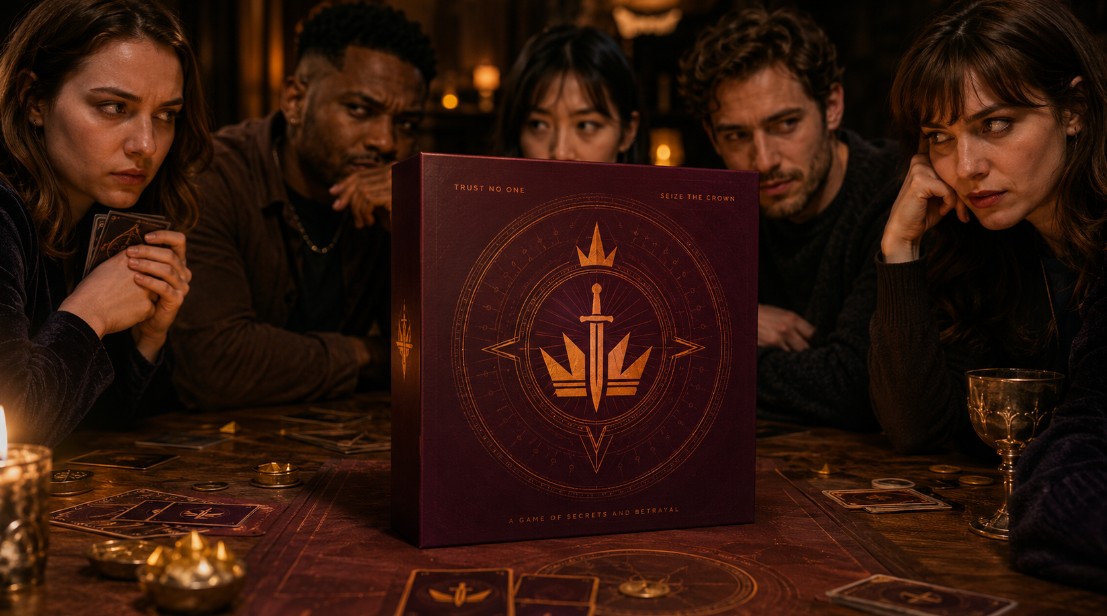
The Traitors Board Game attempts to recreate that experience around the dining table, putting one player secretly in the role of the Traitor while the Faithful try to identify them before it is too late.
The current Second Edition was released in the UK on 5 August 2026, bringing six new adventures while retaining the missions, Round Table, murders and final betrayal that define the game. It is designed for 4–6 players aged 12 and over.
But does it actually feel like The Traitors, or is the television licence doing most of the work?
The Traitors Board Game Review: Quick Verdict
Gaming Mag rating: 8/10
The Traitors Board Game works best as a lively party game rather than a deep strategy title. Its biggest strength is how quickly it creates suspicion between players. Completing missions while simultaneously watching for unusual behaviour gives everyone something to talk about when the Round Table begins.
Fans of the programme will recognise the structure immediately, while the relatively simple mechanics mean occasional board game players should not feel overwhelmed.
The limitations are equally clear. With only four to six players, the social deduction element can occasionally feel smaller and more predictable than the television programme, and the adventure-based format places limits on long-term replayability.
For a group of friends or family members who enjoy bluffing, accusations and theatrical game nights, however, The Traitors Board Game is genuinely entertaining rather than simply another television tie-in.
| Review Category | Gaming Mag Score |
| Gameplay | 8/10 |
| Theme | 9/10 |
| Social Interaction | 9/10 |
| Strategy | 7/10 |
| Components | 8/10 |
| Replay Value | 7/10 |
| Overall | 8/10 |
What Is The Traitors Board Game?
The Traitors Board Game is a social deduction and party game inspired by the television series.
At the beginning, players receive secret roles. Most become Faithfuls, while one player becomes the Traitor.
Everyone participates in missions designed to earn gold, but the Traitor has another objective operating in the background. They must complete secret assignments without drawing attention to themselves.
After missions come accusations and voting at the Round Table. The Faithful are looking for suspicious behaviour, while the Traitor needs to lie convincingly enough to redirect attention towards somebody else.
The game then incorporates familiar elements including:
- Missions
- Gold for the prize pot
- Secret Traitor assignments
- The Armoury
- Shields and rewards
- Round Table voting
- Murders
- Banishments
- A final split-or-betray decision
The current Second Edition includes six adventures, giving groups different scenarios through which to experience the core formula.
How Does The Traitors Board Game Work?
The basic structure is surprisingly easy to understand once the first round gets moving.
Players initially discover whether they are Faithful or the Traitor without revealing their role to anyone else.
A mission then begins.
The group generally needs to cooperate to complete the challenge and increase the amount of gold available. Meanwhile, the Traitor may have a secret task they are attempting to perform unnoticed.
This creates the game’s best psychological trick.
Even though everybody is supposed to be concentrating on the mission, Faithful players inevitably start analysing everyone else.
Why did someone move that card?
Why did they suddenly suggest changing the strategy?
Why are they being unusually quiet?
Was that mistake genuine?
The missions therefore provide more than points or gold. They generate the evidence, or imagined evidence that drives the discussion afterwards.
Is the Round Table the Best Part?
Almost certainly.
The Round Table is where The Traitors Board Game comes closest to capturing the television programme.
Players discuss their suspicions before voting for the person they believe could be the Traitor. Once someone becomes convinced that another player is guilty, completely innocent actions can suddenly become evidence.
That is exactly what a good social deduction game should produce.
The system becomes particularly entertaining when the Traitor successfully plants suspicion elsewhere. A confident accusation can redirect the entire table, and players quickly discover that appearing too defensive can be just as dangerous as behaving suspiciously.
It is less about complicated tactical calculations and more about reading personalities, bluffing and persuading the room.
For the right group, that can generate considerably more entertainment than another game built around moving pieces around a board.
How Faithful Does It Feel to the TV Show?
The theme is one of the game’s strongest areas.
Instead of merely attaching The Traitors branding to an unrelated board game system, the designers have incorporated many of the programme’s recognisable stages.
Players complete missions, visit the Armoury, accuse suspects at the Round Table and encounter murders before eventually reaching an endgame involving trust and betrayal.
The physical game contains a Round Table board and spinner alongside mission, Armoury, role, reward and voting cards, plus gold pieces, gold bars, voting stands and six blindfolds.
The blindfold sequences are particularly theatrical, although they can also introduce one practical problem: in a quiet room, players may hear where somebody is moving. Other reviewers have similarly identified keeping the Traitor’s movements genuinely secret as one of the game’s weaker elements.
A little background noise can make those sections work more effectively.
Is The Traitors Board Game Actually Strategic?
Yes, although this is not a heavyweight strategy game.
There are two layers of strategy happening simultaneously.
Playing as a Faithful
Faithful players need to observe what happens during missions rather than simply concentrating on completing them.
A strong Faithful will remember:
- Who behaved differently during important moments
- Which players repeatedly made strange decisions
- Who immediately supported particular accusations
- Whether someone appears to be manipulating the group
- Which behaviours could indicate a secret assignment
The difficulty is separating actual evidence from coincidence.
Playing as the Traitor
The Traitor has a much more psychologically demanding role.
They need to complete hidden objectives without looking like they are completing hidden objectives.
Sometimes the best approach is subtlety. At other times, behaving almost too obviously can create enough uncertainty that other players dismiss the action as impossible for a real Traitor.
The Traitor also benefits from understanding the personalities around the table. Knowing who is persuasive, who becomes defensive and who follows other people’s accusations can be more important than mastering the board itself.
Does It Work With Four Players?
Technically, yes.
The game supports four to six players, but six is likely to produce the strongest social deduction experience.
With only four players, there are fewer suspects and therefore fewer places for the Traitor to hide. Once players begin eliminating possibilities, suspicions can become concentrated very quickly.
This has also been identified in external play testing, where four-player sessions were described as feeling too small for the deduction system to reach its full potential.
Five players is considerably better.
Six is the sweet spot.
With a full group, accusations become less predictable, competing theories develop naturally and the Traitor has more opportunities to redirect suspicion.
What Is the Biggest Weakness?
Replayability has historically been the game’s biggest criticism.
The original board game used six adventures. Once a group had seen the missions and understood their hidden elements, replaying them could reveal information that was supposed to remain secret. Owners raised exactly this concern, arguing that knowledge of completed adventures significantly reduced the value of subsequent plays.
The situation is better in 2026.
An official Traitors Board Game Expansion Pack now adds another six adventures, complete with new missions and Armoury assignments.
There is also now a Second Edition containing six new adventures, meaning buyers searching for the game in 2026 should pay close attention to which edition they are purchasing.
That improves longevity considerably, although this still is not an infinitely replayable social deduction game.
Its adventures are experiences to discover rather than systems designed to remain completely unknown after dozens of plays.
What Is Inside The Traitors Board Game Second Edition?
The Second Edition contains a surprisingly substantial collection of components:
| Component | Quantity |
| Round Table game board with spinner | 1 |
| Mission cards | 32 |
| Armoury cards | 32 |
| Role cards | 11 |
| Reward cards | 12 |
| Gold pieces | 30 |
| Gold bars | 15 |
| Voting cards | 48 |
| Voting card stands | 6 |
| Blindfolds | 6 |
The physical pieces help make the game feel like an event rather than simply another deck of hidden-role cards.
How Long Does The Traitors Board Game Take?
Players should allow roughly an hour to 90 minutes, particularly while learning the rules.
Some groups will move through sessions faster once everybody understands the different phases, but discussion is deliberately a major part of the experience.
A heated Round Table can easily take longer than expected.
That is not necessarily a flaw.
If everybody is arguing passionately about who sabotaged a mission, the game is doing exactly what it is supposed to do.
Is The Traitors Board Game Good for Families?
Yes, provided younger players are comfortable with bluffing and social deduction.
The recommended age is 12+, which feels appropriate.
There is nothing particularly difficult about moving pieces or managing complicated calculations. The greater challenge is understanding deception, recognising suspicious behaviour and being able to defend yourself during accusations.
Families with teenagers should get considerably more from it than families with very young children.
It is also a strong option for Christmas gatherings because people who rarely play modern board games can understand the central premise quickly — especially if they already watch The Traitors.
Who Will Enjoy The Traitors Board Game Most?
The game is particularly well suited to:
- Fans of The Traitors
- Groups of five or six players
- Families with teenagers
- Friends who enjoy bluffing games
- Players who like social deduction
- Christmas and party game nights
- Groups that enjoy arguing their case and accusing each other
It is less suitable for people who prefer quiet, highly tactical board games where victory depends mainly on long-term strategic planning.
The personalities around the table matter enormously.
A lively group willing to accuse, bluff and debate can turn an ordinary round into something memorable.
A group that quietly completes every mission before voting without discussion will miss most of what makes the game interesting.
The Traitors Board Game vs The Traitors Card Game: Which Is Better?
They target slightly different experiences.
The card game is the more compact option. It is easier to carry, quicker to set up and better suited to players wanting a lighter version of the social deduction concept.
The board game is the more theatrical choice.
The physical Round Table, missions, voting stands, blindfolds, Armoury and gold system create a much closer approximation of participating in the television programme.
For dedicated fans of the show, the board game is therefore the stronger experience.
For occasional players wanting something faster and easier to take anywhere, the card game may make more sense.
Is The Traitors Board Game Worth Buying?
For fans of The Traitors, yes especially when played with five or six people.
This is not the deepest social deduction game available, and serious tabletop gamers may find its strategy comparatively light. Its adventure structure also means replayability remains more limited than games built around endlessly randomised roles and scenarios.
But judging it purely as a strategy game misses the point.
The appeal comes from watching a perfectly innocent player become the main suspect because of one strange decision. It comes from a Traitor convincingly accusing a Faithful. It comes from everyone analysing meaningless gestures and then discovering that the person they trusted most was lying.
Those moments are where the game succeeds.
Gaming Mag Final Verdict
The best thing about The Traitors Board Game is not the board, the gold or even the missions. It is what happens between the players.
The game provides enough structure to create suspicion and then allows the personalities around the table to do the rest.
The missions keep everyone involved, the Round Table produces the biggest laughs and arguments, and playing the Traitor provides exactly the kind of uncomfortable pressure fans of the programme will want.
The limited player count and adventure-based replayability stop it from becoming an essential social deduction classic, but the newer Second Edition and available expansion make the package considerably easier to recommend in 2026.
Gaming Mag score: 8/10
Best for: The Traitors fans, families and groups of five or six.
Think twice if: you mainly play with two or three people or want a highly replayable competitive strategy game.
Verdict: A surprisingly convincing tabletop recreation of The Traitors that succeeds because it turns friends and family into suspicious, argumentative amateur detectives.
Frequently Asked Questions
How many people can play The Traitors Board Game?
The Traitors Board Game is designed for four to six players, with five or six generally providing the strongest deduction experience.
What age is The Traitors Board Game suitable for?
The official recommended age is 12 years and over.
Is The Traitors Board Game the same as the card game?
No. The board game provides a larger experience built around missions, the Round Table, the Armoury, gold and physical components. The card game is more compact.
Can The Traitors Board Game be played more than once?
Yes, although individual adventures lose some mystery after players know their hidden mechanics. The Second Edition contains six new adventures, while an expansion pack provides another six.
Is The Traitors Board Game difficult to learn?
The first game may require some rule checking because several phases are involved, but the basic Faithful-versus-Traitor concept is straightforward once play begins.
Is The Traitors Board Game good with four players?
It works with four, but five or six players provide more suspects and generally create better bluffing and Round Table discussions.
Is The Traitors Board Game worth it for people who do not watch the show?
It can still work as a social deduction party game, but fans of the television programme will get considerably more from the theme, terminology and recreated moments.
Score
Convincing, tense and entertaining.