How to Play Ticket to Ride?: Complete Rules, Scoring, Strategy and Beginner’s Guide
Learn how to play Ticket to Ride with easy-to-follow rules, setup instructions, scoring tips and winning strategies. Explore the differences between Ticket to Ride Europe, London and the original board game.

Contents
Learning how to play Ticket to Ride is surprisingly straightforward. Winning, however, requires considerably more than collecting colourful train cards and placing railway pieces across a map.
At its heart, Ticket to Ride is a strategy board game about connecting cities, completing hidden travel objectives and competing for valuable railway routes before other players claim them.
The rules are simple enough for a family game night, yet the decisions involve resource allocation, timing, risk management and strategic planning.
A player might spend several turns collecting the cards needed for an important connection, only to discover that an opponent has claimed it first. That single decision can turn a promising railway network into a costly detour.
We analysed the official rules, scoring systems and strategic differences between the original Ticket to Ride board game, Ticket to Ride Europe and Ticket to Ride London.
One conclusion stands out: the strongest strategy is rarely to build the most railway lines. It is to build the connections that create the greatest scoring opportunities while controlling risk.
This guide explains everything from setting up your first game to calculating final scores, avoiding common mistakes and choosing the right edition.
What Is the Ticket to Ride Board Game?
Ticket to Ride is a railway-themed board game designed by Alan R. Moon and originally released by Days of Wonder in 2004.
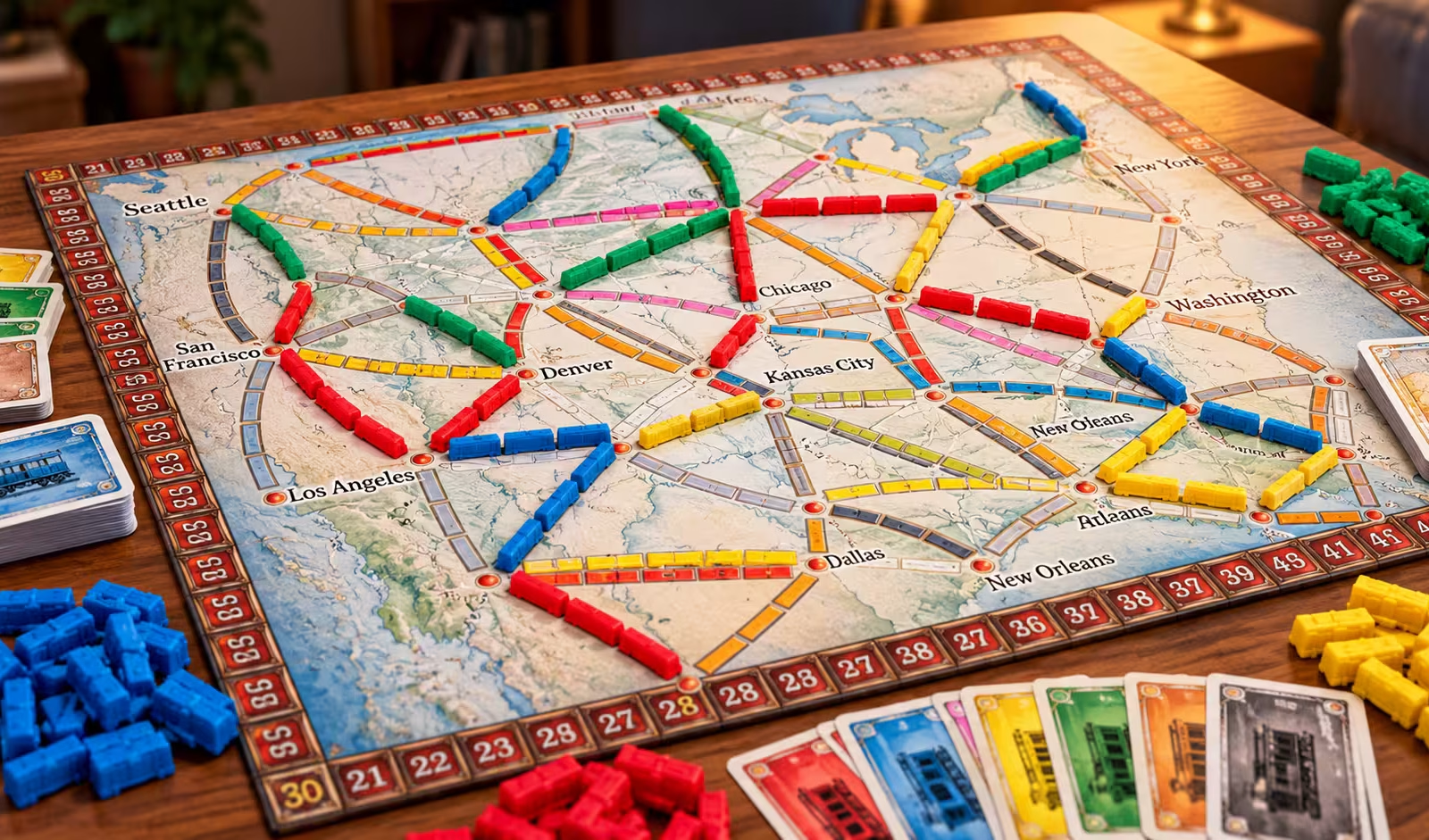
Players compete to build railway networks connecting cities across North America. They collect matching coloured train cards, spend those cards to claim routes and attempt to complete secret Destination Tickets.
The central objective is to finish the game with the highest total score, rather than simply building the longest railway network or placing all your trains first.
| Game Details | Original Ticket to Ride |
| Designer | Alan R. Moon |
| Original release | 2004 |
| Publisher | Days of Wonder |
| Players | 2–5 |
| Recommended age | 8+ |
| Playing time | 30–60 minutes |
| Game category | Route-building strategy |
| Main objective | Score the most victory points |
| Main mechanics | Card collection, route claiming and network planning |
| Main map | North America |
| Difficulty | Beginner-friendly with strategic depth |
The original game won the prestigious Spiel des Jahres award in 2004, helping establish it as one of the most recognisable modern family strategy games.
Its enduring appeal comes from a simple structure: players have only three possible actions on their turn, but choosing the right one can significantly influence the final result.
Unlike games heavily dependent on dice, Ticket to Ride combines uncertain card draws with decisions players can control.
For players exploring the wider tabletop gaming market, it remains a notable inclusion among the best board games for families and adults, particularly because it introduces meaningful strategy without requiring extensive preparation.
What Do You Need to Play Ticket to Ride?
Before starting, identify the main components and understand their roles.
The current North American edition contains the following:
| Component | Quantity | Purpose |
| Game board | 1 | Displays the railway network |
| Plastic trains | 225 playable trains | 45 per player across five colours |
| Train cards | 110 | Used to claim railway routes |
| Destination Tickets | 33 | Provide secret connection objectives |
| Scoring markers | 5 | Track points during gameplay |
| Longest Path bonus card | 1 | Awards 10 additional points |
| Rulebook | 1 | Explains gameplay and scoring |
Some boxes contain spare plastic trains, which should not be added to the standard allocation of 45 per player.
The train cards include eight route colours and 14 multicoloured Locomotive cards.
Locomotives function as wild cards, meaning they can replace cards of other colours when claiming routes.
Destination Tickets are different. They show two cities that players must connect using their railway network, along with a point value awarded or deducted at the end.
Understanding this distinction is important because collecting train cards helps build routes, while completing Destination Tickets determines whether those routes deliver sufficient strategic value.
How Do You Set Up Ticket to Ride Before Playing?
Correct setup prevents several common beginner mistakes, particularly around the starting tickets and available train pieces.
Step 1: Prepare the Game Board
Place the North American railway map in the centre of the table so every player can see the available routes.
Each city is connected to neighbouring cities through coloured or grey railway spaces.
Step 2: Distribute the Trains
Each player chooses a colour and receives 45 plastic trains and the matching scoring marker.
Place each scoring marker on zero on the scoring track around the board.
Keep unused trains in front of their owners so the remaining supply can be monitored.
Step 3: Deal the Train Cards
Shuffle the Train Car deck and give four cards to every player.
Place the remaining cards face down beside the board.
Turn five cards face up next to the deck. These cards form the shared display from which players can collect resources.
If three or more of the five visible cards are Locomotives, immediately discard the entire display and replace it with five new cards.
Step 4: Distribute Destination Tickets
The current 2025 North American rulebook instructs players to receive four Destination Tickets initially.
Each player must retain at least two, although keeping three or four is permitted.
Any rejected tickets are returned according to the rulebook’s setup instructions.
Important edition difference: Older North American editions commonly begin with three Destination Tickets rather than four, while still requiring players to keep at least two.
Always follow the rulebook supplied with your particular printing.
Step 5: Prepare the Bonus Card
Place the Longest Path bonus card beside the board.
It will award 10 points to the player or players with the longest continuous railway path when the game finishes.
Step 6: Choose the First Player
Select a starting player using an agreed method.
Turns then proceed clockwise.
Every player begins with the same core opportunities, but their secret tickets create different strategic priorities.
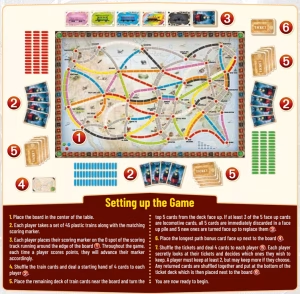
Official Ticket to Ride setup showing the North American board, player trains, Train Car cards, Destination Tickets and starting positions.
How Do You Play Ticket to Ride Step by Step?
The entire game revolves around three possible actions.
On your turn, you must choose exactly one:
- Draw Train Car cards.
- Claim one railway route.
- Draw additional Destination Tickets.
You cannot perform multiple actions during the same turn.
For example, you cannot collect two train cards and immediately use them to claim a route. Claiming that route must wait until a subsequent turn.
This restriction creates the game’s central strategic tension. Every turn spent accumulating resources is a turn that could have been used to secure a valuable railway connection.
Action 1: Collect Train Car Cards
You can normally draw two Train Car cards during your turn.
Cards can be collected from the five face-up cards or drawn blindly from the top of the deck.
You may choose one visible card followed by another visible card, one blind card followed by another blind card, or a combination of the two.
Whenever a face-up card is taken, replace it immediately.
The main exception involves Locomotives.
If you take a face-up Locomotive, it must be your first card and you cannot collect a second card that turn.
However, a Locomotive drawn blindly from the deck counts as a normal draw, allowing you to take another card.
There is no maximum hand size, so players can accumulate as many Train Car cards as they wish.
The practical consideration is whether holding additional cards is worth delaying construction.
Action 2: Claim a Railway Route
Claiming routes converts the cards in your hand into permanent railway connections on the board.
Every route contains a fixed number of spaces, with a colour indicating which cards are required.
Suppose a route between two neighbouring cities contains three blue spaces.
To claim it, you could discard:
- Three blue Train Car cards.
- Two blue cards and one Locomotive.
- One blue card and two Locomotives.
- Three Locomotives.
After discarding the required cards, place one of your plastic trains on every space of the route.
The entire route must be claimed in a single turn.
You cannot place one train now and finish the remaining spaces later.
You also cannot use more plastic trains than you have available.
An important rule that beginners frequently misunderstand is that a newly claimed route does not need to connect to an existing railway network.
You may claim any open, legally available route anywhere on the map.
This flexibility allows players to secure critical connections before completing the rest of their network.
What Happens With Grey Routes?
Grey railway routes do not require a particular printed colour.
Instead, players can choose any one colour and use a matching set of cards to claim the route.
For example, a four-space grey route could be claimed using four red cards or three green cards plus a Locomotive.
You cannot simply combine unrelated colours unless Locomotives are being used as wild cards.
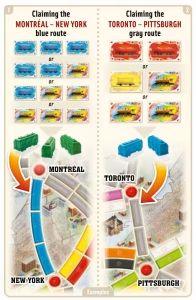
Official rules demonstrating how matching Train Car cards and Locomotives are used to claim coloured and grey railway routes.
Action 3: Draw Additional Destination Tickets
Instead of collecting cards or building a route, you may draw three new Destination Tickets.
You must keep at least one ticket from those drawn.
Any others are returned to the bottom of the ticket deck.
Tickets you previously accepted cannot be discarded later.
This makes accepting additional objectives a potentially rewarding but risky choice.
Imagine that your railway already connects Chicago, Pittsburgh and New York.
A newly drawn Destination Ticket involving two cities already connected by your network could provide additional points without requiring any more trains.
By contrast, accepting a ticket involving distant cities may force you to spend several turns constructing an entirely new railway.
We consider this one of the most significant strategic decisions in Ticket to Ride because an unsuccessful ticket does not merely produce zero points. It creates a direct scoring penalty.
How Does Ticket to Ride Scoring Work?
Ticket to Ride uses a cumulative scoring system.
Players earn points when claiming routes, then adjust their scores at the end according to completed tickets, failed tickets and the Longest Path bonus.
Points for Claiming Railway Routes
Longer railway routes generate disproportionately more points.
| Route Length | Points Earned | Points per Train |
| 1 train | 1 | 1.00 |
| 2 trains | 2 | 1.00 |
| 3 trains | 4 | 1.33 |
| 4 trains | 7 | 1.75 |
| 5 trains | 10 | 2.00 |
| 6 trains | 15 | 2.50 |
The scoring system creates a clear efficiency difference.
Three separate two-train routes use six trains and generate only six route points.
One six-train route also uses six trains but generates 15 points.
That represents 150% more route points for the same number of plastic trains, while also requiring fewer route-claiming actions.
Nevertheless, longer routes are not automatically the strongest decision.
A short railway connection might complete several Destination Tickets simultaneously, creating a higher total return than a long route that serves no important objective.
The ideal strategy balances immediate route points against the broader value of the railway network.
Completing Destination Tickets
Each Destination Ticket displays two cities and a point value.
If your own railway network connects the specified cities, you earn the ticket’s printed value at the end of the game.
If you fail, the same value is deducted.
For example:
| Destination Ticket Result | Points |
| Completed ticket worth 12 | +12 |
| Completed ticket worth 8 | +8 |
| Incomplete ticket worth 10 | −10 |
| Net ticket score | +10 |
A completed ticket does not require the shortest possible connection.
Any continuous path of your own trains between the named cities qualifies.
The same railway network can also complete multiple Destination Tickets.
The Longest Continuous Path Bonus
The original game awards 10 points for the longest continuous path of connected trains owned by one player.
A path may bend through several cities or include loops.
However, individual train pieces cannot be counted twice when determining its length.
Separate railway branches cannot simply be added together if doing so would require retracing the same train pieces.
If multiple players tie for the longest path, all tied players receive the 10-point bonus.
Example of Final Scoring
Consider this hypothetical result:
| Scoring Category | Points |
| Railway routes claimed | 67 |
| Completed Destination Tickets | +31 |
| Incomplete Destination Tickets | −9 |
| Longest Path bonus | +10 |
| Final score | 99 |
The player with the highest total wins.
If scores are tied, the player who completed the most Destination Tickets wins. If the tie remains, the Longest Path bonus is considered, with an unresolved tie resulting in a shared victory.
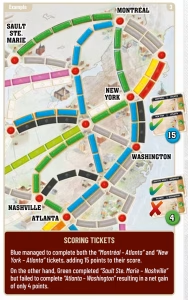
Ticket to Ride final scoring rules showing Destination Ticket rewards, failed-ticket penalties and the 10-point Longest Path bonus.
How Do Double Routes Work in Ticket to Ride?
Some neighbouring cities are connected by two parallel railway routes.
These are called double routes.
A single player cannot claim both sides of a double route.
In games involving four or five players, different players may claim the two parallel routes.
However, games involving only two or three players follow a stricter rule.
Once either side is claimed, the remaining parallel route becomes unavailable to everyone.
This rule significantly increases competition for particular connections when fewer people are playing.
From a strategic perspective, it changes the value of railway bottlenecks.
A route that appears to offer two alternatives may effectively become a single available connection in a smaller game.
Players should therefore consider group size when deciding how urgently to secure important routes.
When Does a Game of Ticket to Ride End?
The game does not finish simply because one player has placed most of their trains.
The final round begins when a player ends their turn with two or fewer plastic trains remaining.
At that point, every player, including the person who triggered the ending, receives one final turn.
After those turns are completed, the final scores are calculated.
For example, suppose a player has five trains remaining and claims a four-space route.
They now have one train left.
This triggers the final round, giving everyone one last opportunity to claim a route, collect cards or draw tickets.
A common mistake is ending the game immediately after the triggering player finishes. Doing so unfairly removes the final turn to which every participant is entitled.
What Are the Best Strategies to Win Ticket to Ride?
Although Ticket to Ride is approachable for beginners, winning consistently requires planning beyond the next available route.
Our analysis of the scoring mechanics suggests that the strongest decisions involve balancing three variables: resource efficiency, route availability and the probability of completing objectives.
1. Prioritise Overlapping Destination Tickets
Two Destination Tickets that share part of the same railway network can be considerably more efficient than two disconnected objectives.
If both tickets require travel through Chicago, for example, a single connecting route might contribute towards both.
This reduces the number of trains needed and frees turns for additional scoring opportunities.
Before keeping your opening tickets, look for shared cities, overlapping corridors and achievable connections.
2. Secure Critical Routes Before Collecting Everything
Players sometimes hold train cards for too long while waiting to build an ideal network.
The danger is that opponents may claim essential connections during that period.
Game designer Alan R. Moon explained his design philosophy through the official publisher, saying:
“I love route building games and I love railroads”
His emphasis on simplifying route-building is visible in the game’s core tension: deciding when to collect resources and when to commit them.
We view a vital railway bottleneck as an asset with a limited window of availability.
Securing it early can be more valuable than holding additional cards for a potentially higher-scoring route elsewhere.
3. Measure the Opportunity Cost of Every Turn
Ticket to Ride rewards efficient decisions, not simply aggressive construction.
Every turn has an opportunity cost.
Drawing cards delays route construction. Drawing tickets delays both. Claiming a route can protect a connection but consumes cards that might serve another purpose.
A useful question is:
Will this action improve my final position more than the alternatives available right now?
For example, claiming a two-space route worth two points may be worthwhile if it completes a 15-point Destination Ticket.
If it serves no objective and does not protect an important connection, collecting cards for a longer route could be more efficient.
4. Think Carefully Before Drawing More Tickets
New Destination Tickets can increase your score considerably, particularly when your existing network already covers a substantial part of the map.
However, the downside can be equally significant.
Consider a purely hypothetical ticket worth 10 points.
If you estimate a 75% chance of completing it, the simplified expected ticket value would be:
(75% × 10) − (25% × 10) = 5 expected points.
This is an illustrative calculation, not a measured probability or guaranteed outcome.
It also excludes the additional cards, turns and possible detours required.
The practical lesson is that a promising ticket should be evaluated according to the railway connections you already own, the remaining time and any routes your opponents control.
5. Preserve Locomotives for Important Connections
Locomotives provide flexibility because they can replace almost any required colour in the original game.
Their greatest value often comes when a critical route needs just one additional card.
However, using several Locomotives to claim an unimportant short route may leave you unable to secure a more valuable connection later.
Collecting a face-up Locomotive also uses the entire drawing action.
That makes it worth considering whether one wild card is better than two ordinary cards.
6. Monitor Opponents’ Train Supplies
The final round can arrive earlier than inexperienced players expect.
Pay attention to how many trains each opponent has left.
If another player has only a handful remaining, consider whether your unfinished Destination Tickets can realistically be completed.
At that stage, adding another ticket may create unnecessary risk.
Protecting your existing score can be more important than pursuing speculative opportunities.
7. Build Flexible Railway Networks
A network with multiple connecting options is generally more resilient than one dependent on a single vulnerable route.
Try to avoid situations where losing one connection makes several tickets impossible to complete.
This is particularly valuable in the original North American edition, where stations cannot rescue a blocked route.
8. Avoid Obsessing Over the Longest Path
The 10-point bonus is useful, but it should not automatically dominate your strategy.
A player who sacrifices multiple achievable tickets to extend their longest route may lose more points than the bonus provides.
The better approach is to pursue the bonus when it complements your existing railway objectives.
What Is Different About the Ticket to Ride Europe Board Game?
The Ticket to Ride Europe board game retains the core mechanics of the original but introduces additional features that make railway planning more flexible and occasionally more unpredictable.
The board covers major European cities, including London, Paris and Berlin, rather than North America.
The main additions are tunnels, ferries and train stations.
| Feature | Ticket to Ride Europe |
| Players | 2–5 |
| Playing time | 30–60 minutes |
| Recommended age | 8+ |
| Railway map | Europe |
| Starting trains | 45 per player |
| Special features | Tunnels, ferries and stations |
| Unused station bonus | 4 points per station |
| Longest path bonus | 10 points |
During initial setup, players receive one long Destination Ticket and three regular Destination Tickets, retaining at least two in total.
The four possible actions on a Europe turn are drawing Train Car cards, claiming a route, drawing Destination Tickets or building a station.
How Do Tunnels Work?
Tunnel routes are identified by their special outlines.
After playing the cards required for a tunnel, the player reveals the top three cards of the Train Car deck.
For each revealed card that matches the colour used, including applicable Locomotives, the player must provide an additional matching card or Locomotive.
For example, a player attempting a three-space red tunnel might initially play three red cards.
If the three revealed cards contain two cards that trigger an extra payment, the player must provide two additional suitable cards.
If the player cannot or chooses not to pay, the attempt fails and the initially played cards return to their hand.
The turn is still consumed.
This introduces uncertainty into route construction, making spare cards particularly useful when attempting important tunnels.
How Do Ferries Work?
Ferries represent routes crossing water.
Certain spaces display Locomotive symbols, and these symbols must be paid for using Locomotive cards.
For example, a ferry route containing four spaces with two Locomotive symbols requires at least two Locomotives, plus appropriate cards for the remaining spaces.
Unlike ordinary grey routes, ferry connections cannot always be claimed using only standard coloured cards.
How Do Train Stations Work?
Train stations are one of the most significant additions in Ticket to Ride Europe.
Each player starts with three station pieces.
A station allows a player to use one railway route belonging to another player that enters or leaves the station’s city when checking whether their Destination Tickets are complete.
The station does not transfer ownership of the route or award the route’s points.
Building stations costs cards:
| Station Built | Required Payment |
| First station | 1 Train Car card |
| Second station | 2 matching Train Car cards |
| Third station | 3 matching Train Car cards |
The cost depends on how many stations you have previously built, not on the location.
Every station remaining unbuilt in your supply is worth four points at the end.
Three unused stations therefore provide 12 points.
Stations also do not contribute other players’ borrowed routes to your Longest Path bonus.
Are Train Stations Worth Building?
This is where a financial-style cost-benefit comparison becomes useful.
Building one station sacrifices the four-point bonus you would have earned by leaving it unused.
However, suppose that station allows you to complete a Destination Ticket worth 12 points that would otherwise remain incomplete.
Instead of losing 12 points, you gain 12 points.
That creates a 24-point scoring improvement.
After accounting for the four-point unused-station bonus sacrificed, the improvement is 20 points, before considering the card and turn costs.
This illustrates why stations can function as strategic safeguards rather than merely construction features.
They should be used when the value of completing an otherwise blocked ticket justifies the cost.
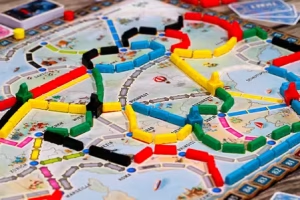
Official Ticket to Ride Europe board and components, showing the expanded railway network and the stations that distinguish the European edition.
How Do You Play Ticket to Ride London?
Ticket to Ride London is a smaller, faster, standalone version of the railway-building game.
Instead of travelling between cities across a continent, players construct transport routes through London using colourful double-decker buses.
The game recreates the atmosphere of 1970s London, incorporating familiar places such as Buckingham Palace, King’s Cross and the British Museum.
It is particularly suitable for people who want the basic Ticket to Ride experience without committing to a full-length session.
| Feature | Ticket to Ride London |
| Players | 2–4 |
| Playing time | 10–15 minutes |
| Recommended age | 8+ |
| Player vehicles | 17 buses each |
| Transportation cards | 44 |
| Destination Tickets | 20 |
| Main map | London |
| Special scoring mechanic | District bonuses |
| Longest Path bonus | No |
Ticket to Ride London Setup
The setup follows the familiar structure but uses fewer components.
Each player takes 17 buses in their chosen colour and the matching scoring marker.
Players begin with two Transportation cards and two Destination Tickets.
At least one of the two starting Destination Tickets must be kept.
Five Transportation cards are placed face up beside the drawing deck.
Taking Turns in Ticket to Ride London
The three available actions remain similar:
- Draw Transportation cards.
- Claim a bus route.
- Draw new Destination Tickets.
However, when drawing new Destination Tickets, players draw two rather than three and must keep at least one.
The multicoloured double-decker bus cards work as wild cards.
Taking a visible wild card uses the whole card-drawing action.
Players claim routes using the appropriate card colours and place their buses on the matching spaces.
How Do District Bonuses Work?
London introduces a scoring feature called Districts.
Locations belonging to the same district share identifying colours and numbers on the board.
If a player connects every location belonging to one district using their own bus routes, they earn the district’s printed point value.
This creates an additional incentive to build compact and connected networks.
A small collection of strategically placed routes may complete a Destination Ticket while simultaneously securing a district bonus.
That can make a short connection more valuable than its immediate route score suggests.
When Does Ticket to Ride London End?
The final round begins when a player finishes their turn with two or fewer buses remaining.
Every player receives one final turn, including the triggering player.
Final scoring includes claimed routes, completed and failed Destination Tickets, and completed District bonuses.
There is no original-game Longest Path bonus in London.
The highest score wins, with completed Destination Tickets used to break a tie. If the tie remains, victory is shared.
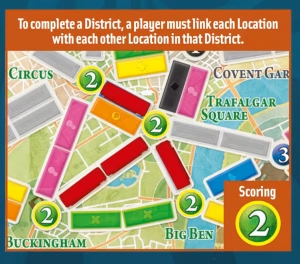
Official Ticket to Ride London rules explaining District bonuses and how connecting locations within a district contributes to the final score.
Which Ticket to Ride Version Is Best for Beginners?
The original, Europe and London editions all share accessible rules, but their strategic depth and time requirements differ.
| Feature | Original | Europe | London |
| Players | 2–5 | 2–5 | 2–4 |
| Playing time | 30–60 min | 30–60 min | 10–15 min |
| Transport pieces | Trains | Trains | Buses |
| Tunnels | No | Yes | No |
| Ferries | No | Yes | No |
| Stations | No | Yes | No |
| District bonus | No | No | Yes |
| Longest Path bonus | Yes | Yes | No |
| Main appeal | Pure route strategy | Flexible, layered strategy | Quick, accessible games |
| Suggested audience | New tabletop players | Families wanting more variety | Casual players and short sessions |
Our preference depends primarily on the time available and the experience of the players.
The original version offers the clearest introduction to the relationship between card collection, railway control and destination objectives.
Europe adds more strategic flexibility through stations while introducing uncertainty through tunnels.
London offers the shortest learning-to-playing cycle, making it particularly useful for younger players and families with limited time.
Readers who enjoy approachable resource-management games may also appreciate My Lil’ Everdell’s family strategy gameplay, which uses a different set of mechanics but similarly rewards efficient decisions.
How Do We Rate Ticket to Ride in 2026?
For this comparison, we evaluated the three editions through gameplay design, replayability, accessibility, suitability for different groups and overall setup and value.
These ratings represent research-based editorial judgements, not independently measured customer satisfaction percentages or claims of hands-on playtesting.
The weighting is 30% gameplay, 25% replayability, 20% accessibility, 15% group suitability and 10% setup, components and value.
| Assessment Category | Original | Europe | London |
| Gameplay and decision-making | 93% | 96% | 87% |
| Replayability | 90% | 95% | 87% |
| Accessibility | 93% | 94% | 97% |
| Suitability for different groups | 94% | 96% | 82% |
| Setup, components and value | 88% | 92% | 88% |
| Overall editorial rating | 92% | 95% | 88% |
The original game scores strongly because it provides a straightforward introduction to strategic decision-making while retaining meaningful replayability.
Europe earns our highest assessment because stations, tunnels and ferries introduce new tactical choices without transforming the underlying gameplay into something substantially harder to learn.
London performs especially well in accessibility, although its smaller map and shorter sessions naturally offer a more condensed experience.
These distinctions matter when considering value for money.
The most suitable purchase is not necessarily the edition with the greatest number of mechanisms. It is the version that matches how frequently and with whom it will actually be played.
What Common Mistakes Should New Ticket to Ride Players Avoid?
New players often lose points through misunderstandings that are easy to prevent.
| Common Mistake | Correct Rule or Better Approach |
| Drawing two cards after taking a face-up Locomotive | A face-up Locomotive uses the entire drawing action |
| Claiming multiple routes in one turn | Only one route may be claimed per turn |
| Mixing unrelated colours for grey routes | Use one colour, with Locomotives where needed |
| Using an opponent’s routes for tickets | Only your own routes count in the original game |
| Claiming both sides of a double route | A single player cannot own both |
| Assuming both double routes remain available with two players | Only one side may be claimed in two- and three-player games |
| Starting with too many plastic trains | Each player receives 45 in the original game |
| Forgetting incomplete ticket penalties | Uncompleted tickets deduct their printed points |
| Ending immediately when someone has two trains left | All players receive one final turn |
| Treating stations as ordinary railway pieces | Europe stations only help complete tickets using specified opponent routes |
| Adding separate railway branches to the Longest Path | The same train piece cannot be counted twice |
The most expensive mistakes usually involve Destination Tickets.
A player may appear comfortably ahead on the scoring track before the final calculation, only to lose substantial points because several secret objectives remain unfinished.
How Can Beginners Learn Ticket to Ride Faster?
The best way to learn is to separate the mechanics from advanced strategy.
For the first game, concentrate on four questions:
- Which cities do my Destination Tickets require me to connect?
- What cards do I need to claim the routes between them?
- Which connections might another player take first?
- How many trains and turns will I need to finish?
Once those questions become familiar, the strategic possibilities become easier to understand.
The original Ticket to Ride is particularly effective for this learning process because all players use the same basic actions throughout the game.
There are no complicated technology trees, lengthy character abilities or extensive special powers to memorise.
For readers who enjoy board games where positional planning becomes increasingly important with experience, learning the rules and strategies of backgammon offers another useful introduction to managing risk and anticipating an opponent’s decisions.
Final Thoughts: Is Ticket to Ride Worth Learning?
Ticket to Ride succeeds because its mechanics are accessible while the decisions become increasingly interesting with experience.
New players see a colourful railway map and a straightforward card-collection game. More experienced players recognise a competition over scarce routes, limited turns and competing objectives.
That balance makes it suitable for families, casual players and people who enjoy strategy without committing to lengthy rulebooks.
Our comparative assessment favours Ticket to Ride Europe at 95%, followed by the original at 92% and London at 88%. Nevertheless, all three offer worthwhile experiences for different audiences.
For someone learning how to play Ticket to Ride for the first time, the most useful approach is simple: concentrate on completing achievable Destination Tickets, secure essential routes before opponents and treat every turn as an opportunity to improve your final scoring position.
Once those fundamentals become familiar, the difference between an ordinary railway network and a winning one becomes much clearer.
Frequently Asked Questions
Is Ticket to Ride Easy to Learn?
Yes. Ticket to Ride is designed for beginners and families. Most players can understand the three main turn actions quickly, although learning the best route-building strategies takes longer.
How Many People Can Play Ticket to Ride?
The original Ticket to Ride and Europe editions support two to five players. Ticket to Ride London supports two to four players.
How Many Train Cards Can You Draw?
Normally, you can draw two Train Car cards per turn. If you take a face-up Locomotive, it counts as your only draw for that turn.
Can You Claim Two Routes in One Turn?
No. Players may claim only one route during a turn, regardless of how many Train Car cards they hold.
Can You Build Routes Anywhere on the Board?
Yes. A route does not have to connect to railway lines you previously claimed, provided it remains available and you can pay the necessary cards.
What Happens If You Cannot Complete a Destination Ticket?
You lose the number of points printed on the incomplete ticket when calculating the final score.
Do You Have to Use All Your Trains?
No. You do not have to place all 45 trains to win. The endgame begins when a player ends their turn with two or fewer trains remaining.
Can Two Players Share the Longest Route Bonus?
Yes. If multiple players tie for the longest continuous path, each tied player receives the 10-point bonus.
Can You Play Ticket to Ride Online?
Yes. Digital adaptations of Ticket to Ride allow players to enjoy railway-building gameplay without a physical board. Available features and supported platforms depend on the particular digital edition.
Is Ticket to Ride Europe Better Than the Original?
Europe provides additional features such as stations, ferries and tunnels, which may appeal to players who enjoy more tactical options. The original remains preferable for those wanting a more direct route-building experience.
Is Ticket to Ride London a Full Game or Expansion?
Ticket to Ride London is a standalone game. It has its own board, cards and bus pieces, so owning the original Ticket to Ride is unnecessary.
Can You Play Ticket to Ride With Two Players?
Yes. The original and Europe editions both support two players. Double-route restrictions become particularly important because only one side of each double route may be claimed.