How to Play Backgammon? Rules, Setup, Moves and Beginner Strategy
Learn how to play backgammon, from setting up the board and moving checkers to hitting, bearing off, doubles and simple beginner strategies.

Contents
Learning how to play backgammon looks more complicated than it really is.
At first glance, the board is packed with triangles, checkers are moving in opposite directions, dice control movement and experienced players start talking about blots, anchors, primes and doubling cubes.
Strip all of that back and the basic objective is simple.
Two players start with 15 checkers each. Both race their checkers around the board towards their own home board. Once all 15 checkers are home, they can begin removing them from the board — known as bearing off. The first player to bear off every checker wins.
Where backgammon becomes interesting is that it is not simply a race.
You can block routes, hit exposed opposing checkers, send them back to the bar and build positions that make particular dice rolls much more valuable. Dice create uncertainty, but your decisions determine how effectively you use the rolls you receive.
For someone playing their first game, the best way to learn is not to memorise every advanced concept. Learn the board, understand exactly how dice movement works, recognise legal moves and then add strategy once those mechanics feel natural.
Backgammon Rules at a Glance
Here is the complete game in its simplest form:
- Each player has 15 checkers.
- The board contains 24 triangular points.
- Players move in opposite directions towards their respective home boards.
- Two dice determine movement.
- Each die normally represents a separate move.
- Two or more opposing checkers block a point.
- A single opposing checker can be hit and sent to the bar.
- Checkers on the bar must re-enter before anything else can move.
- Once all 15 checkers reach your home board, you can bear them off.
- The first player to bear off all 15 checkers wins.
That is enough to understand the basic objective. The details below explain how each stage actually works.
Play Backhgamoon Online Now
What Do You Need to Play Backgammon?
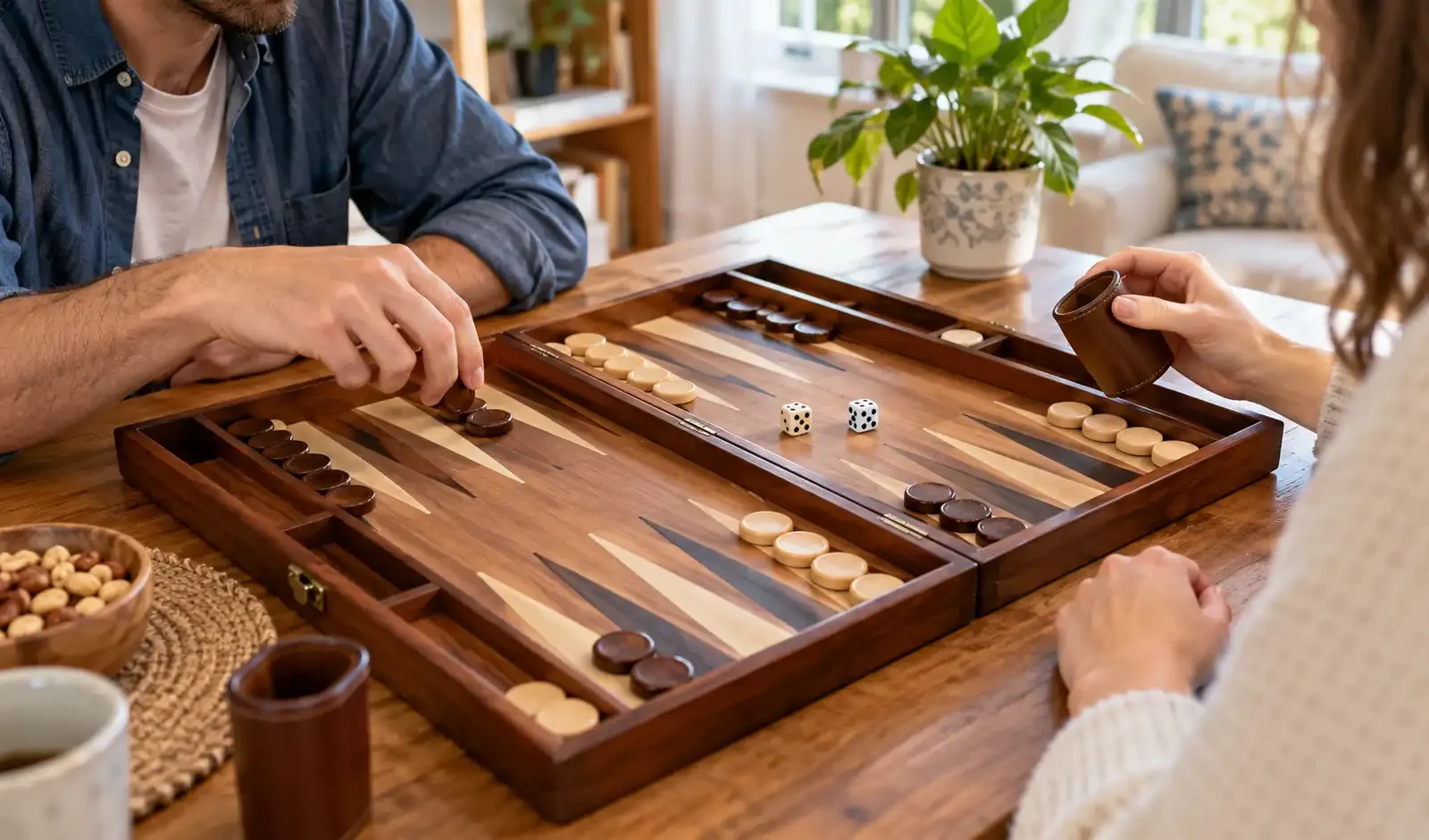
A traditional backgammon set contains a board divided into 24 points, 30 checkers in two colours, two ordinary six-sided dice for each player, dice cups and a doubling cube.
You do not need to use the doubling cube while learning.
For a first game, concentrate on the board, checkers and normal dice. Once movement, hitting and bearing off feel comfortable, the cube can be introduced without making the game unnecessarily confusing.
| Backgammon component | Purpose |
| 24 points | Spaces along which checkers move |
| 15 checkers per player | Pieces each player must move and bear off |
| Two dice | Determine movement during a turn |
| Bar | Holds checkers that have been hit |
| Home board | Final six points before bearing off |
| Doubling cube | Raises the value of a game |
| Dice cups | Used for rolling dice in traditional play |
How Is a Backgammon Board Set Up?
Each player starts with the same distribution of 15 checkers.
From your own perspective, place:
| Point | Starting checkers |
| 24-point | 2 |
| 13-point | 5 |
| 8-point | 3 |
| 6-point | 5 |
| Total | 15 |
Your opponent uses the same formation from their perspective.
A useful memory trick is:
2 – 5 – 3 – 5
That gives you all four starting stacks.
The numbering can initially cause more confusion than the checker arrangement itself. Each player numbers the board from their own perspective. Your 1-point is therefore the opponent’s 24-point, while your 24-point is their 1-point.
You do not usually see numbers printed on a traditional board. Players learn to visualise them.
Your 1-point through 6-point form your home board. Your checkers ultimately need to reach this six-point section before they can be removed.
Which Direction Do Checkers Move in Backgammon?
The two players move in opposite directions.
From your perspective, your checkers travel from your 24-point towards your 1-point. The opponent is doing exactly the same thing from their perspective.
This creates the distinctive backgammon pattern where both armies effectively pass one another as they travel towards their respective home boards.
Unlike some board games, checkers do not move backwards.
Once a checker has advanced towards your home board, its normal journey continues in that direction.
How Do You Decide Who Goes First?
Backgammon has a slightly unusual opening roll.
Each player rolls one die.
The player with the higher number goes first, but instead of rolling again, that player uses the two numbers that have already been rolled.
For example:
| Player A | Player B | Result |
| 5 | 3 | Player A starts with 5-3 |
| 2 | 6 | Player B starts with 6-2 |
| 4 | 4 | Roll again |
If both players roll the same number, both roll again.
That also means the first move cannot be doubles because matching opening dice are rerolled.
How Does Movement Work in Backgammon?
This is probably the single most important rule for a new player to understand:
The two dice are separate moves.
Suppose you roll:
6 and 3
You do not simply get a nine-space move.
You have one movement of six points and one movement of three points.
You could move one checker six points and another checker three points.
Alternatively, the same checker could potentially move six points and then three points, provided both stages of the movement are legal.
That intermediate landing position matters.
Imagine you want to move one checker nine points using 6-3.
If the checker can legally move six and then three, the move works.
If the six-point destination is blocked, however, you cannot simply jump nine points to an open final destination.
You could potentially reverse the order and try three followed by six.
This makes apparently similar dice rolls produce very different positions depending on which route you choose.
What Makes a Point Open or Blocked?
A checker can land on a point containing:
| Point contains | Can you land there? |
| No checkers | Yes |
| Your own checker(s) | Yes |
| One opponent checker | Yes. you hit it |
| Two or more opponent checkers | No |
Two opposing checkers therefore create a made point.
A made point works like a wall. Your opponent cannot land there.
They can move past that point if their dice allow them to land somewhere beyond it, but they cannot finish an individual die movement on the blocked point.
This distinction becomes extremely important when several consecutive points are blocked.
What Happens When You Roll Doubles?
Doubles give you four moves instead of two.
If you roll:
4-4
you effectively receive:
4 + 4 + 4 + 4
Each four is treated as an individual move.
You could move four different checkers four points each, move one checker four times, or divide the movements across your checkers in another legal combination.
Every stage still needs to be legal.
Rolling double sixes therefore does not mean one checker can automatically travel 24 points. Each six-point movement must have a legal landing point.
When you cannot use all four movements, you must play as many legal parts of the roll as possible.
Do You Have to Use Both Dice?
Yes, whenever legally possible.
A player cannot deliberately ignore part of a roll because another move looks strategically safer.
This produces an important rule that beginner explanations sometimes skip.
If both dice can legally be played, you must play both.
If only one die can be played, you play that die.
If either die could individually be played but it is impossible to play both, you must use the higher number.
For example, with a 5-3 roll, if you can legally play either the five or the three but not both, the five must be used.
This seemingly small rule matters because it prevents players from choosing the smaller die simply to preserve a preferred board position.
What Is a Blot in Backgammon?
A blot is a point occupied by exactly one checker.
That checker is exposed.
If your opponent lands on the point, your checker is hit and moved to the bar.
Imagine you leave one checker alone on your 11-point.
Your opponent has a checker six points away and rolls a six.
If the route produces a legal landing, they can move onto your blot, remove your checker and place it on the bar.
The opponent’s checker now occupies the point.
This is one of the mechanics that turns backgammon from a straightforward race into a tactical battle.
What Happens When a Checker Is Hit?
A hit checker goes onto the bar, the raised central section dividing the board.
A player who has one or more checkers on the bar cannot move any other checker until those checkers have re-entered the game.
Re-entry happens through the opponent’s home board.
The dice determine which point is available.
For example, a roll containing a three allows you to attempt to enter on the corresponding three-point in the opponent’s home board.
The normal landing rules still apply.
If the destination contains two or more opposing checkers, entry through that number is blocked.
If it is empty, contains your own checker or contains only one enemy checker, entry is possible.
Landing on a single opposing checker during re-entry hits that checker and sends it to the bar.
What If You Cannot Re-Enter From the Bar?
Sometimes the opponent has blocked the numbers you roll.
Suppose you have a checker on the bar and roll 5-2.
If both corresponding entry points contain at least two opposing checkers, neither die allows you to enter.
You cannot move another checker instead.
Your turn ends.
If one number works but the other does not, you must enter using the available number and then use the remaining die if a legal move is possible.
This situation is sometimes described as dancing or fanning.
A player who makes all six points in their home board while an opponent has a checker on the bar has created a particularly powerful position because there is temporarily no possible re-entry roll.
What Is a Prime?
A prime is a sequence of consecutive points controlled by two or more of your checkers.
For example, controlling four consecutive points creates a four-point prime.
Because an opponent cannot land on any of those points, a long prime can trap checkers behind it.
The maximum prime contains six consecutive made points.
A checker cannot move past a six-point prime because no dice roll can jump farther than six on an individual die.
This is one of the first strategic concepts worth learning because it reveals why backgammon is not simply about moving every checker towards home as fast as possible.
Sometimes controlling space is more valuable than racing.
What Is an Anchor?
An anchor is a point you control inside or near your opponent’s home board, usually with at least two checkers.
Instead of desperately moving your rear checkers forward, keeping them together on a strategically useful point can provide protection and create future hitting opportunities.
Anchors are particularly important when you are behind in the race.
They prevent your rear checkers from remaining isolated blots and make it harder for an opponent to bring every checker safely home.
When Can You Start Bearing Off?
You can only start bearing off after all 15 of your checkers are inside your home board.
Your home board consists of points 1 through 6.
If even one checker remains outside, you cannot remove any checker from the board.
Once all 15 are home, dice can be used to bear checkers off.
A roll matching an occupied point removes one checker from that point.
For example:
| Roll | Possible action |
| 6 | Remove a checker from the 6-point |
| 5 | Remove one from the 5-point |
| 4 | Remove one from the 4-point |
| 3 | Remove one from the 3-point |
| 2 | Remove one from the 2-point |
| 1 | Remove one from the 1-point |
But there is an important exception.
Can You Bear Off With a Higher Number?
Yes, under specific circumstances.
Suppose your highest remaining checker is on the 4-point and you roll a six.
Because there are no checkers on the 5-point or 6-point, you can use the six to bear off a checker from the 4-point.
Now consider a different position.
You have checkers on both the 6-point and 4-point and roll a five.
You cannot use that five to remove the checker from the 4-point because a checker remains on a higher point — the 6-point.
Instead, the five must be used for another legal movement if one exists.
The practical rule is:
An oversized die can bear off your checker from the highest occupied point only when there are no checkers on a higher point.
Can You Be Hit While Bearing Off?
Yes. Reaching your home board does not automatically make every checker safe.
If your opponent still has a checker in your home board, and you leave an exposed blot, it can potentially be hit.
That checker goes to the bar.
You must then re-enter it and bring it all the way back into your home board before you can continue bearing off.
This can turn what appeared to be a comfortable win into a much closer game.
Once the players have passed each other completely and no further contact is possible, backgammon becomes a pure race.
How Do You Win a Game of Backgammon?
The first player to bear off all 15 checkers wins.
However, backgammon recognises three different margins of victory.
| Result | Condition | Basic value |
| Single win | Losing player has borne off at least one checker | 1 |
| Gammon | Losing player has borne off no checkers | 2 |
| Backgammon | Loser has borne off none and still has a checker on the bar or in the winner’s home board | 3 |
The doubling cube can multiply these values further.
What Is the Doubling Cube?
The doubling cube looks like a die but performs a completely different job.
Its faces normally show:
2, 4, 8, 16, 32 and 64
It is used to increase the value of the current game.
At the beginning, the game effectively has a cube value of one.
Before rolling on their turn, an eligible player may offer a double.
The opponent can either take or drop.
If they take, the game continues at twice the previous value.
If they drop, the game ends immediately and they lose at the value that applied before the proposed double.
After a double is accepted, cube ownership also changes. The player who accepted controls the cube and normally has the right to offer the next redouble.
For example:
| Situation | Game value |
| No double | 1 |
| First double accepted | 2 |
| Redouble accepted | 4 |
| Next redouble accepted | 8 |
A gammon or backgammon is then multiplied by the cube.
A gammon with the cube on four is therefore worth eight points.
The doubling cube creates an entirely separate strategic game around position evaluation and risk. For beginners, however, there is nothing wrong with playing several one-point games without it while learning the core mechanics.
How Should a Beginner Actually Play Backgammon?
Once the rules are understood, the biggest mistake is assuming the objective means every checker should simply move forward as quickly as possible.
Backgammon positions constantly change between racing, blocking, attacking and defensive play.
A beginner can make considerably stronger decisions by asking four questions before every move.
Are Any of My Checkers in Immediate Danger?
Look for blots within range of opposing checkers.
You should not automatically avoid every blot strong backgammon frequently involves calculated exposure but understand the risk before leaving one.
An exposed checker close to several opponents may be vulnerable to many possible rolls.
A distant blot might be exposed to only one or two combinations.
The number of ways the opponent can hit matters more than merely recognising that a blot exists.
Can I Make a Useful Point?
Putting two checkers together makes a point.
Home-board points are particularly valuable because they restrict an opponent trying to enter from the bar.
Consecutive points are even stronger because they begin forming a prime.
Instead of asking only, “How far can I move?”, start asking:
“What useful position can this roll create?”
That shift in thinking is one of the biggest steps from beginner play towards genuine backgammon strategy.
Are My Back Checkers Becoming Trapped?
The two checkers beginning on your 24-point are a common beginner problem.
Leave them too long and your opponent may build a prime in front of them.
Move them recklessly and they can become exposed.
Good backgammon regularly involves balancing escape opportunities against positional safety.
Large rolls such as 6-5, 6-4 and doubles may offer valuable opportunities to move rear checkers before the board becomes more restrictive.
Am I Racing or Fighting for Position?
This question becomes increasingly important as the game develops.
When the players no longer have any possibility of hitting each other, the game is a pure race.
At that stage, blocking points and anchors have almost no strategic value. Efficient movement and bearing off become everything.
When contact remains, however, a player who appears behind may still have attacking chances through hits, anchors or a strong home board.
Understanding whether you are in a race position or a contact position helps determine what matters.
What Is Pip Count in Backgammon?

A pip count measures the total distance all your checkers still need to travel before they can be borne off.
A checker on your 6-point contributes six pips.
A checker on your 10-point contributes ten.
If you have two checkers on the 10-point, those checkers contribute 20 pips.
Add the distances for all 15 checkers and you have your pip count.
The lower number is ahead in the race.
You do not need to calculate the exact pip count every turn during your first games, but learning the concept is valuable.
It explains why two positions that look similar can actually have very different racing prospects.
Experienced players use pip counts to judge racing chances, checker efficiency and doubling decisions.
What Are the Most Useful Backgammon Terms to Know?
| Term | Meaning |
| Point | One of the 24 triangles |
| Home board | Your final six points |
| Outer board | Six points immediately before your home board |
| Bar | Central area holding hit checkers |
| Blot | A point occupied by one checker |
| Made point | Point containing at least two of your checkers |
| Hit | Landing on an opposing blot |
| Bear off | Remove a checker after reaching home |
| Prime | Consecutive made points |
| Anchor | Controlled point in the opponent’s territory |
| Pip count | Total remaining movement required |
| Gammon | Win before opponent bears off any checker |
| Backgammon | Higher-value win with additional positional condition |
| Double | Offer to increase the game’s value |
| Take | Accept a double |
| Drop | Reject a double and concede the game |
| Redouble | Increase the cube again after an earlier double |
What Does a Complete Backgammon Turn Look Like?
Suppose you roll 6-2.
Before touching a checker, scan the board.
You may discover three possibilities.
Move one checker six and another two.
Move the same checker six followed by two.
Move the same checker two followed by six.
Those last two options are not necessarily identical.
The intermediate destination differs depending on the order.
Perhaps moving six first lands on a point containing two opposing checkers. That route is illegal.
Moving two first may land safely and then allow the checker to move another six.
That means 2-then-6 works even though 6-then-2 does not.
This is why experienced players rarely treat a dice roll simply as its combined total.
Every die creates an individual movement decision.
What Are the Most Common Beginner Mistakes?
| Mistake | Why it causes problems |
| Adding both dice together | Each die represents a separate move |
| Moving in the wrong direction | Players travel in opposite directions |
| Landing on two opposing checkers | A made point is blocked |
| Moving another checker while one is on the bar | Bar checkers must enter first |
| Bearing off too early | All 15 checkers must first reach home |
| Ignoring the higher-die rule | When only one die can be used, the higher one may be compulsory |
| Leaving too many unnecessary blots | Gives opponents more hitting opportunities |
| Moving back checkers too late | They can become trapped behind primes |
| Racing when badly behind | Contact may offer better comeback chances |
| Treating every hit as automatically good | A hit can sometimes weaken your own position |
| Ignoring board structure | Making strong points can matter more than maximum forward movement |
The last two deserve particular attention.
Beginners often become obsessed with hitting.
Hitting feels powerful because an opposing checker immediately goes backwards.
But if making the hit leaves several of your own checkers exposed or destroys an important point, it may not be the strongest move.
Backgammon rewards position rather than aggression for its own sake.
Is Backgammon Mostly Luck or Skill?
Both matter.
The dice obviously determine which moves are available. A player can receive excellent rolls or terrible rolls during an individual game.
Skill determines what the player does with those rolls.
A stronger player generally understands probability, board structure, racing efficiency, hitting risk, checker distribution and doubling decisions more accurately.
That is why one game can feel extremely lucky while repeated games reveal substantial differences in playing strength.
The most productive mindset is not to ask whether a roll was good or bad.
Ask:
What is the strongest position I can create from the roll I actually received?
That is the fundamental backgammon decision.
What Is the Best Way to Learn Backgammon Quickly?
Start without the doubling cube.
Play until setup, movement, hitting, the bar and bearing off no longer require constant rule checking.
Then start noticing made points and blots.
Next, learn primes and anchors.
After that, begin considering the race and approximate pip counts.
Only then does cube strategy become especially useful.
Trying to learn advanced cube mathematics during your first game usually adds complexity without improving understanding of the board.
The UK Backgammon Federation provides newcomer resources and points new players towards introductory material before tournament-level concepts. Current UKBGF tournament play uses WBGF tournament rules, but a casual player does not need to memorise tournament procedure simply to start enjoying the game.
How Long Does It Take to Learn Backgammon?
The fundamental rules can be learned in a single session.
You can normally understand enough to complete a game once you know:
setup → dice movement → blocked points → hitting → bar entry → bearing off
Becoming good at backgammon is a completely different challenge.
Once the basic rules become automatic, the game opens into questions about probability, timing, checker distribution, racing equity, primes, anchors, back games and cube decisions.
That depth is part of the reason backgammon remains compelling after the rules themselves stop feeling difficult.
How Do You Play Backgammon Online?
Digital versions generally automate much of the mechanical work.
The software normally prevents illegal moves, handles checker movement, detects gammons and backgammons and calculates scores.
That makes online play useful for learning, although it can also hide rules that a physical board forces you to understand.
If you learn entirely online, pay attention to why the software rejects a move rather than simply selecting another checker.
Understanding the reason will make switching to a physical board much easier.
How to Play Backgammon: The Simplest First-Game Plan
For your first game, forget advanced theory.
Set the board up using the 2-5-3-5 formation.
Roll one die each to determine who begins.
Treat the dice as separate movements.
Remember that two enemy checkers block a point while one enemy checker can be hit.
If one of your checkers is hit, bring it back from the bar before moving anything else.
Try to pair exposed checkers, make useful points and gradually bring all 15 pieces towards your home board.
Once every checker is inside points 1 through 6, start bearing them off.
Remove all 15 before your opponent and you win.
After a few games, start thinking less about simply moving forward and more about position.
That is where backgammon changes.
The beginner sees two dice and asks how far the checkers can move.
The developing player sees the same dice and asks which move creates the strongest board.
That decision-making balancing racing speed, safety, blocking, hitting and probability is what makes backgammon much deeper than its relatively simple rules initially suggest.
Frequently Asked Questions
How Many Checkers Do You Start With in Backgammon?
Each player starts with 15 checkers, giving 30 checkers in total.
Can You Move Backwards in Backgammon?
No. Checkers normally move in one direction towards your home board before being borne off.
Can You Land on Another Player’s Checker?
You can land on a point containing exactly one opposing checker. That checker is hit and moved to the bar. You cannot land on a point occupied by two or more opposing checkers.
Do You Have to Use Both Dice in Backgammon?
Yes, if both dice can legally be played. If only one of two possible dice can be used, the higher number must be played when applicable.
What Happens When You Roll Doubles?
Doubles give four movements of the rolled number. Double fours, for example, provide four separate movements of four points.
When Can You Start Taking Checkers Off the Board?
You can begin bearing off only after all 15 of your checkers are inside your home board.
What Is the Bar in Backgammon?
The bar is the central section where hit checkers are placed. A checker on the bar must re-enter before the player can move any other checker.
What Is a Gammon in Backgammon?
A gammon occurs when you bear off all your checkers before the opponent has removed any of theirs. Without cube modification, it is worth twice a normal win.
What Is a Backgammon Win?
A backgammon is normally scored when the losing player has borne off no checkers and still has a checker on the bar or in the winner’s home board when the game ends.
Is Backgammon Difficult to Learn?
The basic mechanics are straightforward enough to learn during a first playing session. The challenge comes from mastering probability, positional strategy, racing decisions and the doubling cube.