How to Tell If a Pokémon Card Is Fake?: 12 Checks That Actually Work


Contents
Knowing how to tell if a Pokémon card is fake has become increasingly important as collecting has grown and convincing counterfeit cards have become easier to find online.
Some fake Pokémon cards are obvious. They have spelling mistakes, strange colours, incorrect attacks or flimsy cardboard. Others are much harder to identify because counterfeiters copy genuine artwork, card numbers and holographic effects.
The safest approach is therefore not to rely on one famous trick.
To tell whether a Pokémon card is fake, first identify the exact card and printing you are supposed to have. Then compare its back, text, fonts, card number, colours, holographic pattern, texture, cardstock, edges and print quality against a genuine reference.
Several inconsistencies together are much stronger evidence than one unusual feature on its own.
How Can You Tell If a Pokémon Card Is Fake?
Check these areas first:
| Check | What To Look For | How Useful Is It? |
| Card Back | Incorrect blue, blurred artwork or unusual borders | Very Useful |
| Exact Card Version | Wrong set, number, rarity or finish | Very Useful |
| Fonts And Text | Strange fonts, spelling errors or bad spacing | Very Useful |
| Holographic Effect | Wrong pattern, direction or coverage | Very Useful |
| Texture | Missing or incorrect texture on cards that should have it | Very Useful |
| Cardstock | Unusually thin, thick, glossy or flexible | Useful |
| Colours | Over-saturated, washed-out or inaccurate printing | Useful |
| Edges | Rough cuts, peeling or unusual layers | Useful |
| Print Detail | Pixelated artwork or fuzzy text | Useful |
| Light Test | Unusual transparency | Secondary Test |
| Price | Extremely cheap high-value card | Warning Sign |
| Seller And Listing | No back photos, stock images or unclear provenance | Warning Sign |
The important word here is combination.
A real Pokémon card can have poor centring, small print defects or slightly different colour saturation. A fake card can also copy one feature extremely well.
Authentication works best when multiple details agree.
Identify the Exact Pokémon Card Before Checking Whether It Is Fake
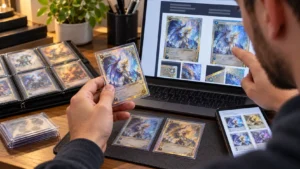
This is the step many collectors skip.
You cannot reliably decide whether a card looks wrong until you establish exactly what the genuine version is supposed to look like.
Look at the bottom of the card and identify:
- Card Name
- Collector Number
- Expansion Or Set
- Set Symbol Or Set Code
- Language
- Rarity
- Holographic Version
- Promotional Markings
- Edition Or Printing
- Copyright Information
Then find a reliable image of that exact version.
Do not simply Google the Pokémon’s name and compare your card with the first image.
The same Pokémon may appear on dozens or even hundreds of different cards. One design may exist as a standard card, reverse holo, promotional card or another legitimate variation.
Vintage cards introduce even more complications.
A suspicious difference can therefore mean one of two things:
The card is counterfeit, or you are comparing two different legitimate printings.
Establishing the exact card first dramatically reduces false alarms.
1. Check the Back of the Pokémon Card
The card back is one of the most useful places to start.
Take a Pokémon card you know is genuine and place it beside the suspicious card under the same lighting.
Compare:
- Blue colour
- Border definition
- Central Poké Ball
- Red and white areas
- Yellow Pokémon lettering
- Fine artwork details
- Colour transitions
- Print sharpness
Fake cards frequently use blue that is either noticeably too dark, too pale or too saturated.
The artwork may also appear slightly blurry because the counterfeit has effectively reproduced an image of the original design rather than recreating the original printing process.
However, colour by itself should never be treated as definitive.
Lighting, age, manufacturing differences and photographic processing can all affect how a card appears.
Comparing the suspicious card physically against a genuine card from a similar period is much more useful than comparing two photographs on different screens.
2. Read Every Word on the Card
Poor counterfeit Pokémon cards regularly expose themselves through the text.
Look carefully for:
- Spelling mistakes
- Missing punctuation
- Incorrect capitalisation
- Strange sentence structure
- Inconsistent spacing
- Incorrect attack names
- Wrong Energy requirements
- Incorrect weakness or resistance
- Unrealistic HP or damage figures
The word Pokémon itself should also be printed correctly where applicable.
An absurd stat such as 1,000 HP on what appears to be an ordinary Pokémon TCG card is an immediate reason for suspicion.
But absence of spelling mistakes does not prove authenticity.
Better counterfeits simply copy the original card’s text exactly.
This makes text checking an excellent way to eliminate bad fakes but a poor standalone method for confirming sophisticated ones.
3. Compare the Fonts Very Carefully
Fonts are surprisingly difficult to reproduce perfectly.
Counterfeit cards may have letters that are:
- Too thick
- Too thin
- Too rounded
- Too narrow
- Incorrectly spaced
- Slightly larger
- Slightly smaller
Look particularly closely at:
The Pokémon’s name, HP, attack names, attack damage and collector information.
A fake Charizard might contain every correct word yet still look subtly wrong because its typography does not match the genuine card.
Do not compare fonts between completely different generations of Pokémon cards.
Typography has changed throughout the history of the TCG.
Compare your card against the same card or another genuine card from the same set whenever possible.
4. Check the Collector Number and Set Information
One of the fastest authenticity checks is confirming that the card actually exists in the format being presented.
For example, imagine a card says:
123/198
Check whether:
- That Pokémon really occupies card number 123
- The artwork matches that card number
- The stated set contains the card
- The rarity matches
- The expected holographic treatment matches
- The card exists in that language
Counterfeiters occasionally combine information from different genuine cards.
The artwork may belong to one release while the collector number belongs to another.
The official Pokémon Trading Card Database is particularly useful for checking many legitimate cards and expansions.
For older, unusual promotional or extremely scarce releases, additional specialist references may be required.
This becomes especially important when investigating the rarest Pokémon cards, where trophy cards, promotional releases and tiny-distribution printings can look very different from normal booster-pack cards.
5. Check the Holographic Pattern
A card being shiny does not mean it is genuine.
Counterfeit manufacturers can easily create holographic-looking surfaces.
What matters is whether the holographic effect is correct for that exact card.
Look at:
- Direction of the shine
- Holographic pattern
- Areas where foil appears
- Areas where foil should not appear
- Reflectiveness
- Texture
- Movement when tilted
Cheap fake Pokémon cards commonly use a generic rainbow foil covering most or all of the card.
The genuine version may use a much more controlled effect.
There is an important warning, though.
Not Every Real Pokémon Card Has Texture
This is one of the biggest mistakes made by new collectors.
Some genuine premium cards have obvious surface texture. Others are genuinely smooth.
You cannot say:
“No texture = fake.”
Instead ask:
“Should this exact version have texture?”
If a card known to have a distinctive textured surface is completely smooth, that becomes a substantial warning sign.
6. Look at the Card Surface and Texture
Tilt the card slowly underneath a strong light.
On cards that should have texture, inspect whether the pattern:
- Matches the artwork
- Changes naturally across the surface
- Contains fine detail
- Feels integrated into the card
- Follows the genuine version’s pattern
Counterfeits may simply print an image of texture onto a flat surface.
From directly above, this can look convincing.
Tilting the card exposes the difference because genuine physical texture interacts with light differently from printed lines.
Texture authentication is particularly valuable for expensive modern cards.
But again, always confirm that the exact printing was actually produced with texture.
7. Feel the Cardstock
Experienced collectors often notice a counterfeit before identifying exactly what is wrong.
The card simply feels different.
Possible warning signs include cardstock that is:
- Unusually thin
- Excessively thick
- Too flexible
- Too rigid
- Very glossy
- Waxy
- Rough
- Flimsy
This becomes easier to judge when holding a genuine card beside it.
Avoid comparing a modern English card against a completely different Japanese or vintage product and expecting the materials to feel identical.
Pokémon cards have been manufactured across different periods, languages, factories and product types.
Cardstock is useful supporting evidence, not an automatic pass-or-fail test.
8. Inspect the Edges
Look closely at all four edges.
Genuine Pokémon cards normally have relatively clean manufacturing cuts.
Counterfeits may show:
- Rough cardboard fibres
- Uneven cuts
- Peeling layers
- Strange laminates
- Excess adhesive
- Unusually rounded corners
- Poorly cut corners
A magnifying glass can make these problems considerably easier to see.
Be careful with heavily played cards.
Years of handling can create edge whitening, worn corners and damaged surfaces on completely legitimate cards.
Condition damage should not be confused with evidence of counterfeiting.
9. Examine the Printing Under Magnification
For a more advanced check, use a small magnifier or jeweller’s loupe.
Look at:
- Text edges
- Energy symbols
- Fine lines
- Small copyright text
- Artwork details
- Colour transitions
Genuine commercial printing should normally show controlled, consistent detail.
Cheap counterfeits may reveal obvious digital printing artefacts, fuzzy letters, irregular dots or pixelated artwork.
This is especially useful when a fake appears convincing at normal viewing distance.
High-quality counterfeit printing can be much harder to identify, so magnification should still be combined with the other checks.
10. Use the Light Test Carefully
The Pokémon card light test is probably the most debated authentication method.
The idea is simple.
Hold a card in front of a bright light and observe how easily light travels through the cardstock.
Some counterfeit cards are printed on thinner or cheaper material and allow dramatically more light through than genuine cards.
That can expose a poor fake quickly.
However, the test has limitations.
Different authentic cards can behave differently because of variations in:
- Cardstock
- Printing period
- Foil treatment
- Card construction
- Light strength
- Room conditions
That means the light test should be treated as a supporting check rather than definitive proof.
For the best comparison, use another genuine card from the same set or production period and test both under identical conditions.
A suspicious difference adds evidence.
It does not automatically settle the question.
11. Check the Seller Before Buying Pokémon Cards Online
Sometimes the easiest fake to identify is the one you never purchase.
Before buying an expensive Pokémon card online, inspect the listing as carefully as the card.
Warning signs include:
- Price dramatically below the normal market
- Only stock photographs
- No photograph of the card back
- Blurry or heavily compressed images
- Seller refusing to provide extra photographs
- Recently created seller account
- Large quantities of supposedly rare cards
- Identical high-value cards repeatedly available
- No purchase history or provenance
- Pressure to pay outside the marketplace
- Description avoiding specific details about the card
Ask for clear photographs of:
The front, back, corners, edges and surface under angled light.
If the card is textured, request a photograph or video showing how the texture and holographic finish react as the card moves.
Price is also relevant.
A £500 card being offered for £25 deserves considerably more scrutiny than the same card being sold within a normal market range.
That does not mean every bargain is counterfeit.
It means the financial incentive for counterfeiting increases dramatically as the genuine card becomes more valuable.
This becomes particularly important at the extreme end of collecting, where the most expensive Pokémon card has sold for millions rather than hundreds of pounds.
12. Be Careful With Graded Pokémon Cards Too
A plastic grading case does not mean collectors should stop checking authenticity.
Counterfeiters can imitate slabs and labels as well as raw cards.
If buying a professionally graded card, inspect:
- Grading company
- Certification number
- Card description
- Grade
- Label design
- Holder design
- Card visible inside
- Seller provenance
Check the certification number directly through the grading company’s official verification system where available.
Then make sure the certification details match the actual card in front of you.
A Real Certification Number Does Not Automatically Make a Slab Genuine
This is an increasingly important point.
A counterfeiter can potentially copy information from a genuine graded card.
Therefore, finding a valid certification number should be treated as one part of the authentication process rather than absolute proof that the physical slab being offered is the genuine item associated with that number.
For extremely valuable cards, provenance, seller reputation and professional inspection become increasingly important.
How to Tell If a Pokémon Booster Pack Is Fake?

Fake individual cards are only part of the problem.
Entire booster packs, boxes and collection products can also be counterfeit.
Before opening a sealed product, compare it with genuine examples and inspect:
- Packaging quality
- Artwork
- Spelling
- Set name
- Product layout
- Seal quality
- Pack shape
- Colour accuracy
- Barcode and product information
- Price
Poor counterfeit booster packs frequently have unusual seals, excessive space inside the wrapper, inaccurate artwork or suspicious print quality.
Price deserves particular attention.
A current sealed Pokémon product selling at a tiny fraction of its normal retail price should immediately trigger additional checks.
Too Many Rare Cards Can Also Be Suspicious
Counterfeit packs sometimes try to impress inexperienced buyers by filling a pack with holographic, gold, rainbow or supposedly ultra-rare cards.
Real Pokémon TCG products follow defined set and pack structures.
Opening a suspiciously cheap pack containing one spectacular-looking rare after another should therefore encourage closer inspection.
Fake Pokémon Card vs Genuine Misprint
Not every strange Pokémon card is fake.
Real manufacturing errors exist.
These can include:
- Miscuts
- Off-centre printing
- Ink problems
- Alignment errors
- Surface defects
- Printing anomalies
A badly centred card can therefore be completely genuine.
The key question is whether the unusual feature is consistent with a manufacturing mistake or whether the entire card fails multiple authenticity checks.
For example:
A genuine miscut might have terrible centring while still possessing the correct fonts, cardstock, artwork, back, foil and printing.
A counterfeit may have bad centring plus incorrect typography, wrong colours, cheap cardstock and an inaccurate holographic effect.
That distinction prevents legitimate error cards from being incorrectly dismissed as fakes.
Fake Pokémon Card vs Proxy or Custom Card
Collectors may also encounter cards deliberately created as:
- Proxies
- Fan art
- Custom cards
- Novelty cards
- Display cards
These are not genuine Pokémon TCG cards.
However, there is an important difference between a clearly identified custom card and a counterfeit being represented as genuine.
A novelty card openly sold as an unofficial decorative item is different from an imitation designed to convince a buyer that it is an authentic collectible.
When buying online, always read the description carefully for wording such as:
Proxy, replica, custom, fan-made, unofficial or reproduction.
Don’t Use the Rip Test
One authentication trick recommends tearing the card to examine its internal construction.
Do not do this.
Even if the method revealed useful information, you would have destroyed the card before discovering whether it was valuable.
The same problem applies to aggressive scratch tests, excessive bending and other destructive methods.
A genuine card worth hundreds or thousands of pounds can lose enormous value through physical damage.
Authentication should preserve the item whenever possible.
Don’t Use the Bend Test Either
Another old trick involves bending the card heavily and checking whether it returns to its original shape.
This is unnecessary.
Repeated bending can:
- Create creases
- Damage fibres
- Reduce grading potential
- Damage surface layers
- Lower resale value
The flexibility of a card can already be assessed gently without intentionally stressing it.
There are enough non-destructive authentication methods that bending a potentially valuable collectible makes little sense.
Can a Pokémon Card Scanner Tell If a Card Is Fake?
Usually, no.
Card scanning apps can be extremely useful for identifying:
- Pokémon name
- Set
- Collector number
- Market listings
- Approximate value
- Collection information
But identifying an image is not the same as authenticating the physical object.
A fake card can copy genuine artwork closely enough for software to recognise it as the genuine card design.
The app may correctly identify:
Charizard — card X from set Y.
That does not prove the piece of cardboard in your hand came from an official Pokémon TCG printing.
Use scanners for identification, then perform physical authentication separately.
What Should You Do If You Think a Pokémon Card Is Fake?
Do not immediately destroy it.
First, photograph:
- Front
- Back
- Corners
- Edges
- Suspicious areas
- Packaging
- Receipt or listing
Then compare it against a known genuine example.
If uncertainty remains, take the card to a reputable trading-card specialist.
Potentially valuable cards may justify professional authentication or grading.
If the card was recently purchased online, keep the original listing, messages, photographs and payment records in case a return or counterfeit claim becomes necessary.
Most importantly, do not knowingly resell a suspected counterfeit as genuine.
The Best Order for Checking a Suspicious Pokémon Card
Instead of randomly performing tests, use this order:
- Identify The Exact Card
- Confirm The Set And Collector Number
- Compare The Card Back
- Compare Text And Fonts
- Check Artwork And Colours
- Confirm The Correct Holographic Finish
- Check Expected Texture
- Compare Cardstock And Edges
- Inspect Fine Printing
- Use The Light Test As Supporting Evidence
- Investigate Seller And Provenance
- Seek Expert Authentication If Valuable
This approach reduces the chance of deciding that a genuine card is counterfeit because of one unusual detail.
Final Verdict: How to Tell If a Pokémon Card Is Fake
The most reliable way to tell if a Pokémon card is fake is not to search for one magic giveaway.
Start by identifying the exact card, set, collector number and version.
Then compare the suspicious card against a genuine reference and inspect its back, typography, colours, holographic effect, texture, cardstock, edges and printing.
A spelling mistake might expose a cheap counterfeit instantly.
A missing texture may expose another.
An incorrect card number or holographic treatment may reveal a more convincing imitation.
But individual checks can occasionally mislead.
The strongest conclusion comes when several independent details point in the same direction.
Most importantly, avoid destructive tricks such as ripping or bending a card. If the card could be valuable and the evidence remains unclear, protecting it and obtaining specialist authentication is far safer than destroying the very collectible you are trying to identify.
Frequently Asked Questions
How Can You Tell If a Pokémon Card Is Fake Quickly?
Compare the back, collector number, fonts, holographic pattern and texture with a confirmed genuine version. Multiple differences are much more meaningful than a single unusual feature.
Are Fake Pokémon Cards Holographic?
Yes. Many counterfeit Pokémon cards use holographic or rainbow foil. A shiny surface does not prove authenticity; the foil pattern must match the exact genuine card.
Are Pokémon Cards Without Texture Fake?
No. Many genuine Pokémon cards are smooth. Texture should only be expected on cards and rarities that were originally produced with a textured surface.
Can Fake Pokémon Cards Have Correct Card Numbers?
Yes. Better counterfeits copy the genuine card number, attacks and text exactly. Card numbers should therefore be checked alongside physical characteristics.
Does the Light Test Prove a Pokémon Card Is Real?
No. It can expose some cheap counterfeits, but genuine cardstock and foil treatments vary. Use it alongside other tests rather than treating it as definitive.
Can a Fake Pokémon Card Pass the Light Test?
Potentially, yes. Sophisticated counterfeiters can use materials that behave more like genuine card stock.
Can a Real Pokémon Card Look Different From Another Real Card?
Yes. Manufacturing variation, different print runs, languages, sets, finishes and ageing can create legitimate differences. Always compare the same printing whenever possible.
Are Poorly Centred Pokémon Cards Fake?
Not necessarily. Genuine Pokémon cards can be significantly off-centre or miscut. Centring is primarily a manufacturing and grading issue rather than proof of authenticity.
Are Fake Pokémon Cards Worth Money?
Counterfeit Pokémon cards do not have the same recognised collector value as authentic Pokémon TCG cards. Novelty or custom cards may have interest to particular buyers, but they should never be represented as genuine official cards.
Can Pokémon Card Apps Detect Fakes?
They can help identify which genuine card a suspicious card is copying, but image recognition alone cannot reliably prove physical authenticity.
Should I Rip a Pokémon Card to Check If It Is Fake?
No. The rip test permanently destroys the card. Use non-destructive checks or professional authentication instead.
Should Expensive Pokémon Cards Be Professionally Authenticated?
Professional authentication becomes increasingly sensible as the potential value increases, particularly when buying rare vintage cards, trophies, valuable promotional releases or expensive graded collectibles.