What Is the Most Expensive Pokémon Card? The £12.3 Million Record Explained

Contents
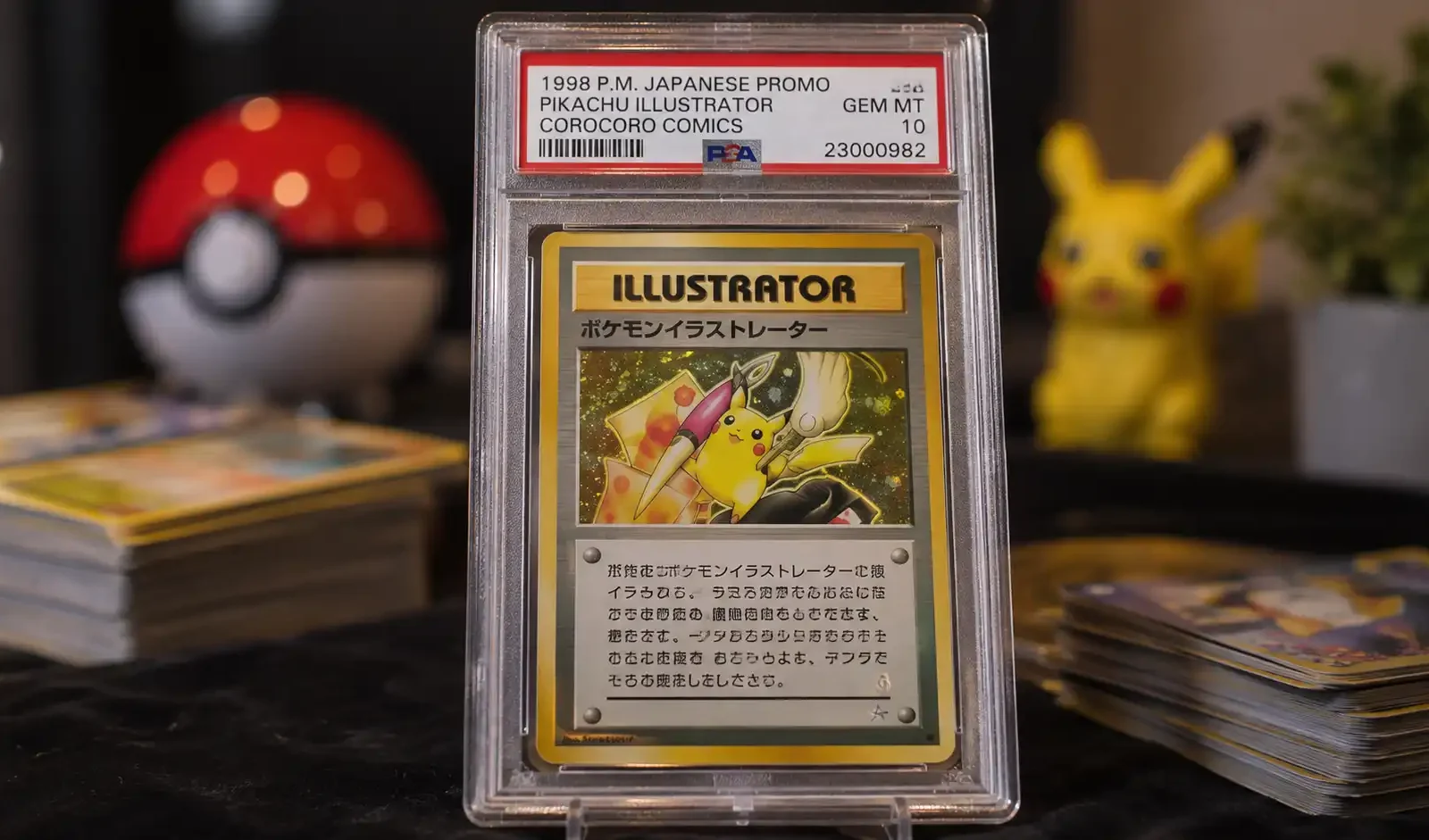
The most expensive Pokémon card ever sold is the PSA 10 Pikachu Illustrator, which sold through Goldin Auctions for $16,492,000 — approximately £12.31 million on 16 February 2026.
The seller was Logan Paul, who had acquired the card in 2021 through a deal valued at $5.275 million, or around £3.94 million at today’s exchange rate. The 2026 buyer was investor AJ Scaramucci.
Guinness World Records verified the February 2026 transaction as both the most expensive Pokémon card sold at auction and the most expensive trading card of any kind sold at auction.
Guinness reported the transaction at approximately £12.07 million at the exchange rate used when the sale took place. Using the exchange rate on 19 September 2026, $16.492 million converts to roughly £12.31 million.
That means articles still describing Logan Paul’s earlier $5.275 million purchase as the Pokémon card record are now substantially out of date.
The timing was also significant. The sale took place just 11 days before Pokémon Day on 27 February 2026, during Pokémon’s 30th-anniversary year.
What Is the Most Expensive Pokémon Card Right Now?
The answer is the 1998 Pikachu Illustrator graded PSA Gem Mint 10.
| Detail | Record |
|---|---|
| Most expensive Pokémon card | Pikachu Illustrator |
| Year | 1998 |
| Grade | PSA Gem Mint 10 |
| Sale price | $16,492,000 / approx. £12.31 million |
| GBP value reported by Guinness at sale | Approx. £12.07 million |
| Sale date | 16 February 2026 |
| Auction house | Goldin Auctions |
| Seller | Logan Paul |
| Buyer | AJ Scaramucci |
| Special status | Only known PSA 10 |
| Wider record | Most expensive trading card sold at auction |
The card was originally awarded through Japanese illustration contests rather than being available from ordinary Pokémon booster packs. Heritage Auctions records that 39 copies were originally distributed across the relevant CoroCoro illustration competitions.
Scarcity alone, however, does not explain a valuation above £12 million.
Pikachu Illustrator combines several characteristics that rarely exist in one collectible: early Pokémon history, Pikachu, unusual distribution, iconic artwork, an extremely limited population, a perfect PSA grade and extraordinary provenance.
Top 15 Most Expensive Pokémon Cards Ever Sold
The table below ranks major documented sales while showing both US dollars and approximate pounds sterling.
GBP figures are approximate conversions using the 19 September 2026 rate of roughly $1 = £0.7464. They are provided to make the values easier for UK readers to compare and do not necessarily represent the exact sterling value on the original transaction date.
| Rank | Pokémon Card | Grade | Sale Price | Approx. GBP | Sale |
|---|---|---|---|---|---|
| 1 | Pikachu Illustrator | PSA 10 | $16,492,000 | £12.31m | Goldin, Feb 2026 |
| 2 | 1996 Ivy Pikachu Glossy Marketing Variation | CGC 8.5 | $3,300,000 | £2.46m | Private sale, Aug 2026 |
| 3 | 2004 Torchic Gold Star, EX Team Rocket Returns | PSA 10 | $2,700,000 | £2.02m | Alt, Sep 2026 |
| 4 | 1998 Bronze No. 3 Trophy Pikachu | PSA 10 | $1,769,000 | £1.32m | Goldin, May 2026 |
| 5 | 1996 Japanese Base Set No Rarity Charizard | PSA 10 | $1,700,000 | £1.27m | Private sale, Mar 2026 |
| 6 | 1996 Ivy Pikachu Glossy Incorrect Illustrator | CGC Gem Mint 10 | $1,300,000 | £970,000 | Private sale, Aug 2026 |
| 7 | No Rarity Charizard, Arita-signed slab | PSA 10 | $1,232,200 | £920,000 | Mar 2026 |
| 8 | 2005 Rayquaza Gold Star, EX Deoxys | CGC Pristine 10 | $1,020,000 | £761,000 | Fanatics Collect, Aug 2026 |
| 9 | 1997 Gold No. 1 Trophy Pikachu | PSA 8 | $982,100 | £733,000 | Goldin, Mar 2026 |
| 10 | 1999 1st Edition Base Set Charizard, Logan Paul Break | PSA 10 | $954,800 | £713,000 | Goldin, Feb 2026 |
| 11 | 1999 Snap Bulbasaur Best Photo Promo | PSA 8 | $809,943 | £605,000 | Goldin, Aug 2026 |
| 12 | 2002 Legendary Collection Reverse Holo Gengar | PSA 10 | $705,000 | £526,000 | Alt, Sep 2026 |
| 13 | 1999 Snap Charmander Best Photo Promo | PSA 8 | $640,500 | £478,000 | Goldin, Aug 2026 |
| 14 | 1999 Base Set Prerelease Raichu | PSA 6 | $640,500 | £478,000 | Goldin, Aug 2026 |
| 15 | 1999 Snap Squirtle Best Photo Promo | PSA 6 | $555,100 | £414,000 | Goldin, Aug 2026 |
Private-sale prices require slightly more caution than major public-auction results because the complete terms are not always independently visible. For that reason, private transactions are clearly labelled rather than being presented as identical to publicly documented auction results.
The table also ranks distinct cards and major variants rather than filling the list with repeated sales of Pikachu Illustrator.
For example, a PSA 9 Pikachu Illustrator sold for $1,406,250, approximately £1.05 million, in March 2026. That is an important result, but listing every Illustrator sale separately would make a ranking of the most expensive Pokémon cards less useful.
Why Did Pikachu Illustrator Sell for £12.3 Million?
Pikachu Illustrator is fundamentally different from an ordinary rare Pokémon card.
It was created as an award for illustration competitions promoted through CoroCoro Comic in Japan. A collector could not simply buy a booster box and hope to pull one.
The artwork was created by Atsuko Nishida, who is closely associated with the original design of Pikachu.
Instead of carrying the usual Trainer designation found on many early promotional cards, it features the unusual Illustrator title and depicts Pikachu holding drawing tools.
Then there is the condition.
Logan Paul’s card is the only known Pikachu Illustrator graded PSA Gem Mint 10.
A rare card can already command substantial money. A famous card with an extremely limited population is more desirable still. When the finest-known example is effectively unique at its grade, the potential price can increase dramatically.
Its provenance added another dimension.
Paul acquired the card in 2021 through a transaction valued at $5.275 million, equivalent to approximately £3.94 million using September 2026 exchange rates.
He subsequently wore the card inside a diamond necklace during WrestleMania 38, giving an already famous Pokémon card a particularly recognisable ownership history.
The Final Auction Reached $16.49 Million Around £12.31 Million
The closing phase of the February 2026 auction demonstrated what can happen when extremely wealthy collectors compete for an item for which there is essentially no identical substitute.
Bidding had been a little above $6 million approximately £4.48 million before an extended bidding sequence drove the hammer price to $13.3 million, or roughly £9.93 million at September 2026 exchange rates.
After the buyer’s premium, the final recorded transaction reached:
$16,492,000 — approximately £12.31 million.
AJ Scaramucci emerged as the successful buyer.
He later discussed the Pokémon card as part of a wider collecting project involving exceptionally rare cultural and historical objects.
The purchase therefore operated at a level far beyond ordinary Pokémon card collecting. It was treated more like the acquisition of a major historical or cultural collectible.
The Pokémon Card Even Beat the World’s Most Expensive Sports Card
The Pikachu Illustrator record is significant beyond the Pokémon market.
One of the previous major benchmarks for trading cards was the one-of-one Michael Jordan and Kobe Bryant Dual Logoman autograph card.
That card sold through Heritage Auctions in August 2025 for approximately $12.932 million, equivalent to about £9.65 million using September 2026 exchange rates.
The $16.492 million Pikachu Illustrator therefore exceeded the sports-card result by approximately:
$3.56 million around £2.66 million.
It does not mean ordinary Pokémon cards have suddenly become multimillion-pound assets. Instead, it demonstrates what can happen when rarity, historical significance, condition, provenance and collector competition converge around one exceptional item.
The £2.46 Million Ivy Pikachu Is Another Major 2026 Sale
February’s Illustrator auction was far from the only extraordinary Pokémon transaction of 2026.
In August, a 1996 Japanese CoroCoro Comics Pikachu Glossy Marketing Variation, commonly called an Ivy Pikachu, reportedly sold privately for:
$3.3 million approximately £2.46 million.
The card was graded CGC 8.5.
CGC reported that only two examples of this Marketing Variation appeared in its population report, with the $3.3 million card being the higher-graded example.
Another Ivy Pikachu variant, the Glossy Incorrect Illustrator version graded CGC Gem Mint 10, reportedly sold privately for $1.3 million — approximately £970,000 in August 2026.
The results illustrate just how quickly the high-end Pokémon market has developed during the franchise’s 30th-anniversary year.
Torchic Became a £2 Million Pokémon Card
Another major 2026 record came from a card that might surprise collectors accustomed to seeing Pikachu and Charizard dominate expensive-card rankings.
A 2004 EX Team Rocket Returns Torchic Gold Star graded PSA 10 sold through Alt in September 2026 for:
$2.7 million – approximately £2.02 million.
The sale was reported as a new record for Torchic and a benchmark for an English-language Pokémon card.
That is particularly notable because only weeks earlier a CGC Pristine 10 Rayquaza Gold Star from EX Deoxys had sold for:
$1.02 million – approximately £761,000.
These transactions show why a Pokémon price ranking requires frequent updating. A record that looks current in July can already be obsolete by September.
Is Pikachu Illustrator the Rarest Pokémon Card?
Not necessarily. The rarest Pokémon card and the most expensive Pokémon card are not automatically the same thing.
Some Pokémon cards may have had smaller production runs or fewer known surviving copies than Pikachu Illustrator.
One of the most striking examples is the Blastoise Commissioned Presentation Galaxy Star Holo.
The card was produced while Wizards of the Coast was developing its approach to an English-language Pokémon Trading Card Game release.
Only two examples were reportedly created, and only one has publicly surfaced.
The known CGC 8.5 example sold for approximately:
$360,000 – around £269,000.
That means a card believed to have only two originally produced copies can still be worth dramatically less than Pikachu Illustrator.
The reason is that rarity is only one component of value.
Character popularity, artwork, historical importance, collector awareness, condition, provenance and competition between buyers can all influence the final price.
Pikachu is the most recognisable character associated with Pokémon, and Pikachu Illustrator has become one of the best-known trading cards in the world.
That combination of rarity and demand is crucial.
How Pokémon Card Grading Can Change the Price?
Professional grading is one of the most important factors to understand when looking at expensive Pokémon cards.
Major grading companies include PSA, CGC, Beckett/BGS and SGC.
Graders assess characteristics such as centring, corners, edges, surface condition, printing defects and possible alteration.
Cards are then authenticated, assigned a condition grade and normally encapsulated in a tamper-evident holder.
A PSA 10 represents Gem Mint condition and sits at the top of PSA’s normal numerical grading scale.
CGC also uses a 10-point system and offers both Gem Mint 10 and its particularly stringent Pristine 10 designation.
Why Can a PSA 10 Be Worth So Much More Than a PSA 9?
The price difference between neighbouring grades is not necessarily small.
The Pikachu Illustrator demonstrates this in spectacular fashion.
A PSA 9 Pikachu Illustrator sold through Heritage Auctions in March 2026 for:
$1,406,250 – approximately £1.05 million.
Only weeks earlier, the unique PSA 10 had achieved:
$16,492,000 – approximately £12.31 million.
That makes the PSA 10 sale almost 12 times the value of that particular PSA 9 transaction.
Collectors should not assume the same multiplier applies to other cards.
The extraordinary difference reflects the PSA 10’s unique population, Logan Paul provenance, enormous publicity and unusual auction circumstances.
However, it demonstrates why checking the population at a specific grade can be just as important as checking the overall rarity of the card.
How Much Is a First Edition Charizard Worth?
The English 1999 Base Set 1st Edition Holo Charizard remains one of the world’s most famous Pokémon cards.
However, not every 1st Edition Charizard is worth hundreds of thousands of pounds.
An exceptional PSA 10 example connected to the “Logan Paul Break” sold for:
$954,800 – approximately £713,000 – in February 2026.
Its unusual provenance and special PSA label mean that result should not automatically be used as the value of every PSA 10 Charizard.
Condition makes an enormous difference.
Collectors must also distinguish between 1st Edition, Shadowless and Unlimited English Base Set Charizard cards.
They may look broadly similar to inexperienced collectors, but they are different printings with very different market values.
There is also the Japanese Charizard market.
A 1996 Japanese Base Set No Rarity Charizard graded PSA 10 reportedly changed hands privately for:
$1.7 million – approximately £1.27 million- in March 2026.
That is a different card and should not be confused with the famous English 1st Edition Charizard.
What Makes an Old Pokémon Card Valuable?
Age by itself does not make a Pokémon card valuable.
A heavily printed vintage card in poor condition may be worth significantly less than a much newer card with strong demand and limited supply.
Important valuation factors include the exact set, card number, language, print variation, edition, holographic treatment, condition, professional grade, grading population, distribution method, provenance and recent completed sales.
Certain features deserve particular attention, including authentic 1st Edition stamps, Shadowless Base Set characteristics, trophy-card origins, Japanese promotional releases, Gold Star cards, printing variations and unusually low populations at high grades.
Condition defects can dramatically affect value.
Creases, dents, scratches, whitening on the edges, staining, poor centring and damaged surfaces can all reduce the grade a card receives.
Collectors should also concentrate on completed sales rather than asking prices.
Someone can list a card online for £100,000. Unless someone actually buys it for £100,000, that listing does not establish a £100,000 market value.
Could Your Old Pokémon Cards Be Worth Money?
Potentially. Collections deserve closer inspection when they contain early holographic Pokémon, genuine 1st Edition cards, Shadowless Base Set cards, Japanese promotional issues, tournament prizes, Gold Stars, unusual errors or sought-after EX-era cards.
The exact identity of the card is crucial.
Two Charizard cards that appear almost identical at first glance can have radically different prices because they belong to different print runs.
Potentially valuable cards should also not be cleaned, trimmed, recoloured or otherwise altered before grading.
Attempts to “improve” a card can actually make professional authentication or numerical grading more difficult.
For valuable cards, basic protection is important. A suitable card sleeve and protective holder can reduce the risk of additional edge, corner or surface damage while the card is being identified or prepared for professional assessment.
Where Can Pokémon Cards Be Graded in the UK?
UK collectors have several grading options.
CGC operates a UK submission operation in Bloomsbury, London, allowing British collectors to submit cards through its UK infrastructure rather than arranging the complete process independently overseas.
CGC has also expanded UK submission options through approved locations and partners.
PSA announced plans for a Greater London receiving operation during the second half of 2026, intended to make UK submissions easier and support pricing in pounds sterling.
Because grading-company locations, submission arrangements, service tiers and insurance limits can change, collectors should confirm the latest process with the grading company before sending a valuable card.
Beckett/BGS and SGC are also established names in the trading-card grading industry.
For a card potentially worth thousands or tens of thousands of pounds, selecting a grading service should not be based purely on the cheapest fee.
Authentication reputation, resale-market acceptance, population reporting, declared-value limits, insurance and shipping arrangements can all matter.
What Are the Most Expensive Pokémon Cards You Could Actually Buy?
There is a major practical difference between the £12.3 million Pikachu Illustrator and expensive Pokémon cards that regularly appear on the open market.
Illustrator cards, trophy cards and unique presentation pieces can disappear into private collections for years.
Modern chase cards are considerably easier to find.
Examples include Umbreon VMAX alternate art, commonly called Moonbreon, Giratina V alternate art from Lost Origin, Umbreon ex Special Illustration Rare from Prismatic Evolutions, and other high-demand modern chase cards.
As of September 2026, market data placed a near-mint Giratina V 186/196 around:
$832 – approximately £621 ungraded.
Some high-end modern releases have approached or exceeded four figures.
Umbreon ex from Prismatic Evolutions, for example, was around:
$1,410 – approximately £1,052 – in one September 2026 market dataset.
Other desirable modern cards can move through the $800–$1,000 range, roughly £600–£750, depending on condition and current demand.
These values are snapshots rather than permanent prices.
Modern Pokémon cards can move sharply as new sets launch, supply increases, grading populations grow or collector attention switches to another card.
Anyone considering buying an expensive modern Pokémon card should therefore check recent completed transactions for the exact card, language, grade and condition.
Why the Most Expensive Pokémon Card Rankings Keep Changing?
The high-end Pokémon market has moved particularly quickly during 2026.
The biggest documented transactions now include the £12.31 million Pikachu Illustrator, approximately £2.46 million Ivy Pikachu, approximately £2.02 million Torchic Gold Star, roughly £1.32 million Bronze Trophy Pikachu, approximately £1.27 million No Rarity Charizard and a growing number of cards selling around or above the £750,000 mark.
That creates two problems for older rankings.
First, prices can become outdated extremely quickly.
Second, different articles use different methodologies.
One list may include every separate Pikachu Illustrator transaction. Another may count only the highest sale for each card. Some include documented private transactions, whereas others accept only public auction results.
Others mistakenly include asking prices or inadequately verified claims.
That is why the sale type and source matter just as much as the headline price.
What Is the Most Expensive Pokémon Card? Final Answer
As of September 2026, the answer is clear. The PSA 10 Pikachu Illustrator is the most expensive Pokémon card ever sold at auction, reaching:
$16,492,000 – approximately £12.31 million.
Guinness World Records recorded the transaction at approximately £12.07 million based on the exchange rate around the time of the February 2026 sale.
Its value comes from much more than simple scarcity.
It is a prize card from Pokémon’s earliest years, depicts the franchise’s most recognisable character, carries artwork by Atsuko Nishida, is the only known PSA 10 example and has one of the most famous ownership histories of any modern collectible.
The wider 2026 market has also demonstrated that expensive Pokémon cards are no longer confined to Pikachu Illustrator and Charizard.
An Ivy Pikachu has reached approximately £2.46 million, Torchic Gold Star approximately £2.02 million, Bronze Trophy Pikachu approximately £1.32 million, No Rarity Charizard approximately £1.27 million and Rayquaza Gold Star more than £760,000.
For collectors looking through an old binder at home, however, those record-breaking sales should be treated as fascinating market landmarks rather than direct valuations.
The true value of any Pokémon card still depends on its exact version, rarity, condition, grade, population and recent comparable sales.
Frequently Asked Questions
What Is the Most Expensive Pokémon Card Ever Sold?
The 1998 Pikachu Illustrator graded PSA 10 is the most expensive Pokémon card ever sold at auction.
It achieved $16,492,000 on 16 February 2026, equivalent to approximately £12.31 million using the 19 September 2026 exchange rate.
Guinness World Records reported its sterling value at approximately £12.07 million when the record was confirmed.
Is Pikachu Illustrator Still the Most Expensive Pokémon Card?
Yes. As of 19 September 2026, the $16.492 million – approximately £12.31 million – PSA 10 Pikachu Illustrator remains far ahead of other documented Pokémon card sales.
Who Bought Logan Paul’s Pikachu Illustrator?
Investor AJ Scaramucci bought Logan Paul’s PSA 10 Pikachu Illustrator at the February 2026 Goldin auction.
How Much Did Logan Paul Pay for the Pikachu Illustrator?
Paul acquired the card in 2021 through a transaction valued at $5.275 million.
Using the September 2026 exchange rate for comparison, that is approximately £3.94 million.
How Much Did Logan Paul Sell the Pokémon Card For?
The card sold for $16.492 million, which is approximately £12.31 million at September 2026 exchange rates.
The difference between the headline 2021 acquisition value and the 2026 sale price is therefore more than:
$11.2 million — around £8.37 million — before considering fees, taxes, transaction structure and other costs.
What Is the Rarest Pokémon Card?
There is no single universally accepted answer because rarity can refer to original production quantity, known surviving copies or professional grading population.
The Blastoise Commissioned Presentation card is among the most striking examples. Only two were reportedly produced, while one publicly known example sold for $360,000 – approximately £269,000.
That demonstrates why the rarest Pokémon card is not automatically the most expensive.
What Is the Most Expensive Charizard Pokémon Card?
A 1996 Japanese Base Set No Rarity Charizard graded PSA 10 reportedly sold privately for $1.7 million in March 2026, approximately £1.27 million at September exchange rates.
For English Base Set Charizard, the special PSA 10 “Logan Paul Break” example achieved $954,800 — approximately £713,000 — in February 2026.
What Is the Most Expensive English-Language Pokémon Card?
As of September 2026, a 2004 EX Team Rocket Returns Torchic Gold Star graded PSA 10 has reportedly reached $2.7 million — approximately £2.02 million.
Is a PSA 10 Pokémon Card Always Valuable?
No. A PSA 10 means the card has achieved an exceptionally high condition grade, but its actual market value still depends on rarity and demand.
A modern card with thousands of PSA 10 examples may be considerably cheaper than a PSA 8 trophy card with only a handful of known copies.
Are Old Pokémon Cards Automatically Worth Money?
No. Age matters, but the exact printing, edition, rarity, condition, character, professional grade and collector demand are normally more important.
Some old Pokémon cards may be worth only a few pounds, while exceptionally scarce examples can be worth hundreds of thousands or millions.
How Can I Find Out What My Pokémon Card Is Worth in the UK?
Identify the exact card, set, card number, language and printing first. Then assess condition and compare recent completed sales of the same card.
For potentially valuable cards, professional authentication and grading can provide substantially more information than simply comparing photographs with expensive listings online.