Cluedo Board Game Review: Is the Classic Murder Mystery Still Worth Playing in 2026?

Contents
Some board games become popular for a few years before disappearing. Others remain relevant across generations because their central idea is simple enough to understand but clever enough to keep people returning.
The Cluedo board game belongs firmly in the second category.
Originally released in 1949, Cluedo has become one of the most recognisable murder mystery board games ever created.
Its familiar combination of suspicious characters, hidden evidence, secret weapons and detective-style questioning has entertained families for decades.
But the tabletop gaming market has changed considerably.
Modern board games increasingly offer complex strategies, cooperative missions, immersive storytelling and sophisticated player interaction.
Against that competition, can a traditional game built around moving through a mansion and eliminating suspects still justify its place in a family collection?
Hasbro’s refreshed 2023 edition attempts to answer that question with redesigned characters, improved components, additional Clue cards and updated presentation.
After examining the official gameplay mechanics, product specifications, published reviews and UK customer feedback, our assessment is that Cluedo remains a highly enjoyable family deduction game, although some longstanding limitations have become more noticeable.
Our overall rating is 85% — 8.5/10.
Its strongest qualities are logical deduction, accessible rules and excellent replay potential for casual family gaming.
Its main weaknesses are dice-dependent movement, downtime between turns and a relatively limited two-player experience.
So, is Cluedo still worth buying in 2026?
Cluedo Board Game Review: Our Ratings at a Glance
| Review Category | Our Rating | Assessment |
| Gameplay and Deduction | 87% | Engaging investigation built around logical elimination |
| Replayability | 84% | Randomised solutions keep repeat games interesting |
| Family Accessibility | 89% | Approachable for children and casual adult players |
| Player-Count Versatility | 76% | Stronger with three or four players than two |
| Components and Value | 86% | Attractive refreshed edition at a reasonable retail price |
| Strategic Depth | 81% | Smart questioning matters, although movement introduces luck |
| Two-Player Experience | 69% | Playable through special rules but less socially engaging |
| Overall Rating | 85% | A highly recommended classic family mystery game |
Our overall percentage is a weighted editorial score: gameplay and deduction account for 30%, replayability 25%, family accessibility 20%, player-count versatility 15%, and components and value 10%.
These ratings are based on an editorial assessment of published information and gameplay design, not a statistical survey or a claimed original playtest.
Cluedo Board Game Details
| Feature | Information |
| Game | Cluedo: The Classic Mystery Game |
| Original Release | 1949 |
| Original Creator | Anthony E. Pratt |
| Current Reviewed Edition | Hasbro’s 2023 refreshed edition |
| Product Reference | F6420 |
| Publisher | Hasbro Gaming |
| Players | 2–6 |
| Recommended Age | 8+ |
| Estimated Playing Time | Approximately 30–60 minutes |
| Game Genre | Murder mystery, deduction and family strategy |
| Core Mechanics | Deduction, hand management, dice movement and information gathering |
| Main Objective | Identify the murderer, murder weapon and crime scene |
| Solo Mode | No official solo mode in the physical F6420 edition |
| Our Rating | 85% |
Playing times are estimates. First-time groups may need longer to understand the rules, while experienced players may finish considerably faster.

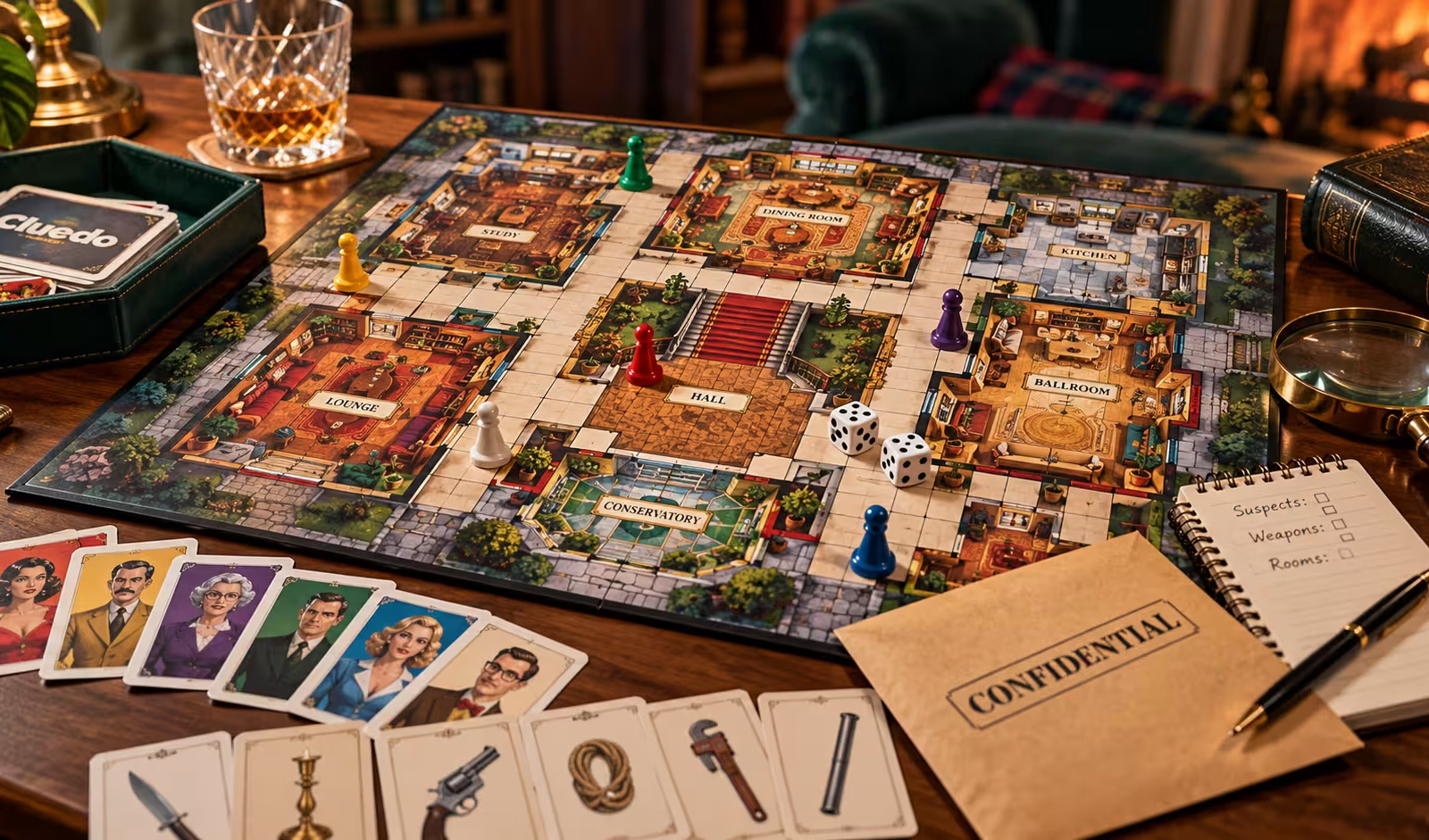
Hasbro’s refreshed Cluedo board game features a redesigned Tudor Mansion, updated suspects and detailed weapon tokens.
What Is the Cluedo Board Game?
Cluedo is a competitive murder mystery board game in which players act as detectives investigating a murder inside Tudor Mansion.
The victim, Boden “Boddy” Black, has been discovered dead after hosting a gathering involving six suspicious guests.
Each character has a potential motive, but nobody knows who committed the crime.
Players must establish three pieces of information:
- Who committed the murder?
- Which weapon was used?
- Which room was the crime scene?
The answer is hidden inside a confidential envelope containing three randomly selected cards.
The remaining evidence cards are distributed among players, who must gradually uncover information by making suggestions and observing how their opponents respond.
The first person to identify all three elements correctly wins.
Although this premise sounds straightforward, the process of reaching the correct conclusion creates a surprisingly satisfying intellectual challenge.
The game rewards observation, accurate record-keeping and the ability to interpret incomplete information.
Unlike modern detective games built around lengthy narratives, Cluedo does not require players to follow an elaborate scripted investigation.
The mystery emerges from the distribution of cards and the decisions made by the participants.
This distinction explains much of its lasting appeal.
How Do You Play Cluedo? Complete Gameplay Explanation
Cluedo’s rules are relatively approachable, but winning consistently requires more than simply moving pieces around the mansion.
The standard game revolves around preparing a hidden solution, collecting evidence and making a final accusation.
Step 1: Prepare the Murder Mystery
Separate the 21 evidence cards into three categories:
- Six character cards.
- Six weapon cards.
- Nine room cards.
Shuffle each category separately and place one card from each into the solution envelope without looking.
These three cards determine the murderer, weapon and location for that game.
There are 324 possible combinations:
6 suspects × 6 weapons × 9 rooms = 324 potential solutions.
Shuffle the remaining evidence cards and distribute them among the players, following the rules for the selected player count.
Each player also receives a detective sheet to record information discovered during the investigation.
Step 2: Move Around Tudor Mansion
Players roll the dice and move their characters through the corridors and rooms.
Entering rooms is important because it gives players opportunities to make suggestions about the crime.
Not every room is equally convenient to reach, and the arrangement of the mansion creates decisions about movement and positioning.
Secret passages can help players move between connected rooms without travelling through multiple corridors.
However, the dice introduce an element of unpredictability.
A player may identify the room they need to investigate but spend several turns trying to reach it.
This is one area where traditional Cluedo begins to feel dated compared with newer deduction games that minimise random movement.
Step 3: Make a Suggestion
Once inside a room, players can propose a possible solution.
For example:
“I suggest it was Professor Plum, in the Library, with the Candlestick.”
The suggested room must match the room being used for the investigation.
Other players then attempt to disprove the suggestion.
Beginning with the player on the left, the first opponent holding any of the named cards must secretly reveal one matching card to the person who made the suggestion.
If they cannot disprove it, the opportunity passes to the next player.
Only one card is shown.
This restriction creates the central deduction challenge.
A player may know that somebody possesses at least one of three cards without learning everything about their hand.
Step 4: Record the Evidence
Every revealed card eliminates one possibility from the hidden solution.
Players should record which cards they have seen and, where possible, who holds them.
However, experienced players can gather additional information simply by listening to other people’s suggestions.
For instance, if two opponents are unable to disprove a particular combination, that information can be useful even when no card is revealed directly to you.
The strongest Cluedo players pay attention throughout the game rather than concentrating exclusively on their own turns.
Step 5: Make the Final Accusation
Once a player believes they have identified the murderer, weapon and room, they can make a formal accusation according to their edition’s rules.
They secretly inspect the envelope.
If all three cards match, they win.
If their accusation is incorrect, they can no longer take investigative turns, although they must continue responding to other players’ suggestions when required.
This consequence makes the final decision particularly important.
Accusing too early can end an otherwise promising investigation.
The official Cluedo instructions demonstrate how players gather evidence, eliminate possibilities and make an accusation to solve the murder.
What Has Changed in the Refreshed Cluedo Board Game?
One of the most important questions for returning players is whether the updated edition offers anything beyond a redesigned box.
Our assessment is that the refresh makes Cluedo more visually attractive and somewhat faster without fundamentally transforming the original gameplay.
Hasbro introduced the reimagined edition in January 2023, retaining the familiar murder mystery structure while updating characters, artwork, playing pieces and additional clue mechanics.
More Detailed Characters
The current F6420 edition includes:
| Character | Identity |
| Miss Scarlett | Investigative journalist |
| Colonel Mustard | Military-themed suspect |
| Mayor Green | Political figure |
| Chef White | Culinary professional |
| Solicitor Peacock | Legal professional |
| Professor Plum | Academic |
The refreshed character identities help create a more distinctive murder mystery atmosphere.
Older Cluedo owners may remember Mr Green, Mrs Peacock, Mrs White or Dr Orchid from different editions.
These variations matter because not every Cluedo box contains the same character names, room designs or additional card mechanics.
Buyers should therefore verify the edition rather than assuming all Cluedo sets are identical.
Redesigned Weapon Pieces
The refreshed edition features six textured, gold-plated zinc weapon tokens.
These include traditional Cluedo weapons such as the candlestick, rope, dagger, revolver, lead pipe and wrench.
The redesigned pieces provide a more substantial physical experience than basic plastic accessories.
This is primarily a presentation improvement rather than a mechanical one, but physical components contribute to how satisfying a board game feels.
Additional Clue Cards
Perhaps the most meaningful gameplay addition is the set of 29 Clue cards.
These introduce opportunities to uncover information more quickly.
For example, certain cards can cause players to reveal evidence or enable a new secret passage.
The magnifying-glass dice mechanic can trigger these additional effects.
From a design perspective, this addresses one of Cluedo’s traditional problems: slow progress when players repeatedly fail to reach useful rooms.
However, it also creates a trade-off.
Faster information gathering can reduce frustration, but special-card effects can make the pace of an investigation less predictable.
Our assessment is that these additions improve accessibility more than strategic depth.
What Comes Inside the Cluedo Board Game Box?
The refreshed F6420 edition includes the following components.
| Component | Quantity |
| Tudor Mansion Game Board | 1 |
| Character Tokens | 6 |
| Weapon Tokens | 6 |
| Character Cards | 6 |
| Weapon Cards | 6 |
| Room Cards | 9 |
| Special Clue Cards | 29 |
| Solution Envelope | 1 |
| Detective Notepad | 1 |
| Dice | 2 |
| Instruction Guide | 1 |
The game contains 50 cards in total.
Our component quality rating is 88%.
The weapon tokens are among the most attractive improvements. The board artwork is more elaborate, and the refreshed characters have a stronger visual identity.
Nevertheless, there are some practical limitations.
The detective notepad is consumable, meaning frequent players may eventually need replacement sheets.
The game also requires enough table space for the mansion board, evidence cards and individual notes.
Although the components are appealing, Cluedo remains a relatively conventional board game in its physical construction.
It is not comparable to premium hobby games featuring elaborate three-dimensional environments or extensive miniature collections.
Is Cluedo Actually a Strategic Board Game?
Yes, but its strategy is more subtle than players sometimes expect.
Our strategic depth rating is 81%.
Cluedo combines two different forms of decision-making.
The first concerns gathering information through questioning.
The second involves navigating the board efficiently enough to obtain that information before other players.
The detective element is considerably stronger.
Information Is More Valuable Than Movement
An inexperienced player might make random suggestions whenever they enter a room.
A stronger player thinks about what each suggestion is likely to reveal.
Suppose you already know that Colonel Mustard cannot be the murderer.
That does not necessarily make his card useless in a suggestion.
Including a card you already hold or know about can help you isolate information about another card.
For example, if you know two of the three suggested cards cannot be part of the solution, another player’s response may reveal something much more specific.
This creates opportunities for controlled questioning.
Why Tracking Other Players Matters?
A basic detective sheet records which cards have been eliminated.
An advanced detective sheet records how information has been revealed.
For example:
- Which player showed a particular card?
- Which players could not answer a suggestion?
- Has somebody repeatedly disproved similar combinations?
- Which suspected cards are still unaccounted for?
- What information might another player already possess?
These observations can expose patterns that are not immediately obvious.
A player who only crosses off cards they personally see may miss important information available from the wider discussion.
Is Bluffing Important?
Cluedo allows a limited form of bluffing.
Players can deliberately include cards from their own hand when making suggestions.
This may conceal which pieces of information they are genuinely trying to discover.
For example, suggesting a weapon you already hold can make an opponent believe you are still investigating that weapon.
However, Cluedo does not offer the same emphasis on deception as a dedicated social deduction game.
The stronger strategic opportunity comes from controlling information rather than persuading people to believe false accusations.
For readers interested in a more socially confrontational experience, The Traitors Board Game review explores how hidden identities, accusations and bluffing create a different style of mystery gaming.
How Many Players Make Cluedo Most Enjoyable?
Although the refreshed edition supports two to six players, we would not recommend every player count equally.
The number of participants influences how much information is available, how quickly turns progress and how complicated the deduction becomes.
| Players | Our Suitability Rating | Experience |
| 2 | 69% | Functional but comparatively limited |
| 3 | 88% | Strong deduction with manageable downtime |
| 4 | 92% | Excellent balance of mystery and interaction |
| 5 | 85% | More information sources, but longer waits |
| 6 | 80% | Social and unpredictable, although potentially slower |
These are editorial suitability scores rather than results from controlled player-count testing.
Why Four Players Is Our Preferred Group Size?
Four players offer a particularly attractive balance.
There are enough opponents to create uncertainty over the location of evidence cards, but not so many that waiting for another turn becomes exhausting.
Players can observe multiple people answering suggestions, which makes the information-gathering process more interesting.
At the same time, everyone remains involved regularly enough to maintain momentum.
For typical family game nights, we consider three or four players the most practical arrangement.
Does Cluedo Work With Six Players?
Yes. Six players can make the investigation feel busier because evidence is spread among a larger group.
However, more players also introduce longer intervals between turns.
This can become frustrating when somebody needs to reach a particular room and repeatedly receives poor dice rolls.
Groups that enjoy discussing discoveries and watching other people’s questions may appreciate the larger format.
Those who prefer fast tactical games may not.
Can Two People Play the Cluedo Board Game?
Yes. The refreshed F6420 edition includes an official two-player variation.
This is particularly relevant because some older Cluedo editions were designed primarily for three to six participants.
The two-player variation changes how the evidence is distributed.
After preparing the hidden solution, four evidence cards are placed face down in separate rooms.
Players can examine these hidden cards when they enter the corresponding rooms.
This creates another way to discover evidence despite there being only one opponent available to answer suggestions.
Is Cluedo Good With Two Players?
Our two-player rating is 69%.
The variation functions correctly and allows couples, siblings and smaller households to enjoy the game.
However, it lacks some of the uncertainty that makes the multiplayer experience entertaining.
With only one opponent, information ownership becomes more predictable.
There are fewer opportunities to analyse why different people respond to suggestions, and much of the social atmosphere disappears.
The result is a straightforward deduction contest.
That is not necessarily undesirable.
Some players may prefer a quieter, more focused investigation.
But if the household primarily consists of two regular players, a game designed specifically around two-person strategy may offer better long-term value.
Our selection of the best board games includes alternatives for couples, families and larger groups.
Is Cluedo Difficult to Learn?
Not particularly.
Our accessibility rating is 89%.
The basic objective is easily explained: investigate the mansion, eliminate possibilities and make a correct accusation.
Most beginners understand the central concept quickly.
However, playing effectively requires greater attention than the simplicity of the rules might suggest.
New players must remember to record evidence accurately, understand the difference between suggestions and accusations, and monitor the responses of other participants.
The biggest learning challenge is therefore not remembering the rules.
It is developing the habit of interpreting evidence systematically.
Can an Eight-Year-Old Play Cluedo?
Hasbro recommends Cluedo for children aged eight and above.
We consider that reasonable, although children develop logical reasoning and reading confidence at different rates.
| Age Group | Our Assessment |
| Under 8 | The standard edition may be challenging without substantial support |
| 8–9 | Suitable with guidance and simplified note-taking |
| 10–12 | Strong age range for developing independent deduction |
| 13–17 | Accessible family strategy with enjoyable competitive elements |
| Adults | Entertaining casual mystery game |
| Experienced Hobby Gamers | Enjoyable occasionally but comparatively light |
Cluedo can encourage younger players to practise deductive reasoning and organised note-taking.
However, its murder mystery theme may be unsuitable for children who are uncomfortable with fictional crime.
Parents should also consider the family’s tolerance for competition and elimination.
An incorrect accusation can remove a player from active participation before the game ends.
For families seeking something less confrontational and with gentler themes, My Lil’ Everdell offers a very different introduction to strategic board gaming through resource management, animal characters and approachable decision-making.
Does Cluedo Have Good Replay Value?
Replayability is one of Cluedo’s most important advantages.
Our rating is 84%.
Because the hidden solution changes between games, players cannot simply memorise the murderer or the correct sequence of answers.
The traditional six-suspect, six-weapon, nine-room structure creates 324 possible solutions.
However, this does not mean that every playthrough will feel completely different.
The available actions, room layout and questioning system remain largely consistent.
What changes is the evidence distribution and how players uncover the hidden combination.
Why Cluedo Is More Replayable Than a Fixed Mystery Game?
Some detective board games feature scripted investigations with predetermined answers.
Once a group has completed a case, replaying the same mystery may offer limited excitement because players already know the solution.
Cluedo avoids this problem through randomised evidence.
The mystery is mechanically new every time, even though the underlying story remains the same.
This makes it particularly suitable for households that revisit the same board games over several years.
Where Replayability Becomes Limited?
The main limitation is strategic repetition.
Experienced players may eventually develop reliable routines involving:
- Reaching useful rooms quickly.
- Recording every revealed card.
- Testing combinations containing known cards.
- Tracking opponents’ responses.
- Delaying accusations until enough evidence is available.
These techniques are effective, but the game does not introduce substantially new mechanisms as players become more experienced.
Cluedo therefore offers strong casual replayability without the expanding strategic possibilities found in more complex contemporary board games.
What Is the Biggest Weakness of the Cluedo Board Game?
The biggest weakness is the tension between its deduction mechanics and its dice-based movement system.
The deduction itself is logical.
If players receive enough information and interpret it correctly, they can identify the solution.
Movement, however, introduces randomness.
A skilled detective may know exactly which room they need to investigate but remain unable to reach it efficiently.
Meanwhile, another player may receive a favourable roll, enter the necessary room and obtain decisive information.
This means superior deduction does not always translate into victory.
Does That Make Cluedo Unfair?
Not entirely.
Good players can still improve their chances through efficient movement and stronger questioning.
But the influence of dice becomes noticeable when comparing Cluedo with modern deduction games that allow players more control over how evidence is obtained.
There is also a pacing issue.
When players repeatedly move through corridors without entering useful rooms, the investigation can temporarily lose momentum.
The newer Clue cards help address this concern, but they do not remove it entirely.
For casual family entertainment, this limitation is manageable.
For highly competitive strategy players, it is a meaningful drawback.
Cluedo vs The Traitors Board Game: Which Is Better?
Both games involve suspicion and mystery, but their approaches are very different.
Cluedo is fundamentally an information puzzle.
The Traitors is a social deduction experience involving hidden roles and deception.
| Feature | Cluedo | The Traitors Board Game |
| Main Mechanic | Logical deduction | Social deduction and bluffing |
| Players | 2–6 | 4–6 |
| Recommended Age | 8+ | 12+ |
| Main Challenge | Discovering hidden evidence | Identifying deceptive players |
| Gameplay Style | Investigative and methodical | Social and confrontational |
| Randomised Mystery | Yes | Different roles and adventures |
| Family Accessibility | Higher for younger children | Better suited to older groups |
| Replayability | Strong through changing solutions | More dependent on adventure content |
| Best Group | 3–4 players | 5–6 players |
Which Should Families Choose?
Cluedo is the stronger option for families who enjoy puzzles, logical thinking and methodical problem-solving.
Its structure gives players something concrete to investigate, and success depends significantly on interpreting evidence.
The Traitors is more suitable for groups that enjoy reading personalities, arguing their case and attempting to deceive one another.
Our preference depends entirely on the intended audience.
For a family with children aged eight to twelve, Cluedo is generally the more accessible purchase.
For a lively group of older teenagers or adults, The Traitors may create a more theatrical social experience.
Is the Cluedo Board Game Worth the Money in 2026?
From a financial perspective, the important question is not simply how much Cluedo costs.
It is how much repeat entertainment the purchase provides.
The refreshed edition has been available through UK retailers at different prices, with one major retailer listing it at £17.50 when checked in October 2026.
The typical recommended retail price for the F6420 edition has been around £24.99, although actual offers vary.
Rather than relying on a single advertised price, we recommend evaluating its value at approximately £20.
Cluedo Cost Per Game: An Example
Assume a household buys Cluedo for £20 and plays it eight times.
| Financial Measure | Example |
| Purchase Price | £20 |
| Number of Games | 8 |
| Players Per Game | 4 |
| Total Group Playing Sessions | 8 |
| Cost Per Group Session | £2.50 |
| Cost Per Player Per Session | Approximately £0.63 |
At that level, Cluedo provides relatively inexpensive repeat entertainment.
If the same household plays it 20 times, the purchase cost falls to £1 per group session.
This is a useful way to evaluate traditional board games.
Unlike subscription-based digital entertainment, a physical board game normally does not require recurring payments for standard play.
There may be occasional replacement costs, such as notepads or missing components, but the core game remains reusable.
When Cluedo Offers Poor Value?
Cluedo becomes less attractive when buyers pay a premium for a special edition they rarely use.
A collector’s version may include themed artwork or accessories, but those additions do not necessarily improve the underlying game.
It is also a less compelling purchase for households that rarely organise games involving three or more people.
A game that remains unused because the household dislikes its mechanics has little practical entertainment value, regardless of how inexpensive it was.
Our value-for-money rating is 86%, reflecting the game’s reusable nature, broad family appeal and generally accessible pricing.
What Do Customer Reviews Suggest About Cluedo?
Published customer feedback suggests that Cluedo continues to attract positive responses from families and adults familiar with the original game.
At the time of our October 2026 research, one major UK retailer displayed a 97% customer recommendation rate across 139 reviews for the refreshed edition.
That is a strong indication of satisfaction among the customers represented on that listing, although it should not be treated as a representative survey of all Cluedo owners.
The recurring positive themes include family enjoyment, nostalgia, updated presentation and the satisfaction of solving a mystery.
There are also understandable reservations.
Some experienced players find the dice movement frustrating, while others feel the game lacks sufficient depth for frequent competitive sessions.
Professional review coverage similarly distinguishes the game’s accessible deduction system from the limitations of its traditional movement mechanics.
Our assessment broadly follows that distinction.
Cluedo succeeds most convincingly when evaluated as an accessible family mystery game, not as a sophisticated modern strategy title.
Cluedo Board Game Pros and Cons
What We Like?
- Excellent deduction mechanics: The investigation rewards observation and systematic reasoning.
- Strong family accessibility: The game is approachable without being completely trivial.
- High replay potential: Randomised solutions prevent players from memorising a single answer.
- Recognisable theme: The mansion, suspects and murder weapons create an immediately understandable premise.
- Improved components: The refreshed edition offers more attractive playing pieces.
- Reasonable value: A reusable physical game can provide inexpensive entertainment over many sessions.
What Could Be Better?
- Dice-dependent movement: Players sometimes waste turns reaching important rooms.
- Limited two-player depth: The official variation works but lacks the interaction of larger games.
- Potential downtime: Five- and six-player sessions can become slow.
- Repetitive structure: Experienced players may eventually find the process predictable.
- Limited storytelling: The theme is strong, but the actual narrative does not develop much during play.
- Elimination after incorrect accusations: Players who guess incorrectly may spend the rest of the game only responding to suggestions.
Who Should Buy the Cluedo Board Game?
Cluedo is particularly suitable for families looking for a familiar, intellectually engaging tabletop game.
We would recommend it most strongly to households with children aged eight or above, groups of three or four players, and casual gamers who enjoy investigation-themed entertainment.
It can also make a sensible gift because its rules are widely recognisable and it does not require extensive familiarity with modern tabletop gaming.
Adults returning to board games after several years may find Cluedo a comfortable starting point.
However, we would be more cautious about recommending it to people who primarily play two-player games, dislike random movement or prefer complex strategy systems.
The right buying decision depends less on whether Cluedo is historically important and more on whether the intended players enjoy solving logical mysteries.
Cluedo Board Game Final Verdict: Is It Still Worth Buying?
Cluedo remains a remarkably effective example of how a simple concept can support decades of entertaining gameplay.
Its central mystery is easy to understand.
Somebody has committed a murder, the evidence is hidden, and every player is attempting to identify the correct combination before their opponents.
The enjoyment comes from discovering how much information can be extracted from apparently ordinary questions.
A suggestion that reveals a single card can eliminate several possibilities. An opponent’s inability to answer can suddenly change an entire investigation.
A carefully constructed theory can bring a player close to victory before one unexpected piece of evidence forces them to reconsider.
These are the moments that continue to make Cluedo enjoyable.
The refreshed edition provides a welcome visual improvement and introduces mechanics that can accelerate information gathering.
But it does not completely eliminate the original design’s limitations.
Dice movement can be frustrating, the two-player experience is weaker and dedicated strategy enthusiasts may prefer more sophisticated deduction games.
Nevertheless, Cluedo remains excellent at what it was designed to deliver: a competitive, accessible and satisfying murder mystery for families and friends.
Our Final Rating: 8.5/10
Best for: Families, casual gamers, mystery enthusiasts and groups of three or four.
Think twice if: You mainly play with two people, dislike dice-based movement or want advanced strategic complexity.
Our verdict: Cluedo is still worth buying in 2026. Its deduction mechanics remain rewarding, its theme is timeless and its physical replay value makes it an appealing family entertainment purchase.
The refreshed edition improves the presentation without losing the simple mystery-solving formula that made the original game successful.
Frequently Asked Questions About the Cluedo Board Game
Is Cluedo a good board game?
Yes. Cluedo is a strong family deduction game that rewards logical thinking and careful observation. It is particularly enjoyable with three or four players.
How many people can play Cluedo?
The refreshed F6420 edition supports two to six players. Some older editions have different player-count requirements, so always check the box.
What age is Cluedo suitable for?
The standard refreshed edition is recommended for children aged eight and above. Younger players may need assistance with note-taking and deduction.
How long does a game of Cluedo take?
Allow approximately 30–60 minutes, depending on the number of players, familiarity with the rules and how quickly the mystery is solved.
Can two players play Cluedo?
Yes. The refreshed edition includes special two-player rules involving additional evidence cards placed in rooms.
Is Cluedo based on luck or skill?
Both. Accurate deduction and careful questioning require skill, while dice rolls and certain special-card effects introduce luck.
What happens if you make the wrong accusation?
You lose the ability to continue investigative turns but must still respond to other players’ suggestions when required.
Is the modern Cluedo better than the original?
The modern edition offers improved artwork, redesigned components and additional clue mechanics.
However, players who prefer a more traditional experience may enjoy older editions without those additions.
Is Cluedo good for adults?
Yes. Adults who enjoy logic puzzles and light strategy can find Cluedo entertaining, although experienced hobby gamers may consider it comparatively simple.
How many possible murder combinations are there in Cluedo?
The traditional game contains 324 possible solutions, based on six suspects, six weapons and nine rooms.
Can you play Cluedo alone?
The standard physical board game does not have an official solo mode. Digital adaptations may provide computer-controlled opponents.
What is the difference between Cluedo and Clue?
They are regional names for the same classic murder mystery game. Cluedo is the familiar UK name, while Clue is used in the United States. Specific editions can differ in their components and rules.
Score
Game Review