Tportstick Gaming Trends From ThePortableGamer: What Is Real in 2026?


Contents
Searches for Tportstick gaming trends from ThePortableGamer lead into a surprisingly confusing corner of the gaming web.
The phrase appears repeatedly in articles about handheld consoles, cloud gaming, plug-and-play devices, cross-platform play and mobile esports, but there is an important distinction that many pages fail to make: Tportstick does not appear to be an established gaming platform, console or recognised hardware standard.
The real story is much more useful. Portable gaming is changing rapidly in 2026, driven by Nintendo Switch 2, Windows handheld PCs, Android retro consoles, cloud streaming, subscription gaming and increasingly sophisticated mobile esports.
For UK players, those trends are also being shaped by faster broadband, expanding 5G coverage, changing subscription prices and a much wider range of portable hardware.
| Question | Current Position |
| Is Tportstick a recognised gaming console? | No independently verified mainstream product has been identified |
| What does the phrase usually describe? | Portable gaming trends associated with ThePortableGamer content |
| Are portable gaming devices growing? | Yes, established handheld and hybrid platforms show substantial demand |
| Major 2026 trends | Hybrid consoles, handheld PCs, cloud gaming, subscriptions, cross-platform play and mobile esports |
| Is every so-called gaming stick legitimate? | No. Licensing, ROM ownership, software quality and security should be checked |
| UK advantage | Strong broadband availability makes cloud and remote gaming increasingly practical |
What Does Tportstick Gaming Trends From ThePortableGamer Actually Mean?
The most important thing to establish is what the keyword does not prove.
ThePortableGamer has published content using variations such as “Tportstick gaming trends”, “Tportstick gaming news” and related terminology.
However, different pages use the term in different ways. Some make it sound like a device, while others effectively use it as a label for portable-gaming coverage.
No consistent specification, manufacturer, operating system, launch announcement or recognised retail product establishes Tportstick as a mainstream console comparable with Nintendo Switch, Steam Deck or PlayStation Portal.
It is therefore safer to understand Tportstick gaming trends from ThePortableGamer as a search phrase associated with discussions about portable gaming rather than the formal name of a new gaming ecosystem.
That distinction matters because describing an undefined term as real hardware would create more confusion. The interesting part of the keyword is the collection of genuine trends behind it.
Which Portable Gaming Trends Actually Matter in 2026?
Hybrid Handheld Consoles Are Still Setting the Pace
Portable gaming is no longer synonymous with a small, underpowered handheld designed only for simple games.
Nintendo Switch helped normalise the idea that one device could operate both as a portable console and a living-room system.
Nintendo Switch 2 has extended that model with more powerful hardware, a 7.9-inch display and improved performance.
Nintendo reported 23.68 million Nintendo Switch 2 hardware units sold worldwide by 30 June 2026, demonstrating the scale that hybrid gaming has now reached.
The UK Nintendo Store lists the standard Switch 2 at £395.99 at the time of checking.
Another important advantage is library continuity. Players moving from the original Switch can play many existing physical and digital games on the newer system.
GamingMag has a detailed breakdown of Nintendo Switch games working on Switch 2, including the exceptions involving older Joy-Con features and accessories.
This combination of portability, backwards compatibility and TV play is much more significant to the current handheld market than the vague idea of a single universal “gaming stick”.
Handheld PCs Are Becoming More Powerful and More Expensive
Steam Deck opened the modern handheld-PC market to a much larger audience, but competition has expanded quickly.
Devices now range from relatively accessible models to premium machines with Windows 11, high-refresh OLED displays and desktop-class features.
The standard 2025 ROG Xbox Ally has recently been listed by ASUS UK at £449, while the premium ROG Xbox Ally X remains around £849. ASUS also lists its 2026 ROG Xbox Ally X20 at £1,299.99, showing how far the upper end of portable PC gaming has moved.
Steam Deck OLED continues to occupy a more moderate position, with the 512GB model historically starting at approximately £479 in the UK.
The trend is therefore not simply “more handhelds”. The market is splitting into clear price and performance tiers, much like laptops and desktop PCs.
Cloud Gaming Is Turning Lightweight Devices Into Gaming Clients
Another genuine Tportstick-style trend is the separation of gaming hardware from the device physically held by the player.
PlayStation Portal illustrates that change particularly well. It began primarily as a PS5 Remote Play device but now supports cloud streaming of eligible PS5 games for PlayStation Plus Premium members.
Sony increased the UK recommended retail price of PlayStation Portal to £219.99 from 2 April 2026.
Cloud gaming means a handheld no longer needs enough local processing power to render every game itself. Instead, the game can run in a data centre or another console and stream video to the player’s screen.
That creates opportunities for phones, tablets, dedicated cloud handhelds, smart televisions and portable clients, but it does not eliminate hardware requirements entirely. Network quality becomes part of the gaming specification.
Cross-Platform Libraries Are Becoming More Important Than Individual Devices
Players increasingly expect progress, purchases, multiplayer identities and subscriptions to follow them between devices.
Xbox represents one of the clearest examples. Its cloud ecosystem supports Windows PCs, handheld PCs, phones, tablets, televisions, browsers and other supported devices. Microsoft even lists Steam Deck cloud support as being available in beta.
For players, this changes the buying question.
Instead of asking only, “Which console has the strongest hardware?”, the decision can become, “Which device gives access to the library and account already being used?”
Cross-progression also encourages shorter gaming sessions across several screens. A player might begin on a console, continue through a handheld and use a phone when travelling.
Mobile Esports Is No Longer a Minor Competitive Category
Mobile gaming sometimes gets treated as a casual alternative to PC and console esports, but the financial scale of leading competitive mobile games challenges that assumption.
Mobile Legends:
Bang Bang returned to the 2026 Esports World Cup with a combined US$3.5 million prize pool across its competitions. Its Mid Season Cup alone awarded US$1 million to champion Team Spirit.
PUBG Mobile’s 2026 World Cup prize pool was also approximately US$3.025 million.
Mobile esports therefore deserves a place in any serious portable-gaming trend analysis. Competitive gaming is no longer tied exclusively to gaming PCs or fixed consoles.
Battery Efficiency Is Becoming as Important as Raw Performance
Portable gaming creates a permanent engineering compromise: more performance normally requires more power.
Nintendo rates Switch 2 battery life at approximately 2 to 6.5 hours, depending on the game and usage conditions.
Meanwhile, lower-powered retro handhelds can run for considerably longer. Anbernic rates the RG556’s 5,500mAh battery at around eight hours, while the Evercade EXP-R is advertised at roughly four to five hours.
The next phase of portable hardware development is therefore likely to focus as much on processor efficiency, cooling and battery technology as graphical performance.
Which Real Portable Gaming Products Can UK Players Buy?
One of the biggest weaknesses in existing Tportstick articles is that they describe categories without showing the hardware those categories actually represent.
Prices below were checked around 5 September 2026 and can change with stock, promotions and retailer availability.
| Product | Type | Approximate UK Price | Best Represents |
| Nintendo Switch 2 | Hybrid handheld console | £395.99 | Portable plus TV gaming |
| Steam Deck OLED 512GB | Linux handheld PC | Around £479 | Portable PC gaming |
| ROG Xbox Ally | Windows handheld PC | Around £449 currently | Xbox and Windows libraries |
| PlayStation Portal | Cloud and Remote Play handheld | £219.99 | Streaming-led handheld gaming |
| Retroid Pocket 5 | Android retro handheld | £255.99 | Compact Android and retro gaming |
| Evercade EXP-R | Licensed retro handheld | Around £99.99 | Physical retro game cartridges |
| Anbernic RG556 | Android handheld | Around £220 from some UK marketplace listings | Android and emulation-focused gaming |
Nintendo’s official UK store confirms the £395.99 Switch 2 price, ASUS currently lists the ROG Xbox Ally from £449, Sony’s Portal RRP is £219.99 and the UK Retroid retailer lists the Pocket 5 at £255.99.
The Evercade EXP-R is available through UK retailers such as Argos at approximately £99.99. Unlike many generic retro devices, Evercade uses an officially licensed cartridge ecosystem.
Anbernic pricing is more fragmented because many devices are imported or sold through marketplaces. A UK eBay listing for a new RG556 was recently around £219.99, while Anbernic’s own international store lists the base unit in US dollars.
Are Retro-Bit, Hyperkin and 8BitDo Really Gaming-Stick Brands?
Not in the way some articles imply.
Retro-Bit, Hyperkin and 8BitDo are legitimate gaming brands, but they are strongly associated with controllers and accessories, rather than being evidence that “Tportstick” is a recognised hardware category.
| Brand | Real Example | Current UK Price Example | What It Actually Is |
| Retro-Bit | NES wired controller | About £15.99 | Retro controller |
| Hyperkin | Competitor Xbox/PC controller | About £35 | Modern gamepad |
| 8BitDo | Ultimate 2C Wireless | About £25.99 | PC and Android controller |
| Retroid | Pocket 5 | £255.99 | Android handheld |
| Anbernic | RG556 | Varies by seller | Android handheld |
| Evercade | EXP-R | Around £99.99 | Licensed retro handheld |
Current UK listings support those distinctions.
Grouping all six brands under “gaming sticks” therefore obscures what consumers are actually buying.
Which Gaming Subscriptions Matter Most for Portable Players?
Subscription access is another area where generic trend articles often avoid specific names and prices.
| Service | Current UK Cost | Approximate Library | Cloud Gaming? | Portable Value |
| Xbox Game Pass Ultimate | £16.99/month | 400+ games stated on current plan page | Yes | Excellent across handheld PC, phone, tablet and other supported devices |
| PlayStation Plus Premium | £14.99/month | Hundreds of games | Yes | Especially relevant to PS Portal and PS5 |
| Apple Arcade | £6.99/month | 200+ games | No traditional cloud streaming | Native gaming across Apple devices |
| Netflix Games | Included with Netflix, currently from £7.99/month | 80+ mobile games | Mainly downloaded mobile titles | Useful bonus for existing Netflix users |
Microsoft’s current UK Game Pass information lists Ultimate at £16.99 per month with 400+ games and cloud play.
PlayStation Plus Premium costs £14.99 for a one-month UK membership at the current 2026 rate and includes cloud streaming among its Premium benefits.
Apple Arcade costs £6.99 per month and Apple describes a catalogue of more than 200 games without advertising or in-app purchases.
Netflix is slightly different. Games are included with a normal Netflix membership rather than sold through a separate gaming subscription.
Netflix currently advertises UK memberships starting at £7.99 per month, while its gaming support page lists access to more than 80 exclusive mobile games.
The underlying trend is clear: access to games is becoming detached from ownership of a particular piece of hardware.
Is UK Broadband Ready for Portable Cloud Gaming?
For many households, yes, although headline broadband speed is only part of the equation.
Ofcom reported in its spring 2026 Connected Nations update that 89% of UK homes could access gigabit-capable broadband, while full fibre had reached 82% of UK residential premises by January 2026.
That is far above the raw bandwidth required by most cloud gaming platforms.
| Platform | Stated Connection Requirement |
| PlayStation Portal Cloud Streaming | 5 Mbps to establish a session |
| PlayStation Portal 720p | 7 Mbps |
| PlayStation Portal 1080p | 13 Mbps |
| Xbox Cloud Gaming on mobile | Around 10 Mbps minimum/best-performance guidance varies by device |
| Xbox on PC, console and tablet | Around 20 Mbps |
| GeForce NOW 720p/60 | 15 Mbps |
| GeForce NOW 1080p/60 | 25 Mbps |
| GeForce NOW 4K/120 | 45 Mbps |
Sony’s current Portal support specifies 13 Mbps for 1080p streaming.
Microsoft states that Xbox Cloud Gaming performs best at around 10 Mbps on mobile and 20 Mbps on PCs, consoles and tablets, while NVIDIA specifies 25 Mbps for 1080p at 60fps.
However, latency, Wi-Fi congestion, packet loss and distance from the cloud server can affect gameplay even when a speed test appears fast.
This is especially important for fighting games, racing games and competitive shooters where a small delay between an input and the resulting action is noticeable.
How Can Players Reduce Cloud Gaming Lag?
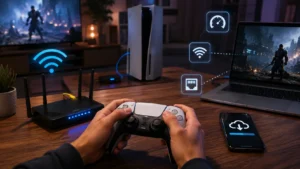
A faster broadband package is not always the first solution. Connection quality inside the home is often the bigger problem.
1. Use 5GHz or 6GHz Wi-Fi where possible. These frequencies normally provide more capacity and less interference than congested 2.4GHz connections at shorter ranges.
2. Move closer to the router or access point. Several walls or floors can reduce wireless stability even when broadband itself is fast.
3. Connect the main console or PC by Ethernet. Remote Play can improve when at least the host device has a wired connection.
4. Stop large downloads and uploads. Game updates, cloud backups and 4K video streams can increase network congestion.
5. Test latency as well as download speed. A 500 Mbps line with unstable latency can feel worse in a game than a stable 50 Mbps connection.
6. Lower streaming resolution when necessary. Dropping from 1080p to 720p can stabilise a weak connection rather than repeatedly buffering at the higher setting.
For portable players, network consistency is more important than simply purchasing the broadband package with the largest advertised number.
How Did Portable Gaming Reach This Point?
Modern portable gaming is the result of several different hardware eras gradually converging.
| Period | Major Development |
| Early 2000s | Plug-and-play TV game systems offered simple console-style gaming from compact hardware |
| 2004 onwards | Nintendo DS and Sony PSP established advanced dedicated handheld ecosystems |
| Smartphone era | iOS and Android turned billions of general-purpose phones into gaming devices |
| 2017 | Nintendo Switch brought mainstream hybrid handheld and television gaming together |
| 2022 | Steam Deck accelerated interest in handheld PC gaming |
| 2023 | PlayStation Portal pushed console Remote Play into dedicated handheld hardware |
| 2025 | Nintendo Switch 2 expanded the hybrid model with substantially newer hardware |
| 2026 | Windows handhelds, cloud gaming and Android retro systems increasingly overlap |
The important trend is convergence.
A modern portable system can now be a console, miniature PC, streaming terminal, Android device, retro machine or several of those things at once.
That makes “portable gaming” a much broader category than it was during the PSP and Nintendo DS years.
Are Gaming Sticks and Preloaded Retro Consoles Legal in the UK?
This deserves more attention than it receives in most Tportstick articles.
Emulation technology and the games supplied with an emulator are two different issues. A device being capable of running an emulator does not automatically mean every ROM supplied with it is legally licensed.
UK copyright law generally prevents copyright material from being copied or distributed without permission unless a licence or recognised copyright exception applies. Computer software is protected by copyright.
That means consumers should be cautious when inexpensive HDMI sticks or handhelds advertise thousands of commercial games with no clear licensing information.
Products such as Evercade take a different approach by distributing games through licensed physical cartridges.
For buyers, useful checks include the publisher names, licensing statements, official game store support and whether software is being supplied by a recognised rights holder.
What Security Risks Come With Portable and Cross-Platform Gaming?
Portable gaming increasingly requires accounts rather than just cartridges.
A single gaming account may now hold purchased games, cloud saves, payment methods, achievements and multiplayer identities across several devices.
Players should therefore avoid entering primary gaming credentials into unknown retro consoles, unofficial apps or modified operating systems unless the software source can be trusted.
Multi-factor authentication or passkeys should be enabled where supported. Recovery email addresses and phone numbers should also remain current.
When selling or recycling a handheld, the device should be fully signed out, locally stored account information removed and the storage reset using the manufacturer’s recommended procedure.
Cloud saves should also be checked before resetting a system to avoid accidentally deleting progress that has not synchronised.
Is Cheap Portable Hardware Creating an E-Waste Problem?
Portability can encourage rapid hardware turnover, particularly at the inexpensive end of the market.
A £30 or £40 generic gaming stick is easier to discard when its controller, storage or software fails than a £400 handheld console designed to receive long-term updates.
For UK buyers, repairability, replacement batteries, firmware support and access to legitimate replacement parts are therefore becoming useful purchasing criteria.
Nintendo, for example, states that the Switch 2 battery is not user-removable but can be replaced through Nintendo Customer Support for a fee.
UK electrical-waste rules also require retailers to provide routes for consumers to dispose of old electrical equipment, including like-for-like take-back when purchasing a replacement product. Games consoles fall within electrical and electronic equipment regulations.
A device that costs slightly more but remains supported and repairable for longer can therefore represent better value than repeatedly buying disposable hardware.
Which Tportstick Gaming Claims Are Real and Which Are Hype?
| Claim | Reality in 2026 |
| Tportstick is a major new gaming console | No reliable evidence currently establishes this |
| Portable gaming is becoming mainstream | Yes |
| Gaming sticks are replacing consoles | No; cheap sticks remain a niche while handheld and hybrid consoles have much stronger evidence of demand |
| Cloud gaming removes the need for powerful local hardware | Partly; it reduces local processing requirements but introduces network requirements |
| Mobile esports is only casual gaming | False; major mobile tournaments carry multimillion-dollar prize pools |
| One subscription gives access to everything | False; catalogues, platforms and cloud rights differ |
| All retro handhelds are illegal | False; licensing depends on the software and content involved |
| Faster broadband always fixes cloud lag | No; latency and Wi-Fi quality are equally important |
| Battery technology has solved portable gaming | No; demanding handhelds can still have relatively short battery life |
This is arguably the most useful way to interpret the keyword.
The Tportstick name is questionable, but many of the gaming trends attached to it are completely real.
What Comes Next for Portable Gaming?
The next phase is likely to reduce the distinction between console, PC, mobile and cloud gaming even further.
More handheld PCs are likely to adopt efficient processors, OLED screens and AI-assisted image upscaling. Console ecosystems will continue expanding beyond a single television-connected device.
Cloud streaming will become easier to access directly from handhelds, televisions and lightweight clients.
At the same time, price will become an important dividing line.
Portable hardware already stretches from sub-£100 retro systems to Windows handhelds costing more than £1,000. That creates very different markets under the same “portable gaming” label.
Subscription ownership will also matter more. Players with large Steam, Xbox, PlayStation, Nintendo, Apple or mobile libraries are increasingly likely to choose devices based on where their existing games can be accessed rather than specifications alone.
For UK players, improving broadband infrastructure makes cloud gaming increasingly realistic, but local hardware is unlikely to disappear.
Offline gaming, latency-sensitive games and ownership concerns continue to give dedicated devices an important role.
Conclusion
Tportstick gaming trends from ThePortableGamer is best approached with some scepticism about the name but considerable interest in the gaming developments associated with it.
There is no need to invent a mysterious new Tportstick console to explain why the keyword exists. Portable gaming itself supplies a much stronger story.
Nintendo Switch 2 has demonstrated continuing demand for hybrid gaming. Steam Deck and ROG handhelds have turned portable PCs into a serious hardware category.
PlayStation Portal and Xbox Cloud Gaming demonstrate how streaming can separate a game from the device running it.
Apple Arcade, Game Pass, PlayStation Plus and Netflix Games show how subscription libraries are changing access, while multimillion-dollar mobile esports competitions underline how far smartphone gaming has developed.
For UK players, the most meaningful trends are therefore better handheld hardware, stronger broadband infrastructure, cloud access, cross-platform libraries, subscription gaming, legitimate retro hardware and longer-term concerns around security, licensing and e-waste.
Those are measurable developments. Tportstick itself, at least for now, is better treated as an unclear label attached to them.
Frequently Asked Questions
Is Tportstick a Real Gaming Console?
There is currently no strong evidence identifying Tportstick as an established mainstream console with a recognised manufacturer, specifications and retail distribution.
The term is used inconsistently online and appears more useful as a search phrase associated with portable-gaming content.
What Are Tportstick Gaming Trends From ThePortableGamer?
The phrase generally leads to content discussing portable gaming developments such as handheld consoles, gaming sticks, cloud gaming, cross-platform play, subscriptions, mobile gaming and esports.
What Is the Biggest Portable Gaming Trend in 2026?
Hybrid and handheld gaming is one of the strongest trends. Nintendo Switch 2 has reached 23.68 million worldwide hardware sales as of 30 June 2026, while Windows handheld PCs and streaming devices continue expanding the category.
What Is the Best Portable Gaming Device in the UK?
There is no single best option. Switch 2 suits players wanting a traditional hybrid console, Steam Deck and ROG Xbox Ally target PC libraries, PlayStation Portal focuses on streaming, and Retroid, Anbernic and Evercade serve different parts of the retro-handheld market.
Can Cloud Gaming Work on Normal UK Broadband?
Yes, in many cases. PlayStation Portal requires around 13 Mbps for 1080p cloud streaming, while GeForce NOW recommends 25 Mbps for 1080p at 60fps.
Ofcom says gigabit-capable broadband is available to 89% of UK homes, although latency and Wi-Fi stability still affect the experience.
Are Preloaded Retro Gaming Sticks Legal?
That depends on the games and licences involved. Emulation should not automatically be confused with copyright infringement, but distributing copyrighted game files without permission can infringe UK copyright.
Buyers should favour devices and game libraries with clear licensing information.
Is Mobile Gaming Becoming More Competitive?
Yes. Major mobile esports competitions now carry substantial prize pools. Mobile Legends competitions at the 2026 Esports World Cup had a combined US$3.5 million pool, while the PUBG Mobile World Cup was worth roughly US$3 million.
Conclusion
Tportstick gaming trends from ThePortableGamer is best approached with some scepticism about the name but considerable interest in the gaming developments associated with it.
There is no need to invent a mysterious new Tportstick console to explain why the keyword exists. Portable gaming itself supplies a much stronger story.
Nintendo Switch 2 has demonstrated continuing demand for hybrid gaming. Steam Deck and ROG handhelds have turned portable PCs into a serious hardware category.
PlayStation Portal and Xbox Cloud Gaming demonstrate how streaming can separate a game from the device running it.
Apple Arcade, Game Pass, PlayStation Plus and Netflix Games show how subscription libraries are changing access, while multimillion-dollar mobile esports competitions underline how far smartphone gaming has developed.
For UK players, the most meaningful trends are therefore better handheld hardware, stronger broadband infrastructure, cloud access, cross-platform libraries, subscription gaming, legitimate retro hardware and longer-term concerns around security, licensing and e-waste.
Those are measurable developments. Tportstick itself, at least for now, is better treated as an unclear label attached to them.