UK Betting Sites 🇬🇧 www.casinominister.blog: Complete 2027 Guide, Reviews, Safety and 2026 Updates
Explore UK betting sites and CasinoMinister.blog in this 2027 guide, covering bookmaker reviews, UKGC licensing, betting odds, gambling safety, consumer protection and the latest regulatory updates.


Contents
The UK online betting market is entering 2027 with significant changes to gambling regulations, consumer protection, promotional offers and bookmaker taxation.
For anyone searching for UK betting sites 🇬🇧 www.casinominister.blog, understanding the difference between a gambling comparison website and a licensed bookmaker is more important than simply choosing the platform displaying the largest welcome bonus.
Our analysis of UK betting comparisons, regulatory information and CasinoMinister.blog’s published content found that betting websites need to be evaluated on more than promotional offers.
Licensing, odds, market rules, withdrawals, complaints procedures and safer-gambling controls can all influence the experience.
CasinoMinister.blog provides informational content about UK sports betting, casino websites, gambling rules and international operators. However, it does not itself accept sports bets or operate an online casino.
For 2027, we have examined what the website offers, how established UK bookmakers compare, the regulatory developments confirmed during 2026 and the scheduled changes that could affect the betting industry.
What Is UK Betting Sites 🇬🇧 www.casinominister.blog?
CasinoMinister.blog is an online gambling information and editorial website offering country-specific guides covering casinos, sportsbooks, betting regulations, promotional terms and consumer safeguards.
Its UK section, available at www.casinominister.blog/uk, includes separate areas for sports betting and casino-related information.
Rather than functioning as a bookmaker, the website explains subjects such as football betting markets, horse racing settlement rules, each-way bets, cash-out options and gambling licensing.
Our review identified several categories of content:
- UK sports betting and bookmaker information
- Online casino reviews and promotional conditions
- Betting without a UK gambling licence
- GAMSTOP and self-exclusion information
- International casino regulation
- Cryptocurrency casino information
- Casino bonuses and wagering requirements
- Betting disputes and consumer protection
One important distinction is that CasinoMinister.blog’s published editorial persona, Elena Vale, is explicitly identified by the website as fictional. Readers should not interpret that persona as evidence of an independently qualified gambling expert or firsthand operator testing.
The platform can therefore be understood as a research resource, but any bookmaker or casino discussed on the website must be assessed separately.

CasinoMinister.blog’s official UK homepage showing its sports betting and casino information categories.
How Does CasinoMinister.blog Compare With Other UK Betting Guides?
We analysed the publicly accessible UK pages and developed an editorial completeness score covering five aspects of its published information.
These are our subjective percentage ratings of the information provided by the website, not ratings of gambling safety, licensing, actual withdrawal performance or customer satisfaction.
They are based on a November 2026 desk review, without financial transactions or independent software testing.
| Editorial assessment | Our rating | What we found |
| Website purpose and disclosure | 90% | Clearly identifies itself as an editorial publication rather than a bookmaker |
| Licensing and jurisdiction explanations | 86% | Discusses UKGC verification and distinctions between markets |
| Sports betting explanations | 82% | Covers settlement periods, each-way bets and cash-out limitations |
| Evidence in individual reviews | 58% | Readers still need independent documentary verification of review claims |
| Direct bookmaker comparisons | 55% | Limited comparative data for evaluating individual UK sportsbooks |
| Overall editorial completeness | 74% | Useful background information, but insufficient alone for choosing a bookmaker |
The overall score is the rounded, equally weighted average of these five assessments.
Our strongest finding concerns the website’s emphasis on reading betting conditions before relying on a promotional claim.
Its sports betting material correctly draws attention to a distinction often overlooked in shorter comparisons: two markets mentioning the same football team may have different settlement rules.
Nevertheless, we would not treat a review site’s inclusion of an operator as proof that it is appropriately licensed.
A useful comparison website should identify the operator’s registered business, the precise gambling domain, the evidence supporting its conclusions and the date its information was checked.
Which UK Betting Sites Are Worth Comparing in 2027?
The UK betting market includes established online bookmakers, specialist sports betting platforms, betting exchanges and pool-betting operators.
Our November 2026 comparison of publicly documented bookmaker features identified several recognisable platforms that readers may encounter when researching the market for 2027.
These are examples for comparison, not a verified ranking of the safest, most profitable or fastest-paying bookmakers in 2027. Operating permissions, betting odds, bonus terms and available features must be rechecked before use.
| Betting platform | Main area to compare | Important consideration |
| bet365 | Football markets, in-play betting and streaming | Check market settlement and live-betting restrictions |
| Betfred | Horse racing, football and sports promotions | Check each-way terms and racing deductions |
| Paddy Power | Football markets and bet builders | Examine correlated selections and bonus conditions |
| Betfair | Betting exchange and sportsbook | Exchange commission and liquidity affect value |
| Sky Bet | Football markets and accumulator features | Review the exact odds and promotional restrictions |
| William Hill | Racing and established sports markets | Compare prices and account conditions |
| Midnite | Modern sportsbook and esports-related coverage | Check event availability and settlement rules |
| Tote | Horse racing pool betting | Dividends depend on pool calculations rather than ordinary fixed odds |
What matters is the contract attached to the actual bet, not simply how recognisable the bookmaker’s name is.
A platform with attractive football markets may offer relatively poor prices on horse racing. Another may provide an exchange model with competitive headline odds but commission deductions.
For that reason, a single percentage rating cannot establish which bookmaker will be most suitable for every adult customer.
How Should We Assess These Betting Sites?
Our preferred editorial assessment framework allocates 100 percentage points across five measurable areas.
| Assessment criterion | Weight |
| Regulatory authorisation and consumer protection | 30% |
| Odds competitiveness and market transparency | 25% |
| Withdrawal conditions and payment transparency | 20% |
| Customer service and complaints handling | 15% |
| App usability and accessibility of account controls | 10% |
| Total | 100% |
Regulatory authorisation remains a mandatory eligibility requirement rather than a weakness that can be offset by a high score elsewhere.
An unlicensed operator should not receive an acceptable overall recommendation merely because its interface is attractive or its advertised odds are high.
This approach also avoids a common problem with online betting rankings: awarding high scores based mainly on welcome bonuses whose conditions may expire or change.
How Can You Check Whether a UK Betting Site Is Licensed?
Licensing is the first and most consequential check for consumers using online betting platforms in Great Britain.
The Gambling Commission regulates commercial gambling in Great Britain. Northern Ireland has a separate legal framework, so an article describing the whole United Kingdom should not assume that all relevant regulatory arrangements are identical.
A website displaying a British flag, accepting pounds sterling or providing UK sporting fixtures is not automatically authorised.
Before evaluating an online bookmaker, readers should check the following:
- Identify the legal company operating the gambling website.
- Find the company’s stated Gambling Commission account or licence details.
- Search the official UK Gambling Commission public register.
- Compare the registered business and trading name with the website accepting bets.
- Check the permitted gambling activities and current licence status.
- Review any recorded regulatory action and the operator’s complaints arrangements.
A genuine overseas gambling licence does not, by itself, establish permission to offer remote gambling to consumers in Great Britain.
This distinction also applies to websites that discuss gambling products across multiple jurisdictions.
For example, our examination of German casino restrictions and international casino websites highlights why readers must distinguish the jurisdiction of a gambling operator from the country its marketing is targeting.
What Changed for UK Betting Sites During 2026?
The most significant confirmed developments affect bonus rules, deposit-limit terminology and the approach to identifying financial vulnerability.
These changes are particularly relevant to people relying on gambling articles published before 2026.
New Gambling Bonus Rules From January 2026
On 19 January 2026, Gambling Commission changes to promotional rules came into force.
The requirements include a maximum 10-times play-through requirement on bonus funds and restrictions on combining different gambling product types within the same incentive.
For example, when a promotional bonus is subject to a permitted 10-times wagering requirement, £20 of bonus funds would involve £200 of qualifying wagering.
That £200 figure represents betting turnover, not an amount the customer is guaranteed to lose or receive.
The rules do not mean that all promotional offers are free from conditions. Expiry periods, eligibility criteria, qualifying bets and other lawful restrictions may still apply.
Tim Miller, Executive Director for Research and Policy at the Gambling Commission, described the intention behind the changes:
“These changes will better protect consumers from gambling harm.”
Our assessment is that the clearer promotional framework makes it especially important for comparison websites to display current, dated terms rather than recycling bonus descriptions from previous years.
Clearer Deposit Limits From June 2026
From 30 June 2026, online gambling operators were required to offer customers the ability to set a deposit limit defined by the amount paid into an account over a specified period.
Other financial controls, such as loss limits, may also be offered but should be distinguished from deposit limits.
The difference matters because deposits, withdrawals and losses are not interchangeable measures.
For example, depositing £100 and later withdrawing £60 does not mean the initial deposit was £40.
A useful gambling account dashboard should make the definitions of available limits clear.
Financial Vulnerability Checks and Risk Assessments
Financial vulnerability checks were already a regulatory requirement before 2026.
Since February 2025, the applicable threshold has generally been net deposits exceeding £150 over a rolling 30-day period. These light-touch checks examine relevant public-record information, including indicators of serious financial difficulty.
Separately, in July 2026, the Gambling Commission announced a staged approach to more extensive Financial Risk Assessments for higher-spending customers.
The first stage is intended to cover larger operators and unusually high spending, with initial thresholds of more than £5,000 net deposits in 24 hours for customers aged 25 and over, and lower thresholds for younger or otherwise higher-risk groups.
Further implementation stages and timing require separate regulatory confirmation. The fully developed thresholds should not be presented as already applying to every customer in November 2026.
Sarah Gardner, then Acting Chief Executive of the Gambling Commission, said the regulator was seeking to support high-spending customers in financial difficulty while “reducing friction for customers who are not in financial difficulties”.
For a 2027 betting comparison, the important distinction is between checks already in force and further measures announced for phased introduction.
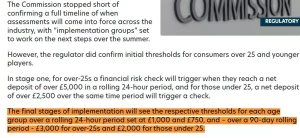
Gambling Commission’s official announcement explaining the staged Financial Risk Assessments, including initial and eventual thresholds.
What Gambling Tax Changes Are Scheduled for 2027?
One of the biggest developments affecting UK online betting businesses is the new remote betting tax rate scheduled for 1 April 2027.
Under the government’s announced gambling-duty changes, the rate of General Betting Duty applying to most remote betting will increase to 25%.
Remote betting on UK horse racing is excluded from that particular increase and is due to remain subject to the existing 15% rate. Other excluded categories are dealt with separately.
This follows the increase in Remote Gaming Duty from 21% to 40%, which took effect in April 2026.
| Gambling tax | 2026 position | Scheduled 2027 position |
| Remote Gaming Duty | 40% from April 2026 | 40%, unless subsequently changed |
| General Betting Duty on most remote bets | Generally 15% | 25% from April 2027 |
| Remote betting on UK horse racing | 15% | 15% |
| General betting in physical betting shops | Generally 15% | Not covered by the new 25% remote rate |
These are taxes on gambling operators, rather than a new 25% tax deducted directly from an ordinary customer’s winnings.
UK customers’ gambling winnings generally remain tax-free.
However, higher operator taxation can affect the commercial economics of online betting. Businesses may review margins, marketing expenditure and promotional budgets in response.
Those are possible commercial responses, not confirmed changes by any individual bookmaker.
Our analysis suggests that consumers should pay attention to the underlying odds and conditions rather than assuming that a bookmaker’s promotional offer will remain unchanged throughout 2027.
The announced policy and its relevant exclusions can be checked through the government’s official gambling-duty guidance.
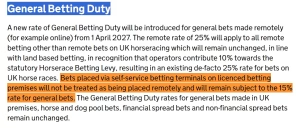
GOV.UK gambling duty changes, showing the proposed 25% remote betting rate from 1 April 2027 and the exclusion for UK horse racing.
How Do UK Betting Odds Affect Actual Returns?
A meaningful betting-site review should examine odds quality instead of focusing only on bonus value.
Decimal and fractional odds describe the same underlying potential payout, but the customer must understand what the displayed price includes.
Consider a £10 single bet at decimal odds of 2.40.
| Calculation | Amount |
| Initial stake | £10 |
| Decimal odds | 2.40 |
| Total return if successful | £24 |
| Net profit if successful | £14 |
| Loss if unsuccessful | £10 |
| Implied probability | 41.67% |
The implied probability is calculated as:
Implied probability = 1 ÷ decimal odds × 100
An implied probability is not an independent forecast of the true likelihood of an event. It represents the probability implied by the bookmaker’s quoted price.
Understanding Bookmaker Margins
Bookmakers ordinarily build a margin into their pricing.
In a simplified two-outcome event, imagine both possible results are quoted at decimal odds of 1.90.
Each selection carries an implied probability of approximately 52.63%.
Together, the two implied probabilities total 105.26%, creating a 5.26% overround.
| Two-outcome pricing example | Odds on each result | Total implied probability | Overround |
| Example A | 1.90 | 105.26% | 5.26% |
| Example B | 1.95 | 102.56% | 2.56% |
The lower-overround example is mathematically more competitive for that particular market.
However, this comparison does not establish that either selection has positive expected value.
Our view is that displaying both the odds and implied probabilities makes a bookmaker comparison significantly more informative.
Which Betting Markets Require the Most Attention?
Football, horse racing, tennis, cricket, darts and other sports use different settlement rules.
Even within a single event, betting markets may involve significantly different outcomes.
A football match-result selection commonly relates to 90 minutes plus stoppage time, excluding extra time and penalties unless stated otherwise.
A qualification market asks a different question: which team progresses.
A team could therefore win a knockout tie after extra time while failing to win a conventional 90-minute match-result bet.
Horse racing has different complications, including non-runners, place terms, Rule 4 deductions and each-way settlement.
An advertised each-way bet of £5 normally represents two £5 components: £5 to win and £5 to place, creating a total £10 commitment.
These distinctions appear in CasinoMinister.blog’s sports betting explanations and are important because they address what a bookmaker is contractually agreeing to settle.
We recommend checking the actual market name and bet slip before accepting any wager. General explanations should never override the relevant operator’s published rules.
What About Accumulators and Bet Builders?
Accumulators combine multiple selections and require every relevant leg to succeed, subject to the bookmaker’s rules.
The attraction is the possibility of a larger combined payout, but the probability of winning generally declines as independent selections are added.
For example, five independent selections each having a true 60% chance of success would have a combined probability of approximately 7.78%.
That calculation assumes independence, which cannot automatically be applied to correlated bet-builder markets.
Bet builders may combine related outcomes within the same sporting event, and the bookmaker’s pricing should account for those relationships.
The displayed potential return should not be confused with a reliable estimate of the chance of success.
What Should Bettors Check About Payments and Withdrawals?
Withdrawal transparency is another important area in which a detailed review can provide more value than a conventional promotional list.
A bookmaker advertising fast withdrawals may still have separate processes for identity verification, payment approval and funds reaching the recipient.
An advertised processing time should not be interpreted as an unconditional guarantee.
Before using a bookmaker, examine the following:
| Payment feature | What to check |
| Minimum deposit | Any lower limit or payment-specific restriction |
| Minimum withdrawal | Whether small balances can be withdrawn |
| Processing time | When the operator starts processing the request |
| Identity verification | Documents and account checks that may be required |
| Payment method | Whether withdrawals must return to the original method |
| Account restrictions | What happens when a payment is under review |
| Bonus balance | Whether promotional terms affect withdrawable funds |
| Complaints process | How an unresolved payment dispute can be escalated |
Regulated gambling operators in Great Britain are also prohibited from accepting credit card payments for gambling, subject to the applicable regulatory scope.
Account verification should not automatically be regarded as evidence that a platform is unreliable. Verification serves legitimate purposes, including age checks, account security and fraud prevention.
Nevertheless, operators should explain their requirements clearly and handle disputes fairly.
A professional betting-site review should distinguish an operator’s advertised payment policy from independently documented withdrawal outcomes.
Without records of real transactions, there is no sound basis for claiming that one bookmaker consistently pays faster than another.
How Can Customers Resolve Disputes With UK Betting Sites?
Consumer disputes may involve incorrect settlement, rejected withdrawals, account restrictions or disagreements about promotional terms.
Licensed gambling operators must provide accessible complaints procedures.
If an eligible complaint remains unresolved after eight weeks, or the operator reaches deadlock sooner, customers should have access to an approved Alternative Dispute Resolution provider.
Before submitting a complaint, it is useful to retain:
- The original bet slip and accepted odds
- Transaction references and payment records
- Relevant betting-market conditions
- Screenshots of promotional terms
- Written customer-service correspondence
- Details of the operator’s final response
For disputed sports bets, the precise market definition is particularly important.
An operator may have correctly settled a market that a customer misunderstood. Conversely, a documented discrepancy between the accepted bet and the applied settlement rules may support a formal complaint.
A review should help readers understand these distinctions instead of promising that every dispute will be resolved in the customer’s favour.
Are Betting Sites Not on GAMSTOP Safer or More Flexible?
Searches involving bookmakers outside GAMSTOP frequently appear alongside UK betting and international casino keywords.
However, the absence of GAMSTOP participation should not be treated as a positive safety feature.
GAMSTOP is a self-exclusion service intended to help individuals prevent access to participating UK-licensed online gambling businesses.
Someone who has registered for self-exclusion should maintain that protection rather than search for alternative gambling websites to bypass it.
A bookmaker operating outside the British licensing framework may not offer the same regulatory protections, complaints arrangements or self-exclusion coverage.
A foreign gambling licence may be genuine, but it does not establish equivalent consumer protection in Great Britain.
This is especially important when a website markets offshore operators using familiar UK sporting events, British currency or a localised interface.
Readers should not interpret a platform’s apparent willingness to accept a UK registration as proof that it is legally permitted to provide gambling services.
Is CasinoMinister.blog a Trustworthy Source for 2027?
Our assessment is that CasinoMinister.blog offers useful educational explanations of betting terminology and regulatory considerations, but it should not be treated as an independent certification authority for gambling businesses.
The website clearly identifies itself as editorial and states that paid listings may involve advertising or commission.
That disclosure is useful.
However, an editorial publication’s description of an operator is not a substitute for verifying its licence, ownership, terms and dispute arrangements.
Its UK-facing material is strongest when it explains how to approach a question, such as whether extra time counts in a football bet or why a foreign licence does not automatically establish British authorisation.
It is less complete as a standalone comparative resource for selecting between licensed UK bookmakers because detailed, independently verifiable performance data is limited.
For 2027, a stronger gambling comparison should distinguish three types of evidence:
| Evidence category | Example | Reliability considerations |
| Regulatory evidence | Official licence records | Strong evidence of recorded authorisation at the time checked |
| Documentary evidence | Operator terms and payment policies | Establishes published conditions, not actual service performance |
| Operational evidence | Documented withdrawals or customer-service testing | Establishes an observed result under specific circumstances |
This distinction helps prevent marketing claims from being presented as independently tested findings.
It is also why our own CasinoMinister.blog score measures editorial completeness rather than guaranteeing that the website’s listed operators are suitable for British customers.
What Should UK Betting Comparisons Prioritise in 2027?
Looking ahead, we believe the most informative betting-site comparisons will be those that regularly review the relationship between gambling regulation, pricing and customer protection.
The 2026 reforms have already changed how operators must structure certain promotions and present deposit limits.
The scheduled April 2027 remote betting tax change adds another consideration for bookmaker businesses.
Meanwhile, Financial Risk Assessments are moving through a planned phased implementation process, subject to confirmed regulatory timetables.
These developments give publishers several areas to monitor.
First, betting comparisons should review the actual price available for the same selection across different licensed operators, while keeping market conditions identical.
Second, promotional comparisons need to record expiry dates and explain whether free-bet stakes are returned, what qualifying bets are required and whether there are additional restrictions.
Third, reviews should consider how clearly an operator communicates the complaints process, account verification and safer-gambling controls.
Finally, readers should be able to distinguish observed transaction performance from claims that appear only in advertising.
We would therefore prioritise transparent documentation and current regulatory information over increasingly large lists of apparently top-rated betting sites.
How Can Adults Approach Online Betting More Safely?
Online betting is a form of gambling with financial risk. No sportsbook, odds format, statistical model or promotional offer can guarantee a profit.
A sensible consumer approach is to treat any amount staked as money that could be lost entirely.
Financial commitments such as housing, utilities, food, savings and debt repayments should not depend on betting outcomes.
Set affordable limits before participating and avoid increasing stakes in an attempt to recover previous losses.
Repeated loss-chasing, borrowing to gamble or feeling unable to stop are warning signs that support may be needed.
The National Gambling Helpline, operated by GamCare, provides free confidential support on 0808 8020 133, 24 hours a day.
Gambling should not be treated as a financial strategy, business income opportunity or reliable way to improve personal finances.
Final Verdict
Our editorial review gives CasinoMinister.blog a 74% content-completeness rating, based on its publicly available UK gambling information as examined in November 2026.
The website provides helpful explanations of sports betting markets, licensing requirements and promotional risks. Its strongest value is educational rather than transactional.
However, choosing a UK betting site in 2027 requires more than reading an editorial comparison. Consumers should independently verify licensing, examine actual betting terms, understand financial exposure and check the available complaints and safer-gambling protections.
The January and June 2026 regulatory changes have already made the UK betting environment more structured in important areas, while the scheduled April 2027 tax change could influence the economics of online bookmakers.
For readers researching UK betting sites 🇬🇧 www.casinominister.blog, the central conclusion is straightforward: distinguish information publishers from gambling operators, rely on verifiable records rather than promotional promises, and recognise that betting always involves the possibility of financial loss.
18+ only. Gambling involves financial risk. Seek support if gambling is affecting your finances or wellbeing.
Frequently Asked Questions
What is UK betting sites 🇬🇧 www.casinominister.blog?
It refers to CasinoMinister.blog’s UK-facing casino and sports betting information. The website publishes gambling guides and reviews but does not itself operate as a bookmaker.
Is CasinoMinister.blog a licensed UK bookmaker?
CasinoMinister.blog identifies itself as an editorial publication rather than a gambling operator. The gambling licences of third-party bookmakers mentioned on the site must be checked independently.
What are the main UK betting regulation updates for 2027?
The most important scheduled development is the 25% remote betting duty on most remote bets from April 2027. Readers should also consider the 2026 changes to promotions, deposit limits and financial protection measures.
Are UK betting winnings taxable in 2027?
Ordinary gambling winnings are generally tax-free for UK customers. The announced remote betting duty change concerns operator taxation, not a direct 25% deduction from customer winnings.
Can a bookmaker licensed overseas legally accept British customers?
A foreign licence alone does not establish permission to provide remote gambling services in Great Britain. Consumers should verify the actual operator and licensed activities through the Gambling Commission.
Do all UK betting sites offer the same odds?
No. Bookmakers can quote different odds for the same selection and may apply different market conditions. Comparing identical markets and understanding the bookmaker’s margin is more informative than comparing welcome bonuses alone.
Is CasinoMinister.blog reliable for choosing a betting site?
It provides relevant background information, particularly on gambling regulation and betting rules. However, its editorial content is not a substitute for independent licence verification, current operator terms or documented customer-service evidence.