My Lil’ Everdell Board Game Review: A Charming Family Strategy Game, But Is It Worth Buying?

Contents
Some board games look like they were designed for children but have enough strategy to keep adults interested. Others promise a clever family experience and end up being little more than colourful distractions.
My Lil’ Everdell sits somewhere much closer to the first category.
At first glance, it looks like a miniature version of Everdell, replacing the original game’s ambitious woodland civilisation with younger animals building their own imaginary settlement.
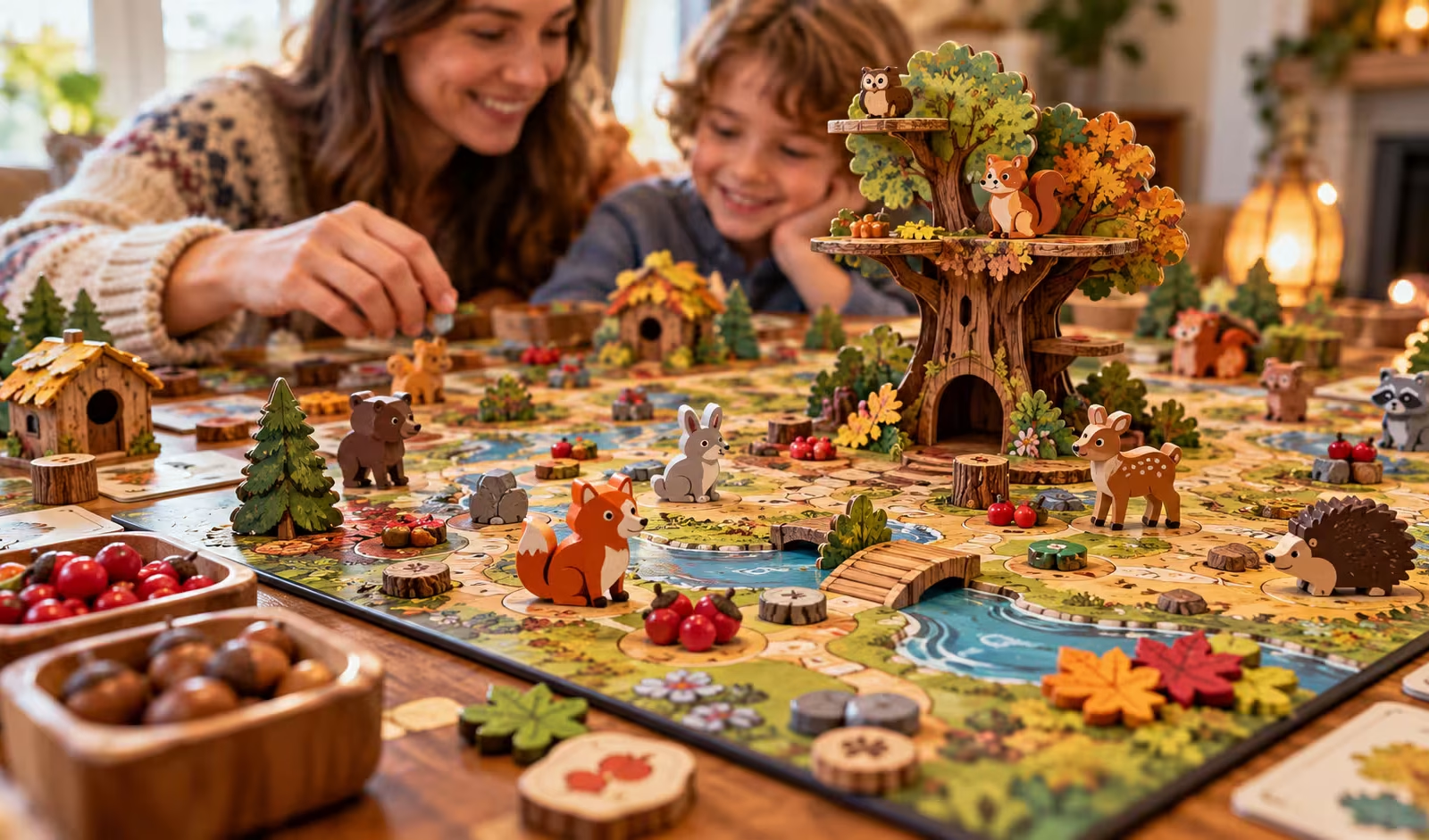
There are colourful berries, wooden animal pieces, beautifully illustrated cards and an inviting forest setting.
But underneath that charming presentation is a surprisingly recognisable strategy game.
Players still need to manage resources, place workers, build card combinations and compete for valuable scoring opportunities. The difference is that My Lil’ Everdell compresses these decisions into a shorter, more approachable experience.
After analysing the official rules, published reviews and feedback from tabletop enthusiasts and family board game players, one point becomes particularly clear: My Lil’ Everdell is not simply a children’s game.
It is a streamlined introduction to the worker-placement and engine-building mechanics that make modern strategy games enjoyable.
However, its limited decision space, reliance on dice and relatively modest strategic depth mean it will not satisfy every Everdell fan.
So, does this smaller woodland adventure deserve a permanent place in your board game collection?
Our overall assessment is 86%: an excellent introductory family strategy game with beautiful components, approachable mechanics and enough meaningful decisions to justify repeated sessions.
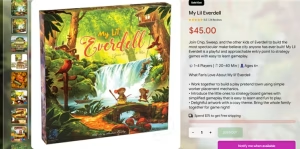
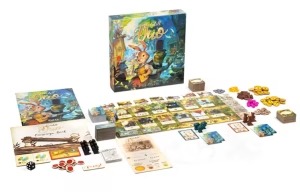
My Lil’ Everdell’s illustrated box, woodland game board, resource containers, cards and animal workers.
My Lil’ Everdell Review: Our Ratings at a Glance
| Review Category | Our Rating | Assessment |
| Gameplay Mechanics | 87% | Simple actions with satisfying decisions |
| Family Accessibility | 92% | Excellent introduction to modern board gaming |
| Learning Curve | 85% | Approachable, although younger children need guidance |
| Strategic Depth | 73% | Meaningful choices but limited long-term complexity |
| Artwork and Theme | 96% | An exceptionally attractive woodland setting |
| Component Quality | 94% | Premium original edition with appealing tactile pieces |
| Replayability | 79% | Enjoyable across multiple sessions, but can become repetitive |
| Solo Experience | 76% | Welcome additional mode with relatively simple opponents |
| Value for Money | 82% | Good for families, particularly at a sensible retail price |
| Overall Rating | 86% | Highly recommended for family strategy gaming |
These percentages reflect our editorial assessment of the game’s design and suitability for its audience rather than a statistical measurement of player satisfaction.
My Lil’ Everdell Game Details
| Feature | Information |
| Game | My Lil’ Everdell |
| Release Year | 2022 |
| Designers | James A. Wilson and Clarissa A. Wilson |
| Publisher | Starling Games / Tabletop Tycoon |
| Main Illustrator | Andrew Bosley |
| Additional Illustration | Jacqui Davis |
| Players | 1–4 |
| Recommended Age | 6+ |
| Typical Playing Time | 20–40 minutes |
| Game Genre | Family strategy and worker placement |
| Core Mechanics | Worker placement, resource management, tableau building and set collection |
| Game Length | 4 rounds |
| Turns per Player | 12 worker placements across the game |
| Solo Mode | Yes, in the original My Lil’ Everdell edition |
| Our Rating | 86% |
What Is My Lil’ Everdell?
My Lil’ Everdell is a standalone family strategy board game set in the same woodland universe as the original Everdell.
Rather than building a full settlement with adult woodland creatures, players guide younger animals who are pretending to establish their own little communities.
The objective is straightforward: gather resources, play Critter and Place cards, build a successful collection of cards and earn more victory points than your opponents.
The gameplay revolves around three important resources:
- Berries
- Twigs
- Resin
These resources are used to purchase cards from a shared display. Cards provide immediate rewards, recurring benefits, extra worker-placement locations or endgame points.
Players also compete to complete special objectives called Parades.
Although the rules are significantly lighter than those of the original Everdell, the fundamental gameplay still rewards efficient resource management and good timing.
One of the game’s biggest strengths is how naturally these mechanics fit together.
You collect resources because you want cards. You play cards because they improve your future opportunities. You build combinations because they help you complete Parades and score more points.
There is a clear sense of progression throughout each session.
That is exactly what a good introductory strategy game should deliver.
What Comes Inside the My Lil’ Everdell Box?
The original My Lil’ Everdell makes an immediately positive impression through its physical components.
The game includes a central illustrated board, individual home boards, colourful cards, resource dice, wooden animal workers and dedicated containers for resources.
The original edition’s main components include:
| Component | Quantity |
| Main Game Board | 1 |
| Home Boards | 4 |
| Animal Friend Meeples | 12 |
| Resource Dice | 4 |
| Solo Mode Eight-Sided Die | 1 |
| Parade Tokens | 16 |
| Resource Pieces | 48 |
| Supply Crates | 4 |
| Main Deck Cards | 54 listed in the publisher’s components |
| Captain Cards | 4 |
| Fort Cards | 4 |
| Solo Opponent Card | 1 double-sided |
| Sun and Moon Tokens | 1 each |
The animal Friend meeples are divided into four groups: butterflies, foxes, lizards and mice.
These are especially appealing components because they make worker placement feel more tangible.
Instead of moving generic discs around the board, players are sending individual woodland animals to gather useful supplies.
The resource pieces also contribute to the experience. Berries, twigs and resin are visually distinct, making it easier for younger players to recognise what they have collected.
Our component quality rating: 94%.
The only significant reservation concerns the practical value of the deluxe-style presentation. Wooden meeples and shaped resources are attractive, but they do not fundamentally improve the strategic mechanics.
The cardboard supply crates are charming, although they also introduce a small amount of assembly and can be less convenient than ordinary resource trays.
For families who enjoy the physical experience of tabletop gaming, the original edition has considerable appeal.
For buyers concerned primarily with price, the less expensive Welcome to Everdell edition deserves serious consideration.
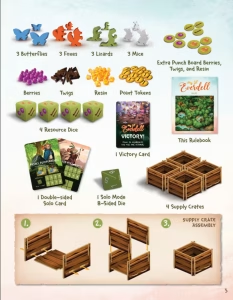
Original My Lil’ Everdell components, including butterfly, fox, lizard and mouse workers, resource pieces, dice and supply crates.
My Lil’ Everdell How to Play: Complete Beginner Explanation?
The most important thing to understand about My Lil’ Everdell is that each player has only three workers to place during a round.
The game lasts four rounds, giving each player a total of 12 worker-placement turns.
On each turn, players place one worker on a location and can then purchase one available card if they have the required resources.
This creates a manageable structure without eliminating the need to plan ahead.
Step 1: Set Up the Game Board
Place the main board in the centre of the table.
Arrange the berries, twigs and resin in their supply areas and keep the victory point tokens nearby.
Each player receives a home board and three matching animal workers.
Next, shuffle the main deck and reveal eight cards face-up in the shared display below the board.
These eight cards represent the available construction and Critter options.
Arrange the four types of Parade tokens in their corresponding locations, placing the highest-value tokens on top.
The starting player receives the Sun token, while the Moon token tracks progression through the game’s four rounds.
Finally, prepare one resource die per player.
The result is a relatively compact setup, especially compared with the original Everdell.
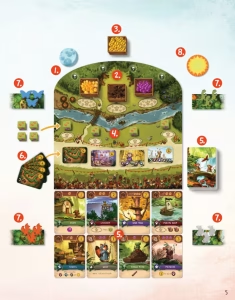
Complete My Lil’ Everdell setup, showing the central board, resource dice, eight-card display, Parade tokens and player pieces.
Step 2: Roll the Resource Dice
At the beginning of each round, the starting player rolls the resource dice.
The dice determine the rewards available at the special resource locations.
These spaces are particularly important because they can provide more valuable combinations than the ordinary resource-gathering areas.
However, only one worker can occupy each special dice location during a round.
That introduces one of the game’s most interesting competitive decisions.
Suppose a die offers the resin you need to purchase an important card. Another player might claim that location before your next turn.
You must therefore decide whether to prioritise the valuable resource location or pursue another part of your strategy.
This is a simplified form of the worker-placement competition found in much larger strategy games.
Step 3: Collect Resources by Placing Workers
Players take turns placing one animal Friend onto an available location.
The three ordinary resource locations remain accessible even when another worker is already there.
Special dice locations are different because only one worker can occupy each of them.
Players who have built particular Red cards may also gain additional personal worker-placement spaces.
These locations cannot normally be used by opponents.
This distinction provides a small but meaningful strategic advantage.
Building a Red card can make your future resource collection less dependent on contested central spaces.
Step 4: Play Critter and Place Cards
After placing a worker, players may purchase one face-up card from the shared display.
To play a card, pay its resource cost and add it to your personal collection.
The purchased card is immediately replaced with another from the deck.
Every card belongs to one of two broad categories:
Critter cards represent the woodland characters who contribute to your community.
Place cards represent locations, activities and structures being created.
The most enjoyable aspect of this system is that different cards interact with one another.
Some provide immediate benefits. Others generate recurring resources or reward players for collecting particular types of cards.
Even though the system is simplified, building combinations can still feel satisfying.
Step 5: Complete Parades
Players can earn Parade tokens by meeting particular card-collection objectives.
Because the first player to complete a Parade receives the highest-value token, there is an incentive to pay attention to opponents.
A player might be close to finishing a five-Critter collection while another player is working towards the same objective.
The timing matters.
Completing the Parade first could make the difference between winning and losing.
Step 6: Finish the Round
Once every player has placed all three workers, the round ends.
Workers return home, the first-player token changes hands and the Moon token advances.
At the start of the next round, the resource dice are rolled again and previously played Green production cards activate.
After four rounds, players calculate their scores.
The player with the highest total wins.
Our gameplay assessment: 87%
The rules successfully establish a satisfying cycle of collecting, building and scoring without requiring players to remember dozens of exceptions.
My Lil’ Everdell Rules: Understanding the Five Card Colours
One area that deserves more explanation than it usually receives is the card-colour system.
Although My Lil’ Everdell is marketed towards children, there are five different types of card abilities to understand.
| Card Colour | What It Does | Strategic Importance |
| Green | Provides resources or rewards immediately and at the beginning of later rounds | Strong for early resource production |
| Blue | Rewards certain actions or reduces specific card costs | Useful for building combinations |
| Tan | Gives a one-time reward when played | Helpful for immediate progress |
| Red | Creates a personal worker-placement action | Expands available action choices |
| Purple | Provides endgame scoring benefits | Valuable for finishing a scoring strategy |
This is where My Lil’ Everdell begins to reveal more strategy than its appearance might suggest.
A Green card played early can generate several rounds of value. The same card purchased during the final round may provide only its immediate reward.
A Purple card might not help you collect resources, but its final scoring potential could outweigh a smaller short-term advantage.
Blue cards become particularly interesting when they reduce costs or reward repeated actions.
The challenge is not simply collecting whichever card looks attractive.
Players must judge whether a card’s effect will be valuable during the remaining turns.
For experienced players, this is relatively straightforward.
For children encountering resource management for the first time, it introduces an important planning skill.
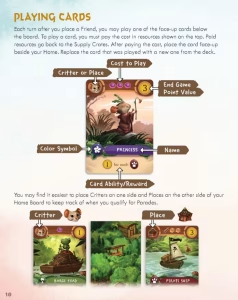
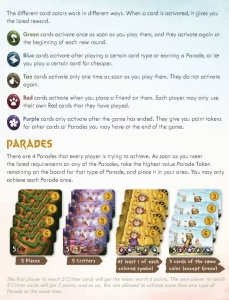
My Lil’ Everdell card anatomy and the five ability colours.
Why Parades Are the Most Important Scoring Mechanic?
Parades provide the clearest competitive objectives in My Lil’ Everdell.
There are four different Parade achievements:
| Parade Objective | Requirement |
| Place Parade | Collect 5 Place cards |
| Critter Parade | Collect 5 Critter cards |
| Colour Collection Parade | Have at least 1 card of each of the five colours |
| Matching Colour Parade | Collect 3 cards of the same colour, excluding Green |
- Each player can claim each Parade type only once.
- The first player to complete an objective receives a token worth six points.
- The next receives five points, followed by four and three points.
- This system rewards efficient development and creates a genuine race between players.
- It also makes the eight-card shared display more competitive.
- A card that seems unremarkable from a resource-production perspective could become essential if it completes an important Parade.
- That can influence which cards players choose.
- For example, imagine a player has four Critter cards and sees an affordable fifth Critter in the display.
- Purchasing it could immediately secure the six-point token.
- But another player may need the same card.
- Suddenly, selecting a card becomes more than a question of improving your personal collection.
The Parade race gives My Lil’ Everdell a welcome dose of competition without turning it into an aggressive strategy game.
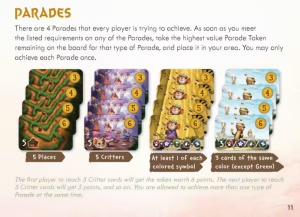
The four Parade achievements and their descending six-, five-, four- and three-point rewards.
How Strategic Is My Lil’ Everdell Really?
Our strategic depth rating is 73%.
That score reflects an important distinction: My Lil’ Everdell has meaningful strategy, but it does not have the breadth of decision-making found in heavier engine-building games.
The most obvious limitation is the number of turns.
With 12 worker placements across the entire game, every player has a relatively small number of opportunities to develop their collection.
This makes decisions easy to understand, but it also reduces the scope for elaborate combinations.
Early Resource Production Matters
Green cards are particularly attractive during the opening rounds because they can continue generating benefits later.
A player who establishes reliable early production may find subsequent purchases considerably easier.
However, prioritising production too heavily can also mean missing valuable Parade opportunities.
The best strategy balances long-term benefits against immediate scoring.
The Shared Card Display Adds Competition
The eight available cards are visible to everyone.
That means players can identify what opponents might be collecting.
A card that completes a rival’s Parade could be especially valuable.
This creates a limited form of indirect player interaction.
However, the game does not encourage aggressive confrontation.
Most of the competition comes from shared spaces, available cards and Parade timing.
Dice Can Disrupt Your Plans
The resource dice introduce variation at the beginning of every round.
That helps maintain replayability, but it can also frustrate carefully prepared strategies.
Sometimes the ideal resource combination simply does not appear.
Experienced players can usually adapt, but children may find it disappointing when their planned purchase becomes difficult.
This is one of the game’s trade-offs.
The dice keep the system accessible and unpredictable, but they reduce the degree of control available to players.
Card Combinations Remain Fairly Limited
The simplified card abilities make the game easier to teach.
Unfortunately, they also mean many successful strategies begin to look similar after repeated sessions.
Resource production, affordable cards and efficient Parade completion are consistently important.
Players looking for complex combinations and unexpected tactical discoveries may eventually prefer the original Everdell.
That does not mean My Lil’ Everdell fails strategically.
It means the game succeeds most effectively when judged against its intended audience.
What Experienced Board Game Reviewers Think About My Lil’ Everdell?
The opinions emerging from established tabletop reviews broadly agree on the game’s strengths while recognising its limitations.
Board game reviewer Tony Mastrangeli described My Lil’ Everdell as:
“a great introduction to the worker placement mechanic.”
That assessment captures one of the strongest arguments in the game’s favour.
It teaches a genuine strategy-game mechanism rather than replacing strategic decisions with random movement or simple luck.
Mastrangeli’s family-focused review also explored how children respond to the shared card display. His experience highlights something worth considering: competitive card selection can produce frustration when one child takes a card another was planning to use.
That is useful context for parents.
Children who are comfortable losing opportunities and adjusting plans may enjoy the game considerably more than those who expect to complete every objective.
Reviewer Spencer Patterson reached a similarly positive overall conclusion, describing the experience as:
“An enjoyable Everdell experience for newcomers and families alike.”
However, Patterson also raised an important concern about the recommended age.
The game’s mechanics are approachable, but children who are only beginning to play modern board games may still struggle with card abilities and planning.
Our assessment agrees with that distinction.
My Lil’ Everdell is easy compared with Everdell, but it is not necessarily easy compared with the simplest children’s board games.
My Lil’ Everdell Age Range: Is It Really Suitable for Six-Year-Olds?
The official My Lil’ Everdell age range begins at six years old.
However, age recommendations do not always communicate how independently a child can play.
A six-year-old who already understands card effects, collecting resources and taking turns may be comfortable with the game.
A child of the same age who has mostly played straightforward roll-and-move games may require considerable help.
Our suggested suitability breakdown is:
| Age Group | Our Assessment |
| Under 6 | Generally too demanding for independent play |
| 6–7 | Suitable with adult guidance, depending on experience |
| 8–10 | Particularly strong introduction to strategy |
| 11–13 | Enjoyable for lighter family sessions |
| Teenagers | Fun as a short game, but may lack complexity |
| Adults | Accessible filler game or family experience |
These are editorial recommendations rather than changes to the official age rating.
Why Six-Year-Olds May Need Help?
The most challenging part is not reading the cards.
Many effects are represented with symbols, reducing the amount of reading required.
The real difficulty comes from understanding how decisions affect later turns.
Children need to recognise that gathering one resource now could enable a more valuable card later.
They also need to remember recurring card effects and keep track of Parade progress.
That introduces several cognitive demands at once.
The Official Rules Include Advantages for Younger Children
One of the most thoughtful design choices is the inclusion of optional starting advantages.
A younger player can receive one Berry, one Twig and one Resin at the beginning of the game.
Alternatively, they can begin with a Captain card, a Fort card or both.
These starting cards help with production and contribute towards Parade objectives.
This is a particularly useful approach when younger children are playing against experienced adults.
Instead of requiring adults to make deliberately poor decisions, the game provides an official way to reduce the skill gap.
Our recommendation is to introduce these advantages during early family sessions rather than treating every game as a perfectly equal competition.
The objective should initially be understanding the mechanics and enjoying the process of building a woodland community.
Winning can become more important once everyone understands how the game works.
Is My Lil’ Everdell Fun for Adults?
Yes, although expectations matter.
An adult playing with younger family members is likely to appreciate the game’s combination of simplicity and familiar strategy mechanics.
There is enough decision-making to avoid feeling entirely passive.
Choosing resources, evaluating card combinations and watching opponents approach Parade milestones are all enjoyable.
However, experienced tabletop enthusiasts may notice that their strategic options become relatively obvious.
The best moves are often determined by the cards currently available and the resources already collected.
A dedicated strategy group seeking an intricate two-hour experience will almost certainly find My Lil’ Everdell too lightweight.
A family wanting a short, attractive game after dinner is much closer to its ideal audience.
Players interested in exploring other tabletop experiences can also compare the different styles of strategy, cooperative and family games among our best board games for every type of player.
Is Welcome to Everdell the Same as My Lil’ Everdell?
Welcome to Everdell and My Lil’ Everdell share essentially the same core gameplay, but they are not identical physical editions.
This distinction matters because buyers may encounter both titles when shopping online.
My Lil’ Everdell is the original premium-style edition, featuring wooden animal meeples, shaped resources and additional components.
Welcome to Everdell is designed as a more affordable version of the same family-oriented gameplay experience.
It replaces many of the premium components with cardboard alternatives.
| Feature | My Lil’ Everdell | Welcome to Everdell |
| Core Gameplay | Family worker placement | Essentially the same core system |
| Players | 1–4, including solo | Primarily 2–4 in the standard rules |
| Recommended Age | 6+ | 6+ |
| Worker Pieces | Wooden animal meeples | Cardboard character standees |
| Resource Pieces | Shaped premium resources | Cardboard resource tokens |
| Solo Equipment | Dedicated solo card and eight-sided die | Not included in the standard essentials edition |
| Component Presentation | More premium | More economical |
| Typical Price Position | Higher | Lower |
The biggest practical difference is therefore not how the main multiplayer game works.
It is the presentation, component quality and included extras.
The original My Lil’ Everdell has a dedicated solo system, while the standard Welcome to Everdell rules and contents focus on multiplayer play.
That is worth checking before purchasing, particularly if the ability to play alone is important.
Which Edition Should You Buy?
Choose My Lil’ Everdell if you value wooden components, attractive resource pieces and the official solo equipment.
Choose Welcome to Everdell if your main priority is enjoying the family gameplay at a lower price.
For households with younger children who mostly play together, Welcome to Everdell may offer better value.
For collectors and people who love the tactile presentation of Everdell games, the original edition remains appealing.
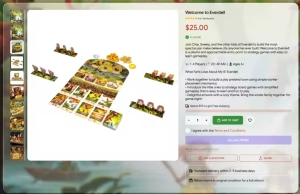
Welcome to Everdell’s more economical presentation, featuring cardboard character standees and resource tokens.
My Lil’ Everdell vs Everdell Duo: Which Is Better?
This is one of the most useful comparisons for anyone entering the Everdell series.
Although both games provide more compact alternatives to the original Everdell, they target different audiences.
My Lil’ Everdell is primarily a family introduction to strategy gaming. Everdell Duo is a more involved woodland strategy experience designed around one or two players.
Everdell Duo introduces a distinctive shared Sun and Moon turn structure, additional card abilities, event objectives and a cooperative campaign.
It is not simply My Lil’ Everdell with a smaller player count.
My Lil’ Everdell vs Everdell Duo Comparison
| Feature | My Lil’ Everdell | Everdell Duo |
| Main Audience | Children and families | Couples and experienced two-player gamers |
| Players | 1–4 | 1–2 |
| Recommended Age | 6+ | 10+ |
| Average Playtime | 20–40 minutes | Around 30 minutes |
| Strategic Complexity | Light | Moderate |
| Worker Placement | Simplified three-worker structure | More involved turn and timing decisions |
| Card Strategy | Basic card combinations | Wider variety of card abilities |
| Competitive Mode | Yes | Yes |
| Cooperative Campaign | No | Yes |
| Solo Play | Yes, original edition | Yes |
| Best Feature | Accessibility | Two-player strategic depth |
Why My Lil’ Everdell Is Better for Families?
My Lil’ Everdell accommodates up to four people.
The rules are simpler, the objectives are easier to explain and the lower age recommendation makes it appropriate for mixed-age households.
It is particularly suitable when parents want to introduce children to resource management without overwhelming them.
Why Everdell Duo Is Better for Two Adults?
Everdell Duo provides more substantial tactical decision-making.
Its shared timing system creates competition over which actions can be completed before the season progresses.
The cooperative campaign also gives couples an alternative to direct competition.
For two adult players who already enjoy modern tabletop strategy games, Duo is generally the stronger long-term recommendation.
Our Recommendation
Buy My Lil’ Everdell for children, mixed-age households and beginners.
Buy Everdell Duo for two players who want deeper strategy and cooperative options.
Buy the original Everdell when the group is ready for a substantially larger engine-building experience.
Everdell Duo’s dedicated two-player board, woodland cards, worker meeples and additional components.
How Does My Lil’ Everdell Compare With the Original Everdell?
The original Everdell remains the most substantial experience of the three for conventional competitive city building.
Players have more opportunities to develop intricate card combinations, manage different worker-placement spaces and create long-term strategies.
My Lil’ Everdell reduces much of that complexity.
The key difference is not simply the number of components.
It is the number of meaningful decisions and the consequences those decisions create.
In Everdell, an early card might contribute towards an elaborate strategy involving numerous future actions.
In My Lil’ Everdell, the same general principle is simplified into a more direct sequence of gathering resources and playing beneficial cards.
This makes My Lil’ Everdell easier to understand and substantially faster to complete.
It also makes it a useful stepping stone.
Families can begin with My Lil’ Everdell, become comfortable with the mechanics and eventually move towards the original game.
However, there is no requirement to progress.
Some households may prefer the shorter experience permanently.
Can You Play My Lil’ Everdell Solo?
Yes. The original My Lil’ Everdell includes an official solo mode.
Players compete against an automated opponent represented by one of two characters:
Prince Pumpernickel or Princess Periwinkle.
The solo system uses a dedicated double-sided opponent card and an eight-sided die.
Each opponent follows rules that determine how workers are placed and cards are selected.
Prince Pumpernickel uses available resource-dice locations before placing elsewhere when necessary.
Princess Periwinkle interacts with the shared card display differently, temporarily occupying the spaces from which cards have been taken.
Neither opponent manages resources in the same way as a human player.
Instead, the automated system develops its own card collection and competes for points.
This makes solo play relatively straightforward to operate.
The rules also include optional adjustments that increase the challenge, such as allowing the opponent to claim Parades earlier or begin with additional cards.
Is the Solo Mode Worth Playing?
Our solo rating is 76%.
The mode is a useful addition, especially for players who want to practise the mechanics or enjoy short independent sessions.
However, the automated opponents are not particularly sophisticated.
They do not replicate the deeper strategic judgement of an experienced human opponent.
The solo game is therefore more enjoyable as a light puzzle than as a highly competitive tactical challenge.
It is a worthwhile inclusion, but not necessarily the main reason to purchase the game.
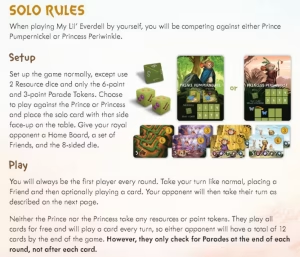
My Lil’ Everdell’s solo opponents, Prince Pumpernickel and Princess Periwinkle, alongside the solo die
My Lil’ Everdell Strategy: Five Ways to Score More Points
Although the game is accessible, several simple strategies can improve your results.
1. Prioritise Production Early
A Green card played early can provide resources across later rounds.
This generally makes early production more valuable than purchasing cards purely for their printed points.
However, avoid buying production cards automatically.
Consider how many rounds remain and whether the resources they provide will be useful.
2. Monitor Every Parade
Do not focus exclusively on your own cards.
Watch which Parades other players are approaching.
Claiming the six-point token rather than the five-point token is a meaningful advantage in a relatively short game.
Also remember that some cards may help satisfy multiple Parade objectives.
3. Use Special Resource Spaces Efficiently
The dice locations can provide stronger rewards than ordinary resource spaces.
But because each is limited to one worker, waiting too long may cause you to lose an attractive opportunity.
When a dice location supplies exactly what you need, securing it early can be worthwhile.
4. Consider Cards That Reduce Future Costs
Cards providing discounts or recurring bonuses can be more valuable than their immediate point totals suggest.
A discount that enables additional purchases across several turns may have a bigger impact than one extra point.
The challenge is recognising whether enough turns remain to benefit.
5. Do Not Waste Resources at the End
Unused resources can be exchanged for points at the end of the game.
Every two remaining resources generate one point.
However, spending resources on a worthwhile card can often provide more points than simply holding them.
In the final round, compare the immediate point value of a purchase against the points you could earn by keeping the resources.
This is a useful final-turn calculation, particularly when the scores are close.
How Does Scoring Work in My Lil’ Everdell?
Final scoring combines several sources:
- Printed point values on your cards.
- Points earned from Parade tokens.
- Point tokens collected during the game.
- Additional points from Purple card abilities.
- Points obtained by exchanging unused resources.
Every two remaining resources can be converted into one point.
For example, consider a hypothetical player with the following results:
| Scoring Source | Points |
| Printed Card Values | 23 |
| Parade Tokens | 11 |
| Collected Point Tokens, Including Purple Bonuses | 4 |
| Five Leftover Resources Exchanged for Points | 2 |
| Final Score | 40 |
The player with the most points wins.
If players are tied, the official multiplayer tiebreaker favours the player with the highest total printed point value on their cards.
This scoring system is accessible once the different sources are understood.
However, younger children may need assistance calculating Purple card bonuses and adding the final totals.
Does My Lil’ Everdell Have Good Replayability?
Our replayability rating is 79%.
The game has several features that support repeated sessions.
Resource dice create variation, the shared card display changes between games and opponents may pursue different Parades.
These elements prevent every session from unfolding identically.
The four-round structure is also short enough that families can replay the game without committing an entire afternoon.
However, replayability has limits.
Players will gradually become familiar with the most useful card combinations and the most efficient methods of completing Parades.
Because the game has a relatively small decision space, experienced players may eventually develop predictable approaches.
There are also fewer opportunities for unusual long-term combinations than in the original Everdell.
For children and casual families, this is unlikely to be a major problem.
For dedicated strategy enthusiasts, the limited complexity could become noticeable much sooner.
My Lil’ Everdell Amazon: Is It Worth Buying Online?
Anyone searching for My Lil’ Everdell Amazon listings should pay particular attention to the edition being advertised.
Listings may include My Lil’ Everdell, Welcome to Everdell or products from the wider Everdell series.
These are not necessarily interchangeable purchases.
Before ordering, confirm the exact box title, included components and whether the seller is supplying the original premium edition.
A My Lil’ Everdell listing should be checked for the wooden animal meeples, shaped resources and dedicated solo materials if these are important to you.
Welcome to Everdell listings generally show cardboard workers and resource tokens instead.
What Is a Fair Price?
The best way to evaluate price is to compare the two editions rather than focus entirely on a percentage discount.
If the original My Lil’ Everdell is only slightly more expensive, its premium components and solo mode can justify the difference.
If Welcome to Everdell is substantially cheaper, families who mainly want multiplayer gameplay may find it the more sensible purchase.
Amazon prices, delivery costs and stock levels fluctuate, so an attractive listing should be checked against specialist UK board game retailers before ordering.
Also check whether the game is a complete standalone product, rather than an expansion, promotional card pack or unrelated Everdell accessory.
What Are the Biggest Weaknesses of My Lil’ Everdell?
Even with its many strengths, the game has several limitations that should influence a buying decision.
Limited Strategic Freedom
The 12-turn structure keeps the experience short, but limits opportunities to recover from inefficient choices or build elaborate combinations.
Resource Dice Can Be Frustrating
Dice-based resource availability introduces unpredictability.
For children who enjoy planning carefully, an unfavourable result can sometimes feel unfair.
The Age Recommendation Can Be Misleading
The official 6+ rating is reasonable for experienced young players.
However, children unfamiliar with strategy games may require more guidance than parents initially expect.
Player Interaction Is Relatively Light
Most players concentrate on building their own card collections.
Competition exists through dice spaces, the shared card display and Parades, but there is little direct confrontation.
Experienced Players May Outgrow It
My Lil’ Everdell introduces engine-building concepts effectively, but its simplified decisions may become repetitive for adults accustomed to more demanding games.
None of these weaknesses makes the game unsuccessful.
They simply explain why its appeal depends so heavily on the experience and expectations of the people playing.
Who Should Buy My Lil’ Everdell?
My Lil’ Everdell is particularly suitable for families who want to introduce children to modern board game mechanics.
It is also an attractive option for parents who already enjoy Everdell and want to share a recognisable version of the experience with younger players.
We would especially recommend it for:
- Families with children around eight years old or older who are beginning to enjoy strategy.
- Younger children who already have experience with modern tabletop games.
- Parents seeking a short, engaging game with more decisions than traditional children’s titles.
- Casual players who enjoy attractive components and relaxed competition.
- Everdell fans interested in a lighter version for family sessions.
We would be more cautious about recommending it to groups consisting entirely of experienced adult gamers.
Those groups may appreciate the presentation but find the gameplay too limited for regular sessions.
Is My Lil’ Everdell Worth Buying in 2026?
Yes, particularly for families and newcomers to worker-placement games.
My Lil’ Everdell succeeds because it understands which parts of the original Everdell experience are most useful for beginners.
It preserves the satisfaction of resource management, card combinations and objective-based scoring.
At the same time, it removes much of the complexity that could overwhelm younger players.
The game also benefits enormously from its presentation.
Its illustrated woodland setting, animal workers and attractive physical components make the experience feel more inviting than many abstract introductory strategy games.
However, it would be a mistake to recommend it purely because it is part of the Everdell series.
The original game remains considerably deeper, and Everdell Duo provides a more substantial alternative for one or two experienced players.
My Lil’ Everdell is most successful when played for what it actually is: a compact, family-friendly introduction to modern strategy.
For that audience, it offers considerable value.
My Lil’ Everdell Final Verdict
The most impressive thing about My Lil’ Everdell is how much of Everdell’s original identity survives the transition into a children’s game.
The familiar process of collecting resources, playing cards and improving your opportunities remains enjoyable.
Parades create useful competitive objectives, while the limited four-round structure prevents games from becoming unnecessarily long.
The artwork and components are excellent, and the optional advantages for younger children demonstrate thoughtful family-focused design.
Its greatest weakness is also a consequence of its greatest strength.
By simplifying almost every major decision, the designers have created a highly approachable game that experienced strategy players may eventually find predictable.
That is a reasonable compromise.
Not every tabletop game needs to provide an exhausting strategic challenge.
Sometimes the most valuable experience is helping a child recognise why gathering one resource now can lead to a better decision two turns later.
My Lil’ Everdell delivers that experience within a wonderfully illustrated woodland setting.
Our Final Rating: 86% — 8.6/10
Best for: Families, children learning modern board game strategy and casual tabletop players.
Think twice if: You mainly play complex strategy games or want extensive card combinations and long-term tactical planning.
Our verdict: My Lil’ Everdell is one of the more appealing ways to introduce younger players to worker placement and engine building. It does not replace the original Everdell, but it provides a charming, accessible and genuinely worthwhile entry point into the series.
Frequently Asked Questions About My Lil’ Everdell
Is My Lil’ Everdell suitable for beginners?
Yes. It simplifies worker placement and resource management, making it an excellent introduction to modern strategy board games. Younger beginners may still need adult assistance.
Is Welcome to Everdell the same as My Lil’ Everdell?
The two games share essentially the same core gameplay. However, Welcome to Everdell is a more economical edition with cardboard components and without the original edition’s dedicated solo equipment.
What is the My Lil’ Everdell age range?
The official recommended age is six years and over. Children around eight and older may find it easier to understand independently, depending on their previous gaming experience.
How long does My Lil’ Everdell take to play?
The publisher generally estimates around 20–40 minutes. Initial sessions may take longer while players become familiar with the rules.
How many people can play My Lil’ Everdell?
The original My Lil’ Everdell supports one to four players, including an official solo mode.
Is My Lil’ Everdell better than Everdell Duo?
It depends on the audience. My Lil’ Everdell is better suited to children and families, while Everdell Duo provides greater strategic depth for one or two players.
Is My Lil’ Everdell a standalone game?
Yes. You do not need the original Everdell to play My Lil’ Everdell.
Can a six-year-old play My Lil’ Everdell?
Many six-year-olds can enjoy it with assistance, particularly if they already have board game experience. The official rules also provide optional starting advantages for younger players.
Does My Lil’ Everdell have a solo mode?
Yes. The original edition includes solo opponents named Prince Pumpernickel and Princess Periwinkle, along with a dedicated eight-sided die and solo card.
Is My Lil’ Everdell worth buying on Amazon?
It can be, provided the price is competitive and the listing clearly identifies the correct edition. Compare My Lil’ Everdell with Welcome to Everdell before buying.
What is the difference between My Lil’ Everdell and the original Everdell?
My Lil’ Everdell reduces the complexity, playing time and number of actions while preserving the original game’s basic resource-management and card-building concepts.
What is the best strategy for My Lil’ Everdell?
Build useful resource-producing cards early, monitor Parade objectives, use valuable dice locations efficiently and avoid wasting resources near the end of the game.
Score
Rewarding Family Gameplay