Pokémon Scarlet and Violet Review: Is It Worth Playing in 2026?


Contents
Few Pokémon games have divided players quite like Pokémon Scarlet and Violet.
When Game Freak released the ninth-generation titles in November 2022, they represented one of the biggest structural changes the mainline series had attempted. Traditional routes gave way to a genuinely open Paldea region, three major story paths could be tackled with considerable freedom, Pokémon wandered visibly through the landscape and multiplayer allowed several trainers to explore together.
The ideas were exciting.
The technical execution was considerably less convincing.
Frame-rate drops, aggressive pop-in, rough textures and visual glitches dominated much of the discussion surrounding the original Nintendo Switch release. Several major reviews praised the underlying game while criticising the condition in which it launched.
That creates an important problem for anyone researching the game today: Pokémon Scarlet and Violet in 2026 are not quite the same experience reviewers played in 2022.
Version 4.0.0 introduced specific Nintendo Switch 2 improvements, with Nintendo confirming enhanced image quality and smoother movement on the newer console. Independent testing subsequently found a dramatic frame-rate improvement compared with the original Switch version.
So, four years after launch, does Paldea finally fulfil its potential?
Pokémon Scarlet and Violet Review: Quick Verdict
Gaming Mag rating: 8.5/10 on Nintendo Switch 2
Gaming Mag rating: 7.5/10 on the original Nintendo Switch
Pokémon Scarlet and Violet contain some of the best ideas introduced into a mainline Pokémon game, wrapped inside one of the series’ least polished technical presentations.
The open-world structure works because catching Pokémon already provides a natural reason to wander. Instead of walking down another predetermined route towards another predetermined town, players can see something interesting on a hillside, change direction and discover an entirely different collection of Pokémon.
Three interconnected storylines provide more flexibility than the conventional Gym-to-Gym journey, while characters including Nemona, Arven and Penny eventually lead into one of the stronger conclusions the main series has delivered.
Terastallization is another major success. It looks ridiculous in exactly the way Pokémon transformations probably should, but beneath the crystal crowns is a genuinely interesting battle mechanic capable of changing weaknesses, strengthening attacks and creating unexpected competitive strategies.
The problem remains presentation.
On the original Nintendo Switch, Scarlet and Violet still cannot escape their compromised foundations. The world can look sparse, objects appear suddenly and environmental detail frequently falls far behind the quality expected from a major Nintendo-published RPG.
On Nintendo Switch 2, however, the equation changes considerably. The free update improves image quality, frame rate and general responsiveness enough that Scarlet and Violet finally have hardware capable of keeping up with much of their ambition.
They still do not become beautiful open-world games.
They do become significantly easier to enjoy.
| Review Category | Gaming Mag Score |
| Gameplay | 9/10 |
| Open-World Exploration | 8.5/10 |
| Story & Characters | 8.5/10 |
| Battling | 9/10 |
| Pokémon Variety | 9/10 |
| Visual Presentation | 7/10 |
| Multiplayer | 7.5/10 |
| Replay Value | 9/10 |
| Overall on Switch 2 | 8.5/10 |
What Are Pokémon Scarlet and Violet?
Pokémon Scarlet and Pokémon Violet are the Generation IX mainline Pokémon RPGs developed by Game Freak.
Both were released for Nintendo Switch on 18 November 2022 and follow broadly the same adventure across the Paldea region.
Players begin as students attending either Naranja Academy in Scarlet or Uva Academy in Violet before being sent on a region-wide Treasure Hunt.
That deliberately broad objective is important.
Instead of giving the player one linear adventure, Scarlet and Violet establish three major story paths:
- Victory Road – defeat eight Gym Leaders and pursue Champion Rank
- Path of Legends – work alongside Arven to find Herba Mystica guarded by Titan Pokémon
- Starfall Street – challenge the different squads belonging to Team Star
The three eventually converge into a final storyline centred around Area Zero, the enormous crater at the heart of Paldea.
It is a much less restrictive structure than the older Pokémon formula.
Does the Open World Actually Improve Pokémon?

For the most part, yes.
Pokémon and open-world exploration fit together remarkably naturally.
Wild Pokémon are already collectibles. Giving players an enormous environment in which they can physically spot those creatures makes exploration rewarding without requiring hundreds of artificial map markers.
A distant group of Pokémon can be enough to change the player’s route.
So can a Tera Raid crystal.
Or a suspicious item sitting on a cliff.
Or a Pokémon species that has not yet been registered in the Pokédex.
Koraidon in Scarlet and Miraidon in Violet eventually gain additional traversal abilities, allowing the player to swim, glide and climb. That gradually changes how Paldea can be explored rather than immediately giving access to every corner.
The result can produce one of the franchise’s most satisfying loops:
explore → discover → battle → catch → improve the team → explore somewhere harder.
Scarlet and Violet also make trainer battles optional rather than forcing opponents to interrupt the player every few metres.
That sounds like a small alteration, but it completely changes the rhythm of travelling through the region.
Players decide when they want to battle.
Is Paldea Interesting Enough to Explore?
This is where the open world becomes less convincing.
Paldea is large but not consistently detailed.
Mountains, grasslands, lakes, deserts, snowy areas and coastal environments provide geographical variety, yet towns and wilderness areas often lack the density found in stronger contemporary open-world RPGs.
Many buildings cannot be entered.
Shops frequently operate through menus rather than explorable interiors.
Some towns feel more like attractive backdrops surrounding a Gym challenge than functioning settlements.
Scarlet and Violet therefore understand why Pokémon benefits from an open world, but they do not always demonstrate how to build a truly memorable open-world environment.
The Pokémon themselves provide most of the personality.
Does the Lack of Level Scaling Hurt the Open World?
Yes. This remains one of Scarlet and Violet’s strangest design decisions.
The games tell players that they can choose their own route, and technically they can.
The challenge levels, however, do not dynamically adjust to the order in which objectives are completed.
A player can therefore encounter a Gym Leader or Team Star base that is substantially beyond the strength of their current team, leave, complete several easier objectives and later discover another supposedly major challenge that has become almost trivial.
Contemporary reviews identified exactly this conflict between free exploration and fixed encounter levels.
It does have one unexpected advantage.
Wandering into an area containing Pokémon far above the party’s level can create a genuine sense of danger that level scaling often removes from RPGs.
The problem occurs when returning in the opposite direction.
Defeating a low-level Gym after accidentally becoming massively overpowered is considerably less exciting.
A more sophisticated scaling system would have made Scarlet and Violet’s open-world promise much stronger.
Which of the Three Story Paths Is Best?
Surprisingly, the conventional Gym challenge is not necessarily the strongest.
Victory Road
Victory Road provides the classic Pokémon structure.
Eight Gym Leaders represent different Pokémon types, after which the player can challenge the Pokémon League.
The personalities of the Gym Leaders are generally more memorable than the challenges required to reach them.
Some Gym Tests are entertaining diversions; others feel like lightweight minigames standing where previous Pokémon generations might have placed proper Gym puzzles.
The battles themselves remain enjoyable, particularly once Gym Leaders begin using Terastallization to alter the typing of their signature Pokémon.
Starfall Street
Starfall Street initially appears to be the familiar story about stopping the generation’s troublesome student gang.
It becomes something more sympathetic.
Each Team Star squad has its own boss and base, with the player’s Pokémon participating in Auto Battles before the main confrontation.
Mechanically, clearing the bases can become repetitive.
Narratively, however, the storyline gradually gives Team Star considerably more context than the typical collection of disposable Pokémon villains.
Path of Legends
Path of Legends is arguably the biggest surprise.
The mechanical idea is simple: locate oversized Titan Pokémon and defeat them alongside Arven.
What begins as a monster-hunting side adventure gradually becomes one of Scarlet and Violet’s most emotional stories.
Arven receives substantially more development than his initial introduction suggests, and the reason behind his search for Herba Mystica gives the storyline an emotional weight rarely associated with Pokémon’s secondary quests.
Completing Titan battles also improves Koraidon or Miraidon’s traversal abilities, which means this storyline simultaneously expands the narrative and the player’s freedom to explore.
Does Pokémon Scarlet and Violet Have a Good Story?
Eventually, yes – and considerably better than the opening hours suggest.
The three-path structure initially makes the narrative feel fragmented.
Nemona appears around the Gym journey.
Arven dominates Path of Legends.
Penny becomes increasingly important to the Team Star story.
Each adventure can almost feel independent.
That changes once the three primary paths are completed and The Way Home begins.
Without spoiling the important revelations, Area Zero brings central characters together and finally gives the adventure a more focused objective.
The descent into the crater also provides something missing from much of Paldea: atmosphere.
The music changes.
The environment becomes stranger.
Normal expectations surrounding wild Pokémon begin changing.
Mysteries that had been sitting quietly in the background suddenly become relevant.
It is one of the rare moments where a Pokémon game’s final hours feel substantially more ambitious than another Elite Four victory lap.
Is Terastallization a Good Battle Mechanic?
Yes.
In fact, Terastallization may be one of Scarlet and Violet’s most successful additions.
Every Pokémon has a Tera Type.
When Terastallized, that type becomes central to its defensive typing while also influencing the power of appropriate moves. The mechanic can therefore be used offensively, defensively or purely to surprise an opponent.
A Fire-type Pokémon might Terastallize into Grass to change the weaknesses an opponent expects.
A Pokémon can instead retain a matching Tera Type to maximise the power of its strongest same-type attacks.
Competitive players can build entire strategies around when the transformation occurs.
That flexibility is what makes the mechanic more interesting than a simple temporary power boost.
The enormous crystal ornaments placed on Pokémon’s heads are less subtle.
Some look spectacular.
Others look completely absurd.
Both descriptions can be true simultaneously.
How Does Catching and Training Pokémon Feel?
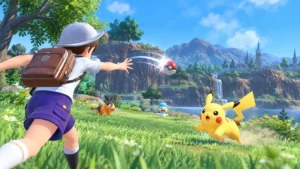
The core loop remains excellent.
Scarlet and Violet return to traditional battles for catching wild Pokémon rather than adopting the direct Poké Ball throwing used extensively in Pokémon Legends: Arceus.
That may disappoint anyone who preferred Arceus’ faster catching system.
The surrounding quality-of-life improvements are valuable, though.
The Let’s Go feature allows a Pokémon to travel alongside the player, collect items and Auto Battle nearby wild Pokémon. Nintendo describes the system as a way for a Pokémon to gather items and independently battle while remaining near its trainer.
It is particularly useful when:
- Gathering Pokémon materials
- Clearing Team Star bases
- Levelling lower-strength Pokémon
- Moving through areas containing familiar species
- Hunting specific Pokémon
Breeding has also moved away from Pokémon Day Care facilities and into the picnic system.
Competitive team building is easier than it was in many older generations, while Tera Types add another variable for players interested in optimisation.
How Good Are Tera Raid Battles?
Conceptually, very good.
Up to four trainers fight a Terastallized Pokémon while a real-time clock continues running.
That creates more urgency than traditional turn-based encounters because players cannot spend unlimited time considering every decision.
Higher-star raids also provide some of the game’s most demanding repeatable battles.
Building the correct Pokémon matters.
Typing matters.
Abilities matter.
Held items matter.
Support moves become genuinely useful.
Simply bringing the strongest legendary Pokémon available can be far less effective than bringing something designed specifically for that raid.
The problems are mainly technical and interface related.
Raid battles can occasionally communicate what is happening poorly, particularly when health, shields, status changes and animations appear to resolve at slightly awkward times.
The underlying cooperative battle system deserves better presentation.
Is Multiplayer Worth Using?
Scarlet and Violet offer considerably more multiplayer freedom than older mainline Pokémon games.
Nintendo confirms that two to four players can explore together locally or online, alongside trading, battling and cooperative Tera Raid Battles.
Seeing friends physically travelling around Paldea makes Pokémon feel more social.
Players can separate rather than remaining permanently attached to the host, so one trainer might be catching Pokémon on one side of an area while someone else explores elsewhere.
There is also a useful benefit to playing with owners of the opposite version because Pokémon associated with each player’s game can appear during shared sessions.
But this is not a fully cooperative story campaign.
Friends are sharing the world rather than progressing through every narrative objective together as one party.
That distinction matters.
Scarlet and Violet provide multiplayer exploration, not a traditional four-player cooperative RPG campaign.
What Is the Difference Between Pokémon Scarlet and Violet?
The fundamental game is almost identical, so the choice mostly depends on aesthetic preference and version-exclusive Pokémon.
The most obvious difference is the Legendary companion.
Scarlet uses Koraidon, while Violet uses Miraidon. Nintendo also confirms different academies and version-specific Pokémon.
Scarlet generally follows an ancient/past visual theme.
Violet leans towards a future/technological theme.
That distinction becomes particularly important later in the game through their respective Paradox Pokémon.
The versions also feature:
| Pokémon Scarlet | Pokémon Violet |
| Naranja Academy | Uva Academy |
| Koraidon | Miraidon |
| Professor Sada | Professor Turo |
| Past-inspired Paradox Pokémon | Future-inspired Paradox Pokémon |
| Red/orange uniform emphasis | Purple uniform emphasis |
Neither version offers a fundamentally better campaign.
Choosing based on Legendary design and exclusive Pokémon is therefore perfectly reasonable.
How Bad Is Performance on the Original Nintendo Switch?
This remains Scarlet and Violet’s biggest weakness.
Updates have fixed bugs and improved specific systems since launch, but they have not transformed the original Nintendo Switch version into a technically polished open-world game.
Players should still expect compromises involving:
- Limited environmental detail
- Visible pop-in
- Short draw distances
- Simplistic textures
- Reduced animation rates at distance
- Occasional camera problems
- Inconsistent performance in demanding areas
Those issues were not minor complaints invented around launch.
They appeared repeatedly across major technical analyses and contemporary reviews.
The important distinction is that the game beneath those problems remains entertaining.
That is what made Scarlet and Violet so frustrating in 2022.
The stronger the adventure became, the more obvious it was that presentation was preventing it from reaching its potential.
Is Pokémon Scarlet and Violet Better on Switch 2?
Considerably.
This is the biggest change anyone reading an older review needs to know.
Nintendo released version 4.0.0 in June 2025, specifically improving Scarlet and Violet when played on Nintendo Switch 2.
Nintendo lists two principal enhancements:
- Improved image quality for the Switch 2 display and high-resolution televisions
- Improved frame rate for smoother movement
Independent technical testing found the difference much more substantial than those conservative patch notes might suggest.
Frame rates can operate around 60fps for much of normal play, distant animations are substantially smoother and loading times are considerably reduced compared with the original hardware. Some pop-in and draw-distance limitations remain because Switch 2 cannot redesign the underlying assets and world structure.
That produces a strange situation.
Scarlet and Violet have not received a remake.
They have not received a complete graphical overhaul.
The environments have not suddenly acquired modern AAA levels of detail.
Yet removing much of the performance friction allows the strengths underneath to become significantly easier to appreciate.
Switch 2 is now the best place to play Pokémon Scarlet and Violet.
Is The Hidden Treasure of Area Zero DLC Worth Playing?
Players who enjoy the base game will find substantial reasons to continue.
The Hidden Treasure of Area Zero is divided into two major parts.
Part 1: The Teal Mask
The Teal Mask moves the player away from Paldea to Kitakami.
Its smaller geographical scale gives the story a more concentrated feeling, with Carmine, Kieran, Ogerpon and the local folklore taking centre stage.
It also introduces returning Pokémon absent from the original Paldea Pokédex.
Part 2: The Indigo Disk
The Indigo Disk sends the player to Blueberry Academy, much of which is located beneath the ocean.
Its enormous Terarium is divided into different biomes, while the academy’s strong emphasis on battling makes this portion particularly appealing to experienced players.
The Pokémon Company describes the expansion as adding new areas, characters and Pokémon while continuing the mystery surrounding the Terastal phenomenon.
The DLC does not magically repair Scarlet and Violet’s original design weaknesses.
What it does provide is more of their strongest material: catching, team building, exploration and increasingly demanding battles.
For players who only want to finish the main campaign, it is optional.
For players who become invested in Generation IX, it considerably strengthens the complete package.
Does Pokémon Scarlet and Violet Have a Good Endgame?
It depends on what the player wants from Pokémon.
After the main story, there are Gym rematches, stronger raids, Pokédex completion, shiny hunting, competitive battles and team building.
The DLC expands that substantially with additional Pokémon, environments and challenges.
There is enough material to occupy dedicated players for hundreds of hours.
But one omission still matters.
Scarlet and Violet lack a traditional Battle Tower-style facility where players can repeatedly test optimised teams against increasingly challenging computer-controlled opponents.
GameSpot identified the absence of a Battle Tower as a weakness both in its original assessment and while reviewing the DLC.
Players interested in sophisticated endgame battling are therefore pushed towards online competition and high-level raids.
For competitive players, that may be enough.
For solo battlers who loved facilities such as the Battle Tower, Battle Frontier or Battle Tree, something is clearly missing.
How Long Does Pokémon Scarlet and Violet Take to Complete?
A normal first playthrough should take approximately 25–40 hours to reach the credits, depending heavily on exploration and catching.
GameSpot estimated roughly 35-40 hours when concentrating primarily on the critical paths, while Nintendo Life suggested around 25–30 hours for a more focused main-story run.
That range makes sense because Scarlet and Violet are particularly easy games to become distracted inside.
A player travelling towards a Gym can suddenly spend an hour:
- Filling missing Pokédex entries
- Entering Tera Raids
- Exploring caves
- Hunting evolution items
- Training a new team member
- Looking for a particular nature or ability
- Following an unexplored path
Completing the Pokédex, DLC, postgame content and competitive preparation can extend playtime enormously.
There is no meaningful upper limit for players interested in shiny hunting or online battling.
Are Pokémon Scarlet and Violet Good for New Players?
Yes.
Despite their size, they remain approachable RPGs.
Type match-ups can initially appear complicated, but the game gradually introduces its systems and most of the main story does not demand heavily optimised teams.
New players can succeed by catching Pokémon they like, maintaining reasonable type variety and keeping their party appropriately levelled.
Experienced players will instead find most ordinary battles fairly forgiving.
High-level raids and competitive play provide substantially more mechanical depth later.
This makes Scarlet and Violet accessible without making the underlying battle system shallow.
Who Will Enjoy Pokémon Scarlet and Violet Most?
Scarlet and Violet are particularly well suited to:
- Pokémon fans wanting a less linear adventure
- Players who enjoy collecting creatures
- Open-world RPG fans who value exploration over visual fidelity
- Competitive Pokémon battlers
- Shiny hunters
- Players with Nintendo Switch 2
- Friends who want to explore Pokémon together
- Anyone who enjoyed the freer structure of Pokémon Legends: Arceus
They are less suitable for players whose enjoyment of open-world games depends heavily on environmental detail, cinematic production values or technically polished presentation.
Someone expecting Paldea to compete visually with Nintendo’s strongest open-world productions may be disappointed.
Someone primarily interested in building a team and discovering Pokémon is far more likely to overlook its limitations.
What Is Pokémon Scarlet and Violet’s Biggest Weakness in 2026?
The answer has changed slightly.
At launch, the obvious answer was performance.
On Switch 2, raw frame rate is no longer the defining problem.
The bigger weakness becomes the underdeveloped world surrounding the Pokémon.
Paldea contains plenty to discover but not enough places that feel genuinely alive.
Many buildings are decorative.
NPC interaction is limited.
Towns offer less meaningful exploration than their size suggests.
Environmental assets can be basic.
The world succeeds as a giant Pokémon habitat far more convincingly than it succeeds as a believable collection of communities.
Switch 2 exposes this in an interesting way.
Once severe frame-rate problems are reduced, players can see more clearly which limitations came from performance and which were embedded in the original world design.
Better hardware fixes the former.
It cannot completely fix the latter.
Are Pokémon Scarlet and Violet Worth Playing in 2026?
On Nintendo Switch 2, absolutely for anyone interested in mainline Pokémon.
The performance update removes one of the largest barriers that made the original release difficult to recommend without qualification.
What remains is an ambitious Pokémon RPG containing excellent team building, enjoyable exploration, surprisingly strong characters and one of the franchise’s most strategically useful battle transformations.
On the original Switch, the answer requires more tolerance.
The adventure itself is essentially the same, but the technical compromises are far more visible.
Players who care primarily about catching, battling and building teams can still have an excellent time.
Players particularly sensitive to frame-rate instability and visual roughness should know exactly what they are buying.
The remarkable thing is how much fun Scarlet and Violet manage to provide despite their obvious faults.
There is a genuinely excellent Pokémon game underneath the compromises.
Switch 2 simply makes that game much easier to see.
Gaming Mag Final Verdict
Pokémon Scarlet and Violet will probably always carry the reputation created by their difficult 2022 launch.
That reputation is not undeserved.
The original versions asked ageing hardware to deliver Game Freak’s largest mainline Pokémon world, and the result frequently looked unfinished.
But judging the games entirely by their launch condition no longer tells the complete story.
Scarlet and Violet took several important risks.
They removed the rigid route structure.
They allowed three major storylines to develop simultaneously.
They made wild Pokémon fundamental to open-world exploration.
They introduced cooperative roaming.
They created Terastallization, one of the franchise’s most tactically interesting transformation mechanics.
And, most importantly, they demonstrated that mainline Pokémon works extremely well as an open-world RPG when the world can keep up with the idea.
The absence of meaningful level scaling remains frustrating. Paldea still looks sparse in places. Towns need greater depth, and the lack of a Battle Tower leaves a noticeable hole in the solo endgame.
Yet the central experience is difficult to dismiss.
Finding an unexpected shiny Pokémon, discovering a powerful team member hours earlier than expected, stumbling into an area far above your level, preparing for a difficult Tera Raid or descending into Area Zero demonstrates why the underlying formula remains so effective.
On Switch 2, technical performance finally interferes far less with those moments.
That makes 2026 a substantially better time to experience Paldea than 2022 was.
Gaming Mag score on Nintendo Switch 2: 8.5/10
Gaming Mag score on original Nintendo Switch: 7.5/10
Best for: Pokémon fans, collectors, competitive battlers and players who want a genuinely open mainline Pokémon adventure.
Think twice if: technical polish, detailed open worlds and dynamic difficulty scaling are essential to your enjoyment.
Verdict: Scarlet and Violet remain technically imperfect but creatively important Pokémon games, and Switch 2 finally gives their excellent open-world adventure enough performance headroom to shine.
Frequently Asked Questions
Are Pokémon Scarlet and Violet Still Worth Playing in 2026?
Yes, particularly on Nintendo Switch 2. The open-world exploration, three storylines, Terastallization, DLC and extensive Pokémon collecting give the games substantial longevity.
Do Pokémon Scarlet and Violet Run Better on Switch 2?
Yes. Nintendo released a free update that improves image quality and frame rate when the games are played on Nintendo Switch 2.
What is the Latest Pokémon Scarlet and Violet Version?
The latest Nintendo-listed software update is version 4.0.0, released in June 2025, adding the Nintendo Switch 2 visual and frame-rate enhancements.
Which is Better, Pokémon Scarlet or Pokémon Violet?
Neither has a substantially better core game. Scarlet focuses on Koraidon and past-inspired themes, while Violet features Miraidon and more futuristic themes.
Can Pokémon Scarlet and Violet Be Played With Friends?
Yes. Two to four players can explore together using local wireless or online multiplayer, as well as trade, battle and participate in Tera Raid Battles.
How Long Does Pokémon Scarlet and Violet Take to Beat?
Most players should expect approximately 25–40 hours for the main adventure, with Pokédex completion, raids, DLC, shiny hunting and competitive play extending that significantly.
Does Pokémon Scarlet and Violet Have DLC?
Yes. The Hidden Treasure of Area Zero contains The Teal Mask and The Indigo Disk, introducing Kitakami, Blueberry Academy, additional Pokémon and an extended storyline.
Is Pokémon Scarlet and Violet Fully Open World?
Yes. Paldea uses an open-world structure and allows players considerable freedom over the order in which they tackle Victory Road, Path of Legends and Starfall Street, although objectives do not dynamically scale to the player’s level.
Does Pokémon Scarlet and Violet Have a Battle Tower?
No. Scarlet and Violet do not include a conventional Battle Tower, making online battles, Tera Raids and DLC activities more important for players seeking challenging endgame content.
What Age is Pokémon Scarlet and Violet Suitable for?
The games are designed to remain approachable for younger and inexperienced players, while team building, Tera Types, raids and competitive battling provide considerably deeper systems for experienced Pokémon players.
Score
Ambitious, addictive and dramatically better on Switch 2.