Crimson Desert Review: An Incredible Open World That Still Fights Against Itself
Crimson Desert delivers an extraordinary open world, deep combat and stunning visuals, but weak storytelling and inconsistent polish hold it back. Here is our full 2026 verdict.

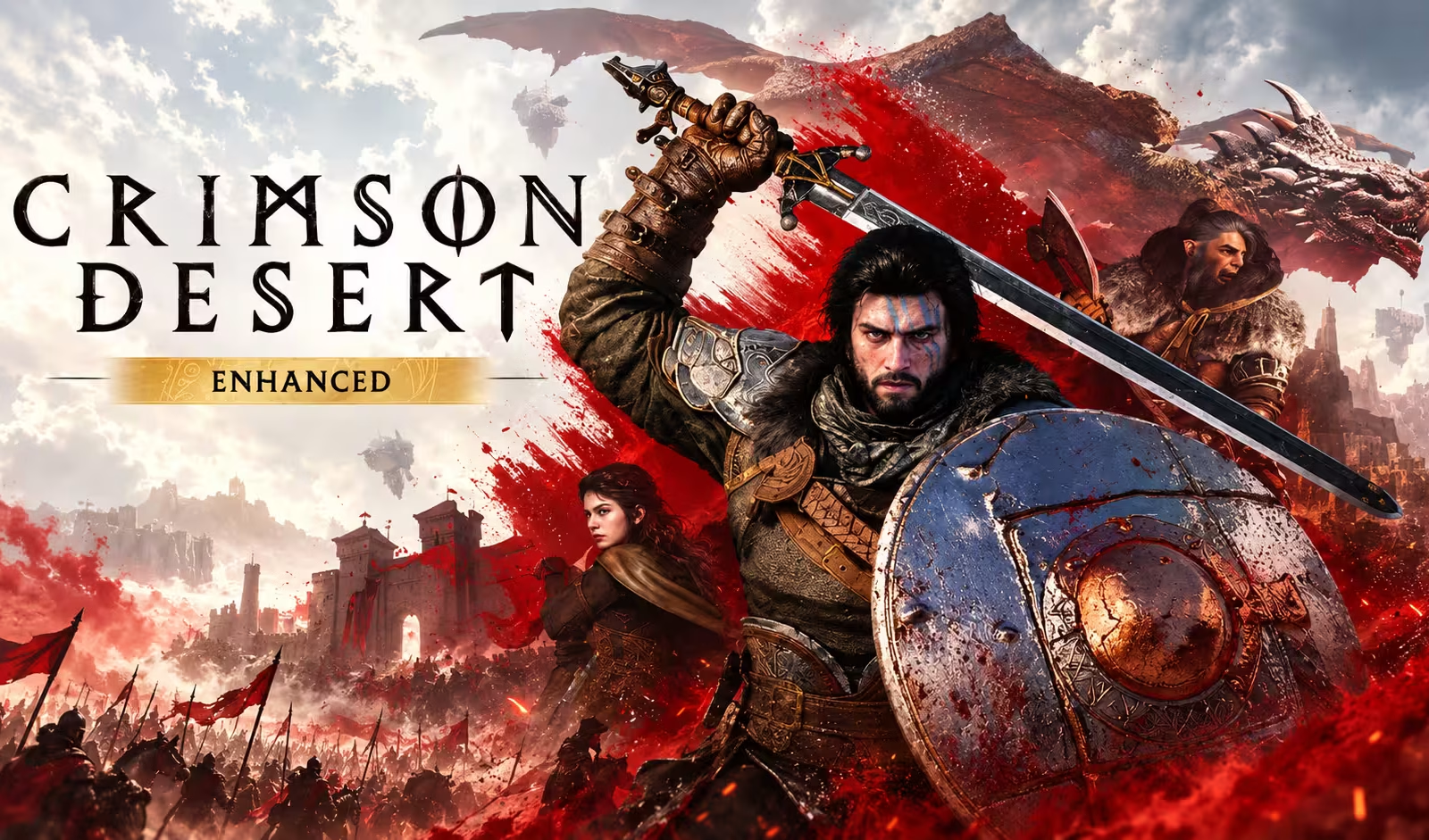
Contents
Hello All! This is Matt. Crimson Desert is one of the strangest open-world games I have analysed in years, because almost everything impressive about it comes with some sort of warning attached.
The world is enormous and genuinely beautiful, but the game can overwhelm you with systems. Combat can look absolutely ridiculous in the best possible way, but learning the controls takes patience.
Exploration can produce brilliant unscripted moments, while the main story can struggle to make you care about what is actually happening.
Then there is the technical side.
Crimson Desert launched in March 2026 with enough problems that some early reviews effectively judged a different game from the one available now.
Months of patches have added difficulty options, controller remapping, storage improvements, better menus, additional skills, graphical refinements and story changes through the Enhanced update.
That makes a Crimson Desert review in late 2026 slightly complicated.
The game is clearly better.
I still do not think it is the masterpiece some of the trailers made it look like.
What Pearl Abyss has created is a hugely ambitious single-player fantasy sandbox with one of the most impressive open worlds of this generation, brilliant environmental animation and an unusually expressive combat system.
It is also messy, occasionally exhausting and still nowhere near as disciplined as the very best open-world RPGs.
My score: 7.3/10.
Crimson Desert at a Glance
| Category | Rating | Verdict |
| Open-World Exploration | 92% | Outstanding |
| Visuals | 94% | Exceptional |
| Animation | 86% | Excellent in motion |
| Combat | 85% | Deep but initially awkward |
| Boss Battles | 78% | Spectacular but inconsistent |
| Traversal | 88% | One of its strongest systems |
| Story | 59% | Improved, still underwhelming |
| Characters | 62% | Serviceable rather than memorable |
| Side Content | 76% | Huge variety, uneven quality |
| Controls | 67% | Much better after updates |
| UI & Quality of Life | 69% | Improved significantly |
| Xbox Series X Experience | 76% | Good with compromises |
| Xbox Series S Experience | 60% | Playable but heavily compromised |
| Performance | 71% | Better now, still inconsistent |
| Audio & Voice Acting | 82% | Strong |
| Value for Money | 83% | Enormous amount of content |
| Overall | 73% | 7.3/10 |
Crimson Desert is worth playing for its exploration, combat freedom and extraordinary world rather than its storyline.
Give the mechanics time to settle, customise the controls and resist the temptation to chase every objective marker. The game becomes much better when you treat Pywel as a sandbox rather than a checklist.
Crimson Desert Is Difficult to Explain Until You Actually See It Moving
Trying to describe Crimson Desert by comparing it with another game does not really work.
There is some Red Dead Redemption-style physicality in the world. There is fantasy exploration that occasionally resembles The Witcher 3.
Climbing and environmental freedom bring Zelda comparisons. Combat sometimes feels like an action RPG before suddenly turning into something closer to a wrestling game, character-action title or large-scale battlefield simulator.
Then somebody pulls out technology that looks like it escaped from an entirely different genre.
That should be a disaster.
Sometimes it is.
Most of the time, though, Crimson Desert somehow gets away with it because Pearl Abyss appears completely unwilling to tell itself that something is too ridiculous to include.
Want to climb?
Fine.
Ride horses?
Obviously.
Glide?
Yes.
Fight enormous monsters?
Of course.
Throw people around like a professional wrestler?
Apparently that belongs in the same game too.
It constantly feels as though another development team would have removed half of Crimson Desert during production.
Pearl Abyss seems to have looked at that problem and added more.
That ambition is both the reason I would recommend the game and the reason I cannot score it higher.
The Most Important Thing to Know: This Is Not the Launch Version Anymore
A lot of Crimson Desert reviews still circulating near the top of search results are effectively historical documents.
They remain useful because many of their criticisms were completely justified.
The original controls were unnecessarily awkward, inventory management created friction, healing could be irritating, some bosses felt poorly tuned and the game lacked several accessibility and difficulty options players reasonably expected.
Pearl Abyss did not leave it there.
The months following release brought storage changes, faster interactions, control improvements, alternative controller presets, proper controller remapping, difficulty settings, inventory improvements, additional fast-travel functionality, boss rematches and a substantial number of smaller refinements.
Then the Enhanced update went further by adding new story moments, additional cutscenes and more refinements to the progression systems.
That does not magically turn every bad design decision into a good one.
It does mean that somebody buying Crimson Desert now should not assume every launch complaint remains accurate.
This is probably the biggest content gap in many early reviews.
They reviewed Crimson Desert at launch.
This review is about Crimson Desert as it exists now.

The current Enhanced version of Crimson Desert feels considerably more approachable than the March launch build, although the sheer number of systems can still make the opening hours overwhelming.
My First Impression of Pywel Is Still the Thing I Remember Most
Crimson Desert sells itself remarkably quickly once it stops forcing you through tutorials and starts letting the world breathe.
Pywel is huge.
Not fake huge either.
There are open-world games where the map looks enormous because icons have been spread across empty terrain. Crimson Desert feels large because the landscape has actual physical scale.
Mountains look like mountains.
Settlements occupy believable spaces.
Roads disappear into valleys.
Forests have density.
Castles have real silhouettes against the horizon.
Weather moves across landscapes in ways that completely change how locations feel.
The lighting is particularly impressive.
Sunlight breaking across a ridge can make you stop moving purely because the landscape looks ridiculous.
Then a storm moves in, visibility drops and the same route feels completely different.
This is where Pearl Abyss’ BlackSpace Engine earns its reputation.
Crimson Desert is not simply technically impressive.
It has visual theatre.
Pywel Might Be the Best Thing About the Entire Game
The world is the main reason to play Crimson Desert.
That became obvious very quickly while analysing how its systems interact.
A weaker open-world game gives you an objective, sends you there and expects the activity itself to justify the journey.
Crimson Desert regularly makes the journey more interesting than whatever you were originally travelling towards.
You might spot unusual movement in the distance.
You might find ruins.
You might see a structure that looks climbable.
You might encounter enemies fighting somewhere you were not planning to visit.
You might find another route through an area.
Then twenty minutes later you realise you have completely forgotten what mission you were supposed to be doing.
That is good open-world design.
The environment is pulling you away from the interface rather than the interface dragging you around the environment.
Players who specifically enjoy large solo adventures should also compare it with our list of the best single-player games for PC, PS5 and Xbox, because Crimson Desert absolutely belongs in that conversation even with its flaws.
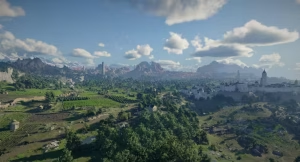
Looking across Pywel from an elevated position shows why exploration is Crimson Desert’s strongest feature. Distant landmarks regularly become places you can actually travel towards.
Exploration Works Because Traversal Is Not an Afterthought
A massive map is useless when moving through it becomes boring.
Crimson Desert understands that.
Horseback travel is only one part of traversal. Climbing, gliding and the more unusual movement systems gradually make Pywel feel less like a gigantic obstacle and more like an enormous playground.
Verticality matters.
That is important because several modern open worlds are surprisingly flat in how they expect players to think. Roads exist, paths exist and climbing usually happens exactly where developers intended.
Crimson Desert is much more willing to let you ask a simple question:
Can I get up there?
Quite often, the answer is yes.
That freedom encourages experimentation.
It also means the game occasionally lets you approach somewhere before you properly understand what is supposed to happen there.
This creates confusion, but I would still prefer an open world that occasionally gives me too much freedom over one afraid to let me leave the designated route.
Combat Looks Ridiculous Until You Understand What Is Happening?
Crimson Desert combat is one of its biggest strengths.
It is also one of the worst systems to explain to somebody watching the game for five minutes.
There is a lot happening.
Sword attacks.
Blocks.
Parries.
Dodges.
Kicks.
Grabs.
Throws.
Special abilities.
Environmental interactions.
Ranged attacks.
Elemental effects.
Combo sequences.
Finishers.
Once the combat system opens up properly, Kliff becomes less like a conventional fantasy swordsman and more like somebody who has accidentally wandered into Pywel after spending years playing fighting games.
Enemies do not simply get hit.
They get launched.
Dragged.
Thrown.
Kicked into scenery.
Dropped onto the ground.
Smacked into other enemies.
That physicality gives fights a personality most open-world RPGs do not have.
Crimson Desert Understands Something Most RPG Combat Systems Forget
Combat should feel good before damage numbers appear.
That sounds obvious.
It is not.
Plenty of RPGs rely heavily on statistics to communicate power. Equip a better sword, increase the number and watch an enemy’s health bar disappear faster.
Crimson Desert still has progression, obviously, but the most satisfying part of becoming stronger is expanding what you can physically do.
A new skill can alter how you enter a fight.
Another changes crowd control.
Another gives you a better answer against a particular enemy.
Combat improves because your options improve.
That is far more satisfying than simply replacing a weapon because its damage number is twelve points higher.
The Wrestling Moves Are Not a Gimmick
I originally expected the grappling-style attacks to be one of those features that looks fantastic in marketing footage but becomes irrelevant during normal play.
That is not really what happens.
Close-range physical attacks give Crimson Desert a surprisingly aggressive identity.
You can move directly into groups rather than constantly circling outside them. Throws can change positioning. Knockdowns create openings. Environmental destruction makes large encounters feel less static.
The animation work helps enormously here.
There is a proper sense of momentum when Kliff changes direction, catches an opponent or transitions between weapon attacks and physical moves.
It is not always perfectly precise.
It is frequently spectacular.
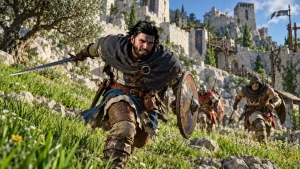
Crimson Desert’s best fights happen when sword combos, grappling attacks and environmental destruction begin flowing together instead of being treated as separate mechanics.
Animation Is One Area Where Crimson Desert Deserves More Attention?
Visual discussions around Crimson Desert usually focus on graphics.
I think the animation deserves nearly as much attention.
The game is constantly dealing with difficult transitions.
Kliff can go from sprinting to climbing, dropping from a ledge, entering combat, grabbing an enemy and executing a special move without the entire sequence obviously breaking into disconnected animation states.
Horses react convincingly to terrain.
Clothing responds to movement.
Vegetation bends during traversal and fights.
Large creatures carry convincing mass.
Combatants crash against environmental objects with enough physical feedback that encounters rarely feel sterile.
The best animation is not always animation you consciously notice.
It is animation that makes movement look believable.
Crimson Desert does that extremely well during normal gameplay.
Facial Animation Is Much Less Convincing
Unfortunately, character conversations expose the opposite problem.
Facial animation does not consistently match the quality of the environment or full-body movement.
Some characters look excellent.
Others feel strangely stiff.
Lip-syncing can also make conversations feel less natural than the voice performance deserves.
This creates a weird technical contrast.
You can finish an extraordinary battle involving dozens of moving objects, dynamic lighting and impressive physical animation, then enter a conversation where two people look less convincing than the horse you rode there on.
That inconsistency matters because Crimson Desert is trying to tell a substantial story.
The Story Is Better Now, but It Still Is Not the Reason to Play
The narrative centres on Kliff and the Greymanes after the group is devastated by the Black Bears.
That is a perfectly workable starting point.
The problem is presentation.
Crimson Desert has lore.
It has factions.
It has politics.
It has characters.
It has supernatural elements.
What it lacks is a consistently strong narrative thread tying all of those things together.
The Enhanced update adds story material and helps certain transitions make more sense, but the fundamental issue remains.
The world is more interesting than the people explaining it.
That is never ideal in an RPG.
Kliff is competent enough as a protagonist, but I rarely find him as interesting as the situations happening around him.
A great protagonist makes you want to continue because you need to know what happens next.
Crimson Desert usually makes you continue because you want to know what is over the next mountain.
Those are not the same thing.
The Opening Still Throws Too Much at You
Crimson Desert desperately wants you to understand how much game exists.
That enthusiasm works against it during the opening.
Systems arrive.
Characters appear.
Combat mechanics appear.
New terminology appears.
New interfaces appear.
Then another mechanic arrives before you feel comfortable with the previous one.
The result can feel less like being taught a game and more like being handed the controls to industrial machinery.
This was worse at launch.
It is still not elegant.
My advice is simple: do not worry about mastering everything immediately.
Learn basic movement.
Learn blocking.
Learn dodging.
Understand your primary attacks.
Then gradually add abilities into your routine.
Trying to memorise every possible combination during the first few hours makes Crimson Desert feel far more complicated than it eventually becomes.
Controller Remapping Changes the Experience More Than It Sounds
One of the smartest post-launch additions is proper controller remapping.
That sounds boring next to wyverns, giant monsters and enormous fantasy battles.
It is actually one of the most important improvements Pearl Abyss has made.
The original controller scheme asked players to remember combinations that did not always match years of muscle memory built through other action games.
Crimson Desert uses a lot of inputs because there are a lot of actions.
That problem cannot disappear completely.
But giving players more control over the layout removes a huge amount of unnecessary friction.
Do this early.
Do not spend ten hours fighting the default layout simply because that is how the game arrived.
Your controller should adapt to you, not the other way around.
Boss Battles Can Be Brilliant and Frustrating in the Same Hour
Crimson Desert knows how to create spectacle.
Some bosses are genuinely excellent.
Scale helps.
Animation helps.
Destruction helps.
The combat system gives you enough offensive options that fights can look completely different depending on how aggressively you play.
A successful parry followed by a powerful counter can be extremely satisfying.
But consistency remains a problem.
Some bosses communicate their attacks well.
Others become visually noisy.
Particles, movement, camera behaviour and unusual hit timing occasionally combine into something where reading the encounter becomes harder than actually understanding the mechanics.
That is an important distinction.
A difficult boss is fine.
A boss where you cannot clearly work out why you were hit becomes annoying.
Pearl Abyss has already retuned several encounters since launch, and the introduction of proper difficulty settings helps enormously.
Even so, the boss design never reaches the consistency of the best dedicated action games.

Boss encounters can be visually astonishing, although heavy effects occasionally make attack timing harder to read than it should be.
Difficulty Options Were Absolutely Necessary
Crimson Desert originally seemed almost determined to force everybody through the same experience.
Adding Easy, Normal and Hard settings was the right decision.
This is not because Crimson Desert needs to become easy.
The combat system has enough depth to support demanding encounters.
The problem is that the game attracts more than one type of player.
Some people are here for exploration.
Some want difficult combat.
Others want story and spectacle.
A huge open-world action game benefits from letting those audiences tune the challenge rather than forcing everybody into the same balance.
Normal is where I would tell most experienced action-game players to start.
Move to Hard once you understand the mechanics if you want more pressure.
Crimson Desert Has a Huge Amount of Content, but More Is Not Always Better
At some point while looking through everything Crimson Desert contains, the obvious question appears.
Did all of this need to be here?
Not really.
There are quests, activities, puzzles, camps, settlements, animals, gathering, different traversal tools, minigames, housing systems, pets, mounts, combat challenges and numerous other distractions.
That variety initially feels incredible.
After enough time, the unevenness becomes more obvious.
Some side activities make Pywel feel alive.
Others feel like leftovers from a game designed by a studio with an MMO background.
That distinction matters.
A strong single-player side quest usually gives you at least one of four things:
A memorable story.
A meaningful decision.
An interesting mechanical challenge.
A worthwhile discovery.
Crimson Desert occasionally gives you all four.
Sometimes it gives you busywork.
The Real Problem Is Content Hierarchy
I do not think Crimson Desert’s biggest issue is having too much content.
The problem is that it does not always communicate which content deserves your attention.
A tiny activity and an excellent discovery can be presented with similar importance.
That leaves the player responsible for filtering the experience.
Once you start doing that, the game improves dramatically.
If an activity feels boring, leave.
If a quest is not interesting, stop treating completion percentage as a job.
If something catches your attention in the distance, investigate it.
Crimson Desert becomes a much stronger game when you give yourself permission not to complete everything.
Progression Eventually Becomes Very Satisfying
The opening combat system can feel overloaded because you have more theoretical options than practical understanding.
Progression gradually fixes that.
You begin identifying attacks you genuinely use.
You develop reliable sequences.
You understand which abilities control groups.
You discover how defensive options fit into your playstyle.
Eventually, combat stops feeling like a list of button combinations and starts becoming something closer to a language.
That transition is extremely satisfying.
It is one reason I think Crimson Desert benefits players willing to stay with it longer than a typical ten-hour review window might suggest.
The learning curve matters.
Visuals Are Outstanding, but They Are Not Flawless
Crimson Desert is capable of producing some of the best open-world screenshots of 2026.
Mountains can look enormous.
Cloud formations dramatically alter scenes.
Vegetation is dense.
Water reacts convincingly.
Settlements can contain huge amounts of geometric and environmental detail.
Night lighting can completely alter familiar routes.
The BlackSpace Engine is clearly doing an extraordinary amount of work.
The problem is that once you start looking closely, the illusion can break.
Texture quality varies.
Pop-in still happens.
Lighting can occasionally behave strangely.
Character rendering does not always match the scenery.
Busy locations can expose performance limitations.
That does not make the game ugly.
Far from it.
Crimson Desert is one of the best-looking open-world games currently available.
It is simply not the perfectly clean technical showcase its best screenshots might suggest.
Xbox Series X Is a Good Way to Play, but Choose Your Mode Carefully
Xbox players deserve more specific advice than simply being told the game runs on Series X.
Crimson Desert is demanding.
On Xbox Series X, the fundamental choice is between image quality and responsiveness.
For a combat-heavy game, responsiveness matters.
I would lean towards the performance-oriented option for players who actively engage with parries, evasive movement and more technical combinations.
A sharper image is nice when standing on a mountain.
Smoother input is more useful when somebody is trying to remove Kliff’s head.
Busy cities and large-scale battles can still stress the hardware, so do not expect perfect frame consistency everywhere.
VRR also becomes useful if the display supports it.
For Series X owners with a good 120Hz VRR television or monitor, experimenting with the available modes is worthwhile rather than automatically choosing whichever setting has the biggest number beside resolution.
Xbox Series S Is Where I Would Be Cautious?
Crimson Desert runs on Xbox Series S.
That does not automatically make Series S the version I would recommend.
This is exactly the type of game that exposes the gap between Microsoft’s two current Xbox consoles.
Pywel depends heavily on visual density.
Vegetation matters.
Lighting matters.
Draw distance matters.
Image clarity matters because the world is constantly showing you things far away.
Reducing those elements hurts Crimson Desert more than it would hurt a simpler game.
Series S can still deliver the complete gameplay experience, and patches have improved Crimson Desert substantially since launch.
But if you have access to Series X, PS5, PS5 Pro or a capable PC, I would choose one of those first.
Xbox Series X score: 76%.
Xbox Series S score: 60%.
PS5 Has Improved Dramatically Since Launch
The PS5 situation is another reason older reviews need context.
Base PS5 performance attracted significant criticism around release.
That criticism was deserved.
Updates have improved image reconstruction, responsiveness, performance and general quality of life since then, meaning the experience today is considerably easier to recommend.
PS5 Pro remains the stronger PlayStation option where available, particularly when trying to balance image quality with frame rate.
The standard PS5 version still requires compromise.
That is not unusual for an open world pushing this much geometry, lighting, physics and simulation.
Players choosing between different PlayStation titles can also see our Grounded PS5 review for an example of a very different open-world survival experience that puts much more emphasis on structured crafting and co-op play.
PC Remains the Best Technical Version With the Right Hardware
A strong PC gives Crimson Desert room to breathe.
This is where the game’s enormous landscapes, lighting system and detailed environments make the most sense.
You can tune performance.
You can adjust visual settings.
Upscaling technologies provide additional headroom.
Higher frame rates make combat noticeably more responsive.
That does not mean PC magically fixes the game’s design problems.
A confusing quest is still confusing at 100fps.
An awkward conversation is still awkward at 4K.
But if your hardware can handle it, PC gives you the best opportunity to see what Pearl Abyss’ engine is actually capable of.
Audio Helps Sell the World Better Than the Story Does
The sound design deserves credit.
Combat has weight.
Weapon impacts sound aggressive.
Environmental ambience helps separate different areas of Pywel.
Storms, wildlife, settlements and large fights all contribute to the feeling that the world exists outside whatever objective you are completing.
Voice acting is also stronger than the underlying dialogue in several places.
That sounds like faint praise.
It is actually important.
Good performances manage to make some fairly ordinary fantasy writing feel more convincing than it looks on the page.
The problem is that even strong actors cannot completely repair conversations that exist mainly to move the player towards another objective.
Crimson Desert Is Sometimes Too Slow and Too Fast at the Same Time
This is one of the stranger things about the game.
Individual systems can be slow.
Interactions can take time.
Dialogue can drag.
Certain quests take longer than they need to.
Then the overall game is simultaneously throwing new activities, mechanics and locations at you.
That creates pacing whiplash.
You can spend several minutes doing something extremely mundane before immediately transitioning into a ridiculous fantasy encounter involving giant creatures and superhuman combat.
Sometimes that contrast is charming.
Sometimes it feels like three games fighting over the controller.
A more disciplined director could probably cut 20% of Crimson Desert and create a better overall experience.
I am also aware that removing the weird excess would eliminate some of its personality.
That is the contradiction at the centre of the game.
Crimson Desert Compared With The Witcher 3, Red Dead Redemption 2 and Dragon’s Dogma
These comparisons happen constantly, so it is worth being clear.
Crimson Desert is not The Witcher 3.
Its writing is nowhere near as consistently strong.
It is not Red Dead Redemption 2 either.
Rockstar’s game is far more deliberate in character development, world simulation and cinematic presentation.
It is not really Dragon’s Dogma 2, although the two games share a willingness to allow unexpected things to happen while exploring.
And despite the climbing and traversal comparisons, it is not Breath of the Wild.
Crimson Desert borrows ideas from all over gaming.
Its identity comes from how irresponsibly many of those ideas it combines.
That sounds negative.
I partly mean it as praise.
There are very few AAA games that feel this unconcerned with restraint.
Is Crimson Desert an RPG?
Sort of.
Calling Crimson Desert an open-world action-adventure is probably more accurate than treating it as a traditional role-playing game.
There is progression.
There is equipment.
There are skills.
There are quests.
There are factions and systems associated with RPG design.
But the core appeal is movement, combat and exploration rather than deep role-playing choices.
If your definition of an RPG requires meaningful dialogue decisions and extensive control over your character’s personality, Crimson Desert may disappoint you.
If you mainly want character progression inside a gigantic fantasy adventure, the label matters much less.
Is Crimson Desert Multiplayer?
No. This is primarily a single-player experience.
That distinction is important because Pearl Abyss is best known for Black Desert, and Crimson Desert’s sheer quantity of systems can occasionally make it look like an MMO that has forgotten to connect other players.
It is not.
The advantage is that the world exists around your progression rather than needing to accommodate thousands of other people.
The downside is that activities with MMO-style repetition feel more obvious when you are completing them alone.
Crimson Desert Enhanced Makes the Story Better, Not Great
The Enhanced update is worth discussing separately because it directly targets one of the original game’s biggest weaknesses.
Additional scenes and narrative material improve context.
Certain character motivations land better.
Transitions feel less abrupt.
New players are therefore getting a stronger version of the campaign than somebody who finished Crimson Desert immediately after launch.
But there is only so much post-release editing can achieve.
The core narrative structure is still fragmented.
Characters still disappear for long periods.
Some important developments are given less attention than comparatively minor events.
So yes, Enhanced improves the story.
No, Crimson Desert has not suddenly become The Witcher 3.
One Thing Pearl Abyss Deserves Credit For: It Actually Kept Updating the Game
Post-launch support has been unusually aggressive.
That matters.
Crimson Desert could easily have become one of those games where the publisher releases two patches, fixes the worst crashes and moves on.
Instead, Pearl Abyss continued adjusting systems.
Storage changed.
Controls changed.
Bosses changed.
Difficulty options arrived.
Controller remapping arrived.
New skills arrived.
Pets and mounts expanded.
Boss rematches appeared.
Housing grew.
Story material was added.
That gives me more confidence recommending Crimson Desert now than I would have had around launch.
It also creates an uncomfortable question.
How much of this should have been ready in March?
Quite a lot.
Both things can be true.
Pearl Abyss deserves credit for fixing the game quickly.
Players were also justified in expecting several of those features on day one.
The Best Way to Play Crimson Desert
Do not play it like a checklist.
That is my biggest recommendation.
Ignore the instinct to clear every icon.
Do not hoard everything simply because it might become useful later.
Remap the controller if the default setup feels uncomfortable.
Choose the difficulty that matches what you actually enjoy.
Experiment with combat instead of relying on one basic sequence.
Explore without an objective.
Give traversal systems time to open up.
And most importantly, accept that you do not need to understand everything immediately.
Crimson Desert gets substantially better once you stop treating every system as homework.
Crimson Desert Pros
There is a lot to like here.
Pywel is exceptional. The scale, geography and environmental density make exploration genuinely rewarding.
Combat has personality. Swordplay, wrestling-style grabs, abilities and environmental interaction create a distinctive fighting system.
Traversal is excellent. Movement becomes part of exploration rather than simply travelling between markers.
Animation is impressive. Full-body combat animation, traversal transitions and environmental reactions are often outstanding.
The graphics can be spectacular. Few current open-world games produce vistas this impressive.
Progression improves combat rather than only numbers. Unlocking additional possibilities makes Kliff more interesting to control.
There is an enormous amount of content. Players who click with Pywel could easily disappear into the game for a very long time.
Post-launch support has been strong. The current game is significantly better than the March build.
Controller remapping helps enormously. Players can finally make the complicated combat layout more personal.
Crimson Desert Cons
The problems are significant enough to keep it below an 8/10.
The story still struggles. Enhanced improves it, but narrative structure remains one of the weakest areas.
There is too much mediocre content mixed with excellent content. The game needs stronger editing.
Controls have a learning curve. Remapping helps but does not remove the underlying complexity.
Performance can still fluctuate. Large settlements and battles can expose technical limits.
Character presentation is inconsistent. Faces and dialogue animation do not always match the extraordinary environment quality.
Boss readability varies. Some battles become visually chaotic rather than intelligently difficult.
Series S requires major compromises. It is not the Xbox version I would choose if alternatives are available.
The opening remains overwhelming. Crimson Desert tries to teach too much before players have developed basic confidence.
Who Should Play Crimson Desert?
I would recommend it if you:
- Love Huge Open Worlds
- Enjoy Deep Action Combat
- Prefer Single-Player Games
- Like Exploring Without Following Objectives
- Enjoy Experimenting With Abilities
- Can Tolerate Complex Controls
- Appreciate Technical Ambition
- Like Games Such As Dragon’s Dogma
- Enjoy Finding Strange Side Activities
- Want Dozens Upon Dozens Of Hours Of Content
I would be more cautious if you:
- Need A Brilliant Main Story
- Prefer Short Focused Campaigns
- Hate Busy Interfaces
- Dislike Learning Complicated Controls
- Want Perfect Technical Performance
- Play Only On Xbox Series S And Prioritise Image Quality
- Feel Compelled To Complete Every Map Activity
- Prefer Carefully Curated Content Over Massive Sandboxes
Is Crimson Desert Worth Buying in 2026?
Yes, with conditions.
This is substantially easier to recommend now than it was during launch week.
The controls are more flexible.
Difficulty can be adjusted.
Quality-of-life systems have improved.
The story has additional material.
Technical issues have been addressed repeatedly.
A large amount of extra content has also arrived.
But I would still not recommend Crimson Desert to everybody.
Players looking for polished cinematic storytelling will probably notice the weaknesses immediately.
Players who value exploration, mechanical freedom and discovering strange systems will have a completely different experience.
That division explains why opinions around Crimson Desert vary so dramatically.
It is a game built for people who enjoy getting lost inside complicated games.
Is Crimson Desert One of the Best-Looking Games of 2026?
Environmentally, yes.
Overall, almost.
That distinction matters.
The landscape rendering can be phenomenal.
Weather is excellent.
Lighting can be extraordinary.
Animation is frequently impressive.
Draw distance creates enormous scenes.
But facial animation, pop-in, reconstruction artefacts and performance limitations prevent the overall presentation from reaching the consistency required for a perfect technical score.
Graphics score: 94%.
Animation score: 86%.
Those are still exceptional numbers.

Lighting, weather and enormous draw distances can make Crimson Desert look almost absurdly impressive, particularly when exploring Pywel’s higher elevations.
Does Crimson Desert Feel Next Gen?
Sometimes, absolutely.
There are moments where the combination of world density, physical interaction, animation, distant scenery, lighting and combat complexity feels like something previous console generations simply would not have attempted at this scale.
Then there are moments where a texture loads late or an NPC conversation looks strangely dated.
That is Crimson Desert in miniature.
Extraordinary technology sitting beside obvious imperfections.
How Long Can You Spend in Crimson Desert?
A long time.
This is not a game where finishing the main storyline tells you how much content exists.
Players focused mainly on critical missions will naturally see much less.
Players who explore, experiment with side systems, pursue optional encounters, develop camps, collect mounts and engage with the wider sandbox can spend dramatically longer.
That makes exact completion numbers relatively meaningless.
The more useful question is whether Crimson Desert keeps giving you reasons to stay.
For players who enjoy the world, it does.
Does Crimson Desert Have Replay Value?
More than you might expect for such a large single-player game.
Difficulty settings create an obvious reason to return.
Combat has enough depth that alternative approaches are possible.
Boss rematches give mechanically focused players somewhere to use late-game skill.
The world also contains enough easily missed discoveries that a second journey will not necessarily feel identical.
Still, the sheer size works against traditional replayability.
Finishing a massive Crimson Desert playthrough and immediately starting another is a considerable commitment.
What I Would Change About Crimson Desert?
I would remove content.
That might sound ridiculous after praising the game’s ambition.
But the best Crimson Desert is already inside Crimson Desert.
Pearl Abyss does not need more systems to make it great.
It needs stronger prioritisation.
Tighter story editing.
Cleaner quest structure.
More consistent boss telegraphs.
Better character animation.
Further performance optimisation.
Fewer low-value activities competing with genuinely brilliant discoveries.
Imagine this exact world and combat system with 20% less clutter and 30% stronger storytelling.
That game could be exceptional.
My Final Crimson Desert Review Verdict
Crimson Desert is one of the easiest games to admire and one of the hardest games to score.
Its ambition is obvious.
The open world is extraordinary.
Combat becomes far better than the confusing first hours suggest.
Traversal constantly encourages experimentation.
The environmental animation is excellent.
At times, the visuals are among the best I have seen from an open-world game.
But ambition is not the same as execution.
Crimson Desert frequently feels as though Pearl Abyss had enough ideas for three games and decided to put all of them into one.
The result is fascinating.
It is also inconsistent.
The storyline never becomes as memorable as Pywel itself.
Quest quality varies dramatically.
Combat takes too long to explain itself.
Performance can buckle when the game becomes especially busy.
And despite months of significant improvements, there are still moments where the experience feels less refined than it should.
Yet I kept coming back to the same conclusion.
I would rather play an ambitious 7.3/10 game that regularly surprises me than a technically flawless 8/10 game I forget immediately.
Crimson Desert is not boring.
It is not safe.
It is not particularly restrained.
And it definitely is not perfect.
But when you are charging across Pywel, spot something completely unexpected in the distance, abandon whatever mission you were supposed to complete and end up fighting something enormous twenty minutes later, Crimson Desert becomes exactly the game Pearl Abyss wanted it to be.
That feeling is why I recommend it.
Just do not expect every part of the journey to match its best moments.
Final Crimson Desert Scores
- Overall Score: 7.3/10
- Overall Percentage: 73%
- Gameplay: 79%
- Combat: 85%
- Exploration: 92%
- Traversal: 88%
- Boss Battles: 78%
- Story: 59%
- Characters: 62%
- Graphics: 94%
- Animation: 86%
- Controls: 67%
- Performance: 71%
- Audio: 82%
- Side Content: 76%
- Progression: 83%
- Value for Money: 83%
- Xbox Series X Experience: 76%
- Xbox Series S Experience: 60%
Final word: Crimson Desert is a technically spectacular, mechanically ambitious and occasionally brilliant open-world adventure trapped inside an overstuffed game that still needs better discipline.
Play it for Pywel, exploration and combat rather than the storyline, and the current Enhanced version is considerably easier to recommend than the game that launched in March.
FAQs About Crimson Desert
Is Crimson Desert Worth Playing in 2026?
Yes. Months of updates have improved controls, difficulty options, inventory management, story presentation and general quality of life, making the current version easier to recommend than the launch build.
Is Crimson Desert Good on Xbox Series X?
Yes, although graphical modes involve compromises. Series X is capable of delivering an impressive experience, but demanding cities and battles can still cause performance fluctuations.
Is Crimson Desert Good on Xbox Series S?
It is playable, but Series S requires much heavier visual compromises. Players with access to Series X, PS5, PS5 Pro or a capable PC will generally get a stronger presentation.
Is Crimson Desert a Multiplayer Game?
No. Crimson Desert is primarily a single-player open-world action-adventure despite Pearl Abyss being best known for the multiplayer-focused Black Desert.
Is Crimson Desert an RPG?
It contains substantial RPG-style progression, equipment, abilities and quests, but open-world action-adventure is the more accurate overall description.
Is Crimson Desert Better After the Updates?
Yes. Difficulty options, controller remapping, inventory improvements, storage changes, additional skills, technical fixes and the Enhanced story update have addressed several major launch complaints.
Does Crimson Desert Have Good Combat?
Yes. Combat is one of its strongest systems once players understand the controls. Sword attacks, parries, grappling, throws, abilities and environmental interaction create far more freedom than the opening hours initially suggest.
Is Crimson Desert Difficult?
It can be challenging, particularly before the combat system clicks. Current versions include Easy, Normal and Hard difficulty settings, so players have more control over the experience than they did at launch.
Does Crimson Desert Have a Good Story?
The story is adequate rather than exceptional. The Enhanced update improves narrative context, but Pywel, combat and exploration remain considerably stronger reasons to play than the central plot.
Is Crimson Desert Open World?
Yes. Pywel is a huge seamless environment built around exploration, traversal, settlements, wilderness, quests, combat encounters and optional activities.
Is Crimson Desert Better on PC or Console?
A capable PC provides the greatest graphical and performance flexibility. Console versions remain worthwhile, especially on stronger hardware, although players should expect compromises depending on the selected visual mode.
Is Crimson Desert Better Than The Witcher 3?
Not in storytelling or character writing. Crimson Desert offers greater mechanical chaos, traversal freedom and combat experimentation, while The Witcher 3 remains considerably stronger as a narrative RPG.
Is Crimson Desert Like Red Dead Redemption 2?
Only in certain aspects of physical world presentation and environmental ambition. Crimson Desert is much more fantasy-driven, combat-heavy and mechanically chaotic.
Is Crimson Desert Worth Full Price?
Players who enjoy enormous open worlds, exploration and complex combat can get substantial value from it. Those mainly interested in story or tightly edited campaigns may want to be more cautious.
Score
Breathtaking, ambitious and frustratingly uneven.